In the cannabis and hemp industries, capturing the true value of real estate holdings in an M&A deal can be both elusive and central to the overall success of the transaction. Difficult-to-acquire licenses and permits are essential for operating, which often drives up the “ticket price” of property, ignoring operational and market realities that suppress value in the long run. On the flip side, real estate holdings are sometimes considered “throw-ins” during a large M&A deal. These properties can hold risks and exposures, or, in many cases, are under-utilized and present an opportunity to uncover hidden value.
Both Acquirers and Target companies must take specific steps toward understanding the varied layers of risk and opportunity presented by real estate holdings. In the following, we will address some common scenarios and provide guidance on the best way to ensure fair value throughout an M&A deal.
Real estate as a starting point for enterprise value
Leaders of cannabis and hemp enterprises must understand that real estate should be a focus of the M&A process from the very beginning. All too often, c-suite executives are well-acquainted with detailed financial analyses for other parts of the business, but have a limited or out-of-date idea of their enterprise’s square footage, details of lease agreements, or comparable values in shifting real estate markets. Oftentimes it takes a major business event, like an M&A deal, to spur leadership to reexamine and understand real estate holdings and strategy. Regrettably, and all too often, principals come to that realization post-closing and realize they may have left money on the table.
In an M&A deal, the party that takes a proactive approach to real estate considerations gains an upper-hand in negotiations and calculating value. Real estate holdings can provide immediate opportunities for liquidity, cost-reduction, or revenue generation. At the same time, detailed due diligence can reveal redundant properties, costly debt obligations, unbreakable leases, and other red flags that would undermine value post-closing.
For both sides of the M&A transaction, real estate strategy and valuation should be a core consideration of the overall goals and value drivers of the deal. A direct path to this mindset is to place real estate holdings on the same level of importance as other assets that drive value – human capital, technology, intellectual property, etc. Ensuring that real estate strategy aligns with business goals and objectives will save considerable headaches and potential liabilities in the later stages of negotiating and closing the deal.
Qualify and confirm all real estate data
One of the harmful side-effects of a laissez-faire attitude toward real estate in M&A is that the entire deal can be structured around data that is simply inaccurate or incomplete. This inconsistency is not necessarily the result of an overt deception, but too often it is simply an oversight. Valuations can also be based upon pride and ego, without supporting market data.
Let’s visit a very common M&A scenario: The Target company has real estate data on file from when they purchased or leased the property (which may have been years ago), and that data says headquarters is 20,000 sq. ft. of office space. Perhaps they invested heavily into improvements like custom interiors that did nothing to add value to the real estate. The Target includes that number in the valuation process and the Acquirer assumes it is accurate. Following the deal, the Acquirer moves in and, in the worst case, realizes there is actually only 15,000 sq. ft. of useable space. Or it is equally common that the Acquirer learns the space is actually 25,000 sq. ft. Either way, value has been misrepresented or underreported. M&A deals involve a multitude of figures and calculations, and sometimes things are simply missed. But those small things can have a major impact on value and performance in the long run.
The only solution to this problem is to dedicate resources to qualifying and quantifying data related to real estate holdings. When preparing to sell, Target companies should review all assumptions – square footage, usage percentage, useful life, etc. – and conduct field measurements and physical condition assessments (“PCA’s”). This will help your team understand the value of your holdings and set realistic expectations, and perhaps just as importantly, it saves you from the embarrassment of providing inaccurate numbers exposed during Acquirer’s due diligence—and getting re-traded on price and terms. That reputation will ripple through the marketplace.
From the Acquirer’s side, the details of real estate holdings should come under the same level of scrutiny as financials, control environment, etc. Your due diligence team should commission its own field measurements and PCA, and also seek out market comparables to confirm appraisals. It is simply unsafe and unwise to assume the accuracy of any of these details. Performing your own assessments could reveal a solid basis to re-negotiate the M&A, and will help shape post-merger integration planning.
Tax analysis will reveal risks and opportunities
The maze of tax regimes and regulatory requirements cannabis and hemp operators navigate naturally creates opportunities to maximize efficiencies. This is particularly the case when it comes to enterprise restructuring to navigate the tax burden of 280E.
For example, it may be possible to establish a real estate holding company that is a distinct entity from any “plant-touching” operations. By restructuring the real estate holdings and contributing those assets to this new entity it may be possible to take advantage of additional tax benefits not afforded to the group if owned directly by the “plant-touching” entity. This all assumes a fair market rent is charged between the entities.
Recently, operators have looked to sale/leaseback transactions to help with cash flow needs and thus these types of transactions have gained prominence for cannabis and hemp operators. It is important that these transactions be carefully reviewed prior to execution to ensure they can maintain their tax status as a true sale and subsequent lease, instead of being considered a deferred financing transaction. If a Target company has a sale/leaseback deal established but under audit the facts and circumstances do not hold up, this could open up major tax liabilities for the Acquirer.
When entering into an M&A transaction, it is important that the Acquirer look at the historical and future aspects of the Target’s assets, including the real estate, to maximize efficiencies of these potentially separate operations. It is also equally important to review pre-established agreements/transactions to ensure the appropriate tax classification has been made and that the appropriate facts and circumstances that gave rise to the agreements/transactions have been documented and followed to limit any potential negative exposure in the future.
Contract small print could make or break a deal
An area of particular focus during due diligence should be a review, and close read, of the Target company’s existing property leases and other contracts. There are any number of clauses and agreements that seem harmless and inconsequential on the surface, but can have disastrous effects in difficult situations. In many cases the lease/contract of a property is more important than the details of the property itself. For example, if the non-negotiable rent on a retail location is too high (and scheduled to go higher), there may be no way to ever turn a profit.
The financial distress resulting from the COVID-19 pandemic has brought these issues to the forefront in the real estate industry. Rent payment and occupancy issues are shifting the fundamental economics of many property deals and contracts. If, for example, you are acquiring a commercial location that is under-utilized because of market demand or governmental mandate, you must confirm whether sub-leases or assignments are allowed at below the contract price. If not, you could be stuck with a costly, underperforming asset amid quickly shifting commercial real estate demand.
In many leases and contracts there are Tenant Improvement Allowance conditions that require the landlord to fund certain property improvement projects. If utilizing these terms is part of the Acquirer’s plans, you may need to have frank and open conversations with landlords about whether the funds for these projects are still available, and if those contract obligations will be met. Details like these are often penned during times of financial comfort without consequences to the non-performing party, but a landlord struggling with cash flow may not have the capability to meet contract standards.
These are just a few examples from a multitude of potential real estate contract issues that can emerge. It is recommended to not only examine these contracts very closely, but have dedicated real estate industry experts perform independent assessments that account for broader social, economic, and market realities. That independent analysis will help your executive team formulate a real estate strategy that better aligns with core business objectives.
Dig deep to uncover real value
There are countless scenarios where issues related to real estate make or break an otherwise solid M&A transaction, whether before or after closing the deal. The only path forward is to treat real estate holdings with the same care and attention paid to the other asset classes driving the deal. The cannabis and hemp industries have recently endured micro-boom-and-bust cycles that have left many assets under-performing. As Target companies offload these assets, and Acquirers seek out good deals, both parties must undertake focused efforts to establish the fair value of complex real estate assets and obligations.
Catch up on previous articles in this series and see what’s coming next…
]]>Imagine a row of dominoes: every block between the first and last must be positioned perfectly, or else the last domino never falls.
Think of M&A transactions in a similar way. The integration of the two entities is both the ultimate goal, and the final phase. But every step between beginning and end must be aligned to facilitate that final result. If there is a failure or distraction at any stage, the whole venture can fail.
This analogy is important because, all too often, we see the integration phase of an M&A deal treated as an afterthought. When, in fact, it is as important as any other stage, and the considerations of integration should play a role throughout the M&A process.
Many cannabis and hemp industry M&A deals are driven by the desire to become vertically integrated, which in some cases, means an entirely distinct business unit will be brought into the fold (e.g., a retailer acquires cultivation/manufacturing facilities). The greater the fundamental differences between Acquirer and Target company, the greater the task of integration. As always, early planning and focused communication represent the only proven and viable path forward.
Integration planning is unique to every organization, and every M&A deal. In the following we will provide the broad strokes of considerations that both sides of the transaction should have in mind throughout the M&A process.
Integration basics: big picture goals
On its face, integration is simple: two companies are coming together to form a combined entity. When structured and executed properly, the ultimate goal can, and should be, making the final entity greater than the sum of its parts. To achieve this, both parties should focus on four key goals:
1. Maintain Momentum – Acquirer and Target company must not allow the M&A deal to significantly disrupt existing operations. Focus should be on a smooth transition that does not interrupt either party so the whole enterprise gains momentum.
2. Build On Each Other – Synergies and opportunities for value creation are typically the drivers of an M&A deal. Never lose focus on these dynamics and lean into them throughout the integration process.
3. Align Cultures and Optimize Organizational Structure – Often culture integration is an afterthought. However, the deal is just the beginning step, what comes after is integration of two different company styles. Establishing shared values and vision will translate into common organizational goals and ultimately faster success.
4. Leverage Efficiencies to Move Forward – The Acquirer is making the deal for a reason, focus on these strategic and tactical advantages to start maximizing value at the onset.
Dedicated and early integration process planning
The first step for ensuring a successful integration is to create a dedicated integration team that will devise a road map for delivering the synergies and efficiencies that were identified, and drove, the M&A deal. The team, as well as the road map, should be focused on delivering the expected value and transformational opportunities.
The road map should describe key activities and decisions throughout essential stages: pre-acquisition; first day following acquisition; weekly goals and metrics; 100 day goals, etc. This road map should address the following:
- Sustaining ongoing operations for both the acquiring and acquired entities;
- Satisfying existing customers and business relationships;
- Identifying the critical decisions that must be made and including when they must be made;
- Steps toward retaining essential employees;
- Maintaining labor relations and productivity;
- Integrating distinct corporate cultures
- Organizing the processes for delivering the expected value to shareholders.
While an integration road map must be followed, it cannot be rigid. There are certain conditions that will only emerge once the deal is closed and the integration process begins in earnest. The integration team must communicate regularly and prepare contingencies and alternate plans to address unexpected issues.
Managing and avoiding personnel issues
A certain amount of personnel turn-over can be expected following any M&A deal. A lack of communication can cause distrust and dismay among Target company staff, and even among the Acquirer’s ranks. That is why a proactive approach to integrating the Human Resources (HR) function, and managing personnel, must be a high priority during the integration process.
The adjustments that occur in an acquisition can be significant, including changes in leadership styles, decision-making practices, organizational structure, and reporting relationships. All of these modifications can disrupt productivity, negatively impact morale, and decrease employee engagement.
To help prevent these negative consequences, an HR integration plan must be established in advance and should include the following steps:
- Form a dedicated HR integration team — A component of the integration team should be solely responsible for managing personnel issues. They should be focused on mitigating cultural differences, directly and regularly communicating the change process, and retaining and motivating key employees.
- Communicate upcoming events to all affected employees — Rumors spread rapidly and employees are often anxious due to the perceived job insecurity and uncertainty of their position in the acquiring company. Head off any cancerous rumors by communicating upfront with employees about the upcoming changes due to the acquisition.
- Address employee concerns regarding retention — The HR integration team must examine the employment contracts of all staff for “change of control” clauses as well as employee stock options. They should then develop and communicate a plan to address these concerns.
- Assessing corporate culture — The HR integration team must anticipate cultural challenges and take steps to integrate the two cultures. For example, one company may be driven by a sales mentality while another may be focused on innovation. Also, decisions in one company may be top-down while the other may be used to more participative decision-making. An integrated culture approach should be considered to mitigate the shock effect of the merger on the Target company’s staff.
- Blend HR policies and procedures — This task can be resource and time-intensive, and include stages of legal review. But it is important to make sure all staff of the new entity understand the employee handbook, their benefits, and all other HR functions. Areas of focus include updating and communicating performance management procedures, training and development opportunities, and developing a shared intranet site.
- Generate a strategy for continuance of benefits — A major point of concern for staff of the Target company will be changes to benefits. In the due diligence stage, the Target company’s benefit packages should be assessed and a pre-integration plan must be put into place that limits disruption of employee health and retirement benefits.
Making systems and processes one
One of the most essential and challenging segments of the integration process will be coordinating and implementing system changes. Particularly, in regard to Information Technology. Technology is pervasive, touching virtually all aspects of a company’s operations, and many of these functions are mission-critical. Because IT is the common denominator among all corporate departments, successful integration is critical to the success of the entire operation.
The following are the key steps to take when integrating IT functions:
- Form an IT Steering Committee – Like the HR integration team, you should also designate a sub-group of professionals focused solely ensuring the integration of all IT operations.
- Align corporate governance – Internal controls are essential in any industry, and cannabis and hemp are no exception. The Acquirer will have their own systems in place and the relative strength and compatibility of the Target company’s own system should be a focus of the due diligence process. The next step will be to combine or update the new entity’s policies, practices, and functions.
- Implement applications and data system – In an ideal environment, the Acquirer and the resulting entity from the M&A deal will share a core information system. Achieving this will require a period of aligning processes and controls and consolidating and eliminating redundant functionality and platforms.
- IT organization and structure – Key IT functions and responsibilities will need to be combined, assigned, and reorganized to support the mission, vision, and strategy of the combined organization.
- Establish security and privacy rules – The new, combined IT environment will need clearly defined policies, standards, and responsibilities for ensuring appropriate handling and protection of company data across the organization.
Integration must be a priority – and not an afterthought
It won’t matter how much time and effort is put into the early stages of the M&A process if the post-merger integration is mishandled. You must keep this ultimate goal in mind throughout all stages and proactively plan for the smoothest integration possible. As with all things, every bit of pre-planning will pay dividends in the end. You want to be launching new products, entering new markets, or engaging in the other value drivers that spurred the deal in the first place. The alternative is wasting hours and resources cleaning up messes and putting out the fires that follow a botched integration. Don’t risk losing all momentum and undermining the value of a deal… start planning for integration early.
Catch up on previous articles in this series and see what’s coming next…
]]>Proactive tax planning during the M&A process is one of the key methods to drive value before, during, and after the transaction. In the cannabis and hemp industries, tax planning takes on a special importance due to the various regulatory concerns at the federal, state, and local levels and the overwhelming impact of IRC Section 280E.
In the simplest terms, the crux of tax discussions at the deal structure level are based on the competing interests of the Acquirer and the Target company’s owners – the former seeking to maximize future tax benefits, and the latter seeks to minimize or defer the tax liabilities relating to the gain from the transaction. In the following, we lay out the tax fundamentals guiding optimal value for both sides of an M&A transaction.
Target company tax classification
A key element to the discussion between the Acquirer and the Target’s owners is the tax classification of the Target company, since this affects a number of transaction structuring decisions. The most common tax classification types are the following:
C Corporation – This is the general form of a corporation. A C Corporation is taxed at the entity level. In addition, distributions to shareholders are typically subject to a second level of tax.
S Corporation – This is a corporation with an S Election. An S Corporation is generally treated as a passthrough entity for income tax purposes, although certain items may be subject to entity level taxation.
Partnership – A partnership is treated as a passthrough entity for income tax purposes. Taxation occurs at the partner level.
Disregarded (as separate from its tax owner) – All income is taxed to the tax owner of the disregarded entity. A common legal form for a disregarded entity is a single-member limited liability company (LLC).
Asset vs. stock acquisitions
This topic was addressed in our article focused on transaction structuring but represents such an essential touchstone that a more in-depth examination is warranted.
Broadly speaking there are two fundamental structures to an M&A transaction, each with its own tax implications: asset acquisition and stock acquisition.
Asset acquisition
The Acquirer purchases some or all of the Target’s assets. The Acquirer can also assume some, all, or none of the Target’s liabilities. (Note that certain successor liabilities can also transfer over.) Target may then either continue operations or liquidate following the transaction.
Tax Impact on Target/Target Owners:
C Corporation: Gain on the asset sale should be subject to tax at the entity level. In addition, any distributions of the proceeds from the transaction should generally be subject to a second level of taxation at the shareholder level.
S Corporation: Gain on the asset sale should typically be subject to tax at the shareholder level. However, certain built-in gains originating from a prior C Corporation conversion could be taxed at the entity level.
Partnership: Gain on the transaction should be subject to tax at the partner level.
Besides the general tax impact by entity type, there are also different classifications of the gain from the transaction:
- Capital Gain – This generally results from the sale of capital assets and assets used in a trade or business.
- Ordinary Gain – This can result from the sale of ordinary income assets (e.g., accounts receivable, inventory) and from depreciation recapture from previously depreciated assets. The amount of ordinary gain can have an effect on a number of tax attributes, as well as how much of a sale can be deferred through installment sale treatment. In addition, for Target Owners that are taxed on the gain as individuals, this gain can result in a higher effective tax rate than capital gain.
Tax Impact on Acquirer:
The Target’s assets that are acquired are typically stepped-up to fair market value, which may potentially generate additional depreciation and amortization deductions, subject to any Section 280E limitations.
Stock acquisition
An equity transaction involves the sale of equity by the Target company’s owners to the Acquirer. Generally, all assets and liabilities of the Target company are transferred in the process. This often includes the Target’s tax liabilities and uncertain tax positions (although there are certain exceptions for partnerships).
As such, the Acquirer may find itself liable for tax audit adjustments.
This is especially relevant in the cannabis industry, where Section 280E audits can result in significant tax liabilities. As part of the diligence process, Section 280E exposure should be identified and quantified. In addition, indemnifications, representation & warranties, and tax representation responsibilities should consider the impact of Section 280E.
Tax Impact on Target/Target Owners:
C Corporation: Gain on the equity sale should be subject to tax at the Target owner level, resulting in a single level of taxation. If the stock meets the qualifications for Qualified Small Business Stock and the requisite 5 year holding period is met (i.e., the Section 1202 exclusion), up to $10 million of the gain can be excluded by Target owners that are not corporations.
S Corporation: Gain on the equity sale should be subject to tax at the shareholder level. S Corporation shareholders do not qualify for the Section 1202 exclusion.
Partnership: Gain on the equity sale should be subject to tax at the partner level.
Usually, gain on the sale of an ownership interest is characterized as capital gain. This is especially important for individuals who have held the equity for more than a year, since they may qualify for preferential tax rates. However, note that partnerships with “hot assets” will have a portion of this gain recharacterized as ordinary gain.
Tax Impact on Acquirer:
An Acquirer purchasing a corporate Target’s stock does not obtain a step-up in the basis of Target, resulting in the Acquirer typically not being able to take the additional tax deductions described above for an asset purchase. However, depending on the circumstances, an IRC 338 election ((g) or (h)(10)) or an IRC 336(e) election may be available to treat the stock acquisition as an asset acquisition for US tax purposes. Tax modelling is often recommended to determine whether making such an election is advisable, especially considering that the election may result in adjustments to purchase price to reflect any additional tax costs or to reflect a premium for allowing the election.
An Acquirer purchasing a partnership Target’s equity also generally does not obtain a step-up in the basis in assets, unless a Section 754 election is in place or the Acquirer is acquiring 100% of the Target’s equity. As a result, a Section 754 election is often made in order to step-up the inside basis of the partnership’s assets to match the outside basis of the ownership interests held by the partners.
Tax attributes (e.g., net operating losses, credits) of the Target company transfer over in an equity transaction. However, they may be subject to limitations due to the ownership change (e.g., Section 382). As a result, a review of the availability of tax attributes post-transaction is often factored into the transaction structuring considerations.
Cash vs. stock vs. debt: the perfect storm of tax-free acquisitions
The other major determinant of the tax implications of an M&A equity deal is the form of consideration paid by the Acquirer. Consideration typically comes in some combination of cash, stock, or debt.
In the notably cash-poor cannabis and hemp industries, equity consideration is commonly used to lower the cash flow needs in M&A. However, the proliferation of distressed assets and over-extended operations have made debt assumptions an emerging and increasingly common form of consideration as well. Consequently, an Acquirer willing to pay in cash is relatively unique and brings significant advantage to the M&A negotiation table.
As the percentage of equity consideration in the transaction increases, the opportunity to have at least a portion of the transaction be tax-free also increases:
Corporations – The transaction may be able to be structured as a reorganization (and sometimes a contribution) if the equity consideration is at least 40%. This usually results in no gain recognition for the equity portion of the consideration. The cash/debt portion would still be taxable.
Partnership – The transaction may be able to be structured as a part-sale/part-contribution. This would result in the contribution portion being nontaxable (subject to certain exceptions).
Navigating tax credits
A thorough review of the potential tax benefits and credits available to a Target can influence the structure of an M&A deal and increase the appeal for the Acquirer. Tax credits and incentives in particular can result in significant tax savings. Even cannabis operators subject to Section 280E can qualify for significant credits and incentives at the state & local levels. For instance, cannabis operators have been able to qualify for job creation credits, social equity incentives, and reduced local tax rates.
International transactions
One final consideration to take into account with M&A is the potential for an international transaction. This can occur in a foreign “go public” transaction or an expansion into international operations. These types of deals add an additional (and possibly unfamiliar) layer of tax considerations to a deal structure. Often, US tax planners familiar with the US tax intricacies of the transaction coordinate with their foreign counterparts to iron out the details of the transaction to ensure that the transaction is tax efficient in all of the respective jurisdictions.
As part of an international transaction, some form of Acquirer structuring usually occurs in order to take advantage of various tax incentives (e.g., treaty benefits) while mitigating exposures such as Subpart F. This can be as simple as forming a new holding company and as complicated as a detailed international structure that considers IP placement, supply chain, and transfer pricing.
Final thoughts
Ultimately, any M&A deal will require careful tax planning to minimize tax burdens and maximize the value of the deal. As an important aspect of the M&A process, tax planning is one of the best ways to ensure that both sides of the transaction get the best deal possible.
Catch up on previous articles in this series and see what’s coming next…
]]>The due diligence process is one of the most important stages of an M&A transaction. Carefully verifying the financial and operational information provided by the Target company helps ensure the quality and fairness of the deal and reduces the risk of inheriting liabilities that could put the Acquirer at risk. The resources and effort invested in due diligence act as a form of insurance against surprises following the transaction.
The financial and regulatory complexities inherent to the cannabis and hemp industries make the due diligence process particularly important. There is tremendous risk in not knowing the full details of the Target company’s tax liabilities, contract obligations, intellectual property issues, licensing terms, litigation risks, and overall operational processes.
Every due diligence process will be unique to the involved parties. In the following sections we will lay out the fundamental steps and provide guidance for potential issues and opportunities unique to the cannabis and hemp industries.
What does M&A due diligence involve?
Due diligence is an in-depth investigation into a Target company’s financial, operational, and strategic initiatives. It is the act of looking at key issues of the business, including profits, financial risks, legal issues, and examining historical records and future projects. The process not only reviews financials and projections, but must also provide an accurate view of the Target company’s business model, including operational details, strength of internal controls, customer relationships, vendor contracts and relationships, skill-levels of current employees, and competitive status within the market.
Benefits to a robust due diligence process include:
- Improved negotiation process — Performing due diligence can facilitate better negotiation of the terms of the deal, including those pertaining working capital targets and definitions, net debt definitions, and optimal allocations of tax benefits.
- Risk analysis — Due diligence may uncover exposures to liability due to faulty products, regulatory compliance, tax exposures, environmental concerns, and other issues that can escalate to the point that the Acquirer’s operation may be at risk.
- Inherent bias — Both Acquirers and Target companies can be either intentionally or unintentionally biased. Due diligence puts analysis and confirmation behind core concepts, including integration potential or projections of sales and profits.
- Inability to seek restitution — It is essential to uncover any issues/liabilities before a transaction is complete, as opportunities for restitution are limited after a deal is closed.
If an Acquirer is entering the due diligence process, it has already completed some analysis of the risks and rewards. Too often, Acquirers approach due diligence as a high-level analysis limited to a search for red flags and fatal flaws. While this is an appropriate starting point, a comprehensive approach includes more detailed analysis of the target’s information, industry, and economic prospects.
Overview of key stages of the due diligence process
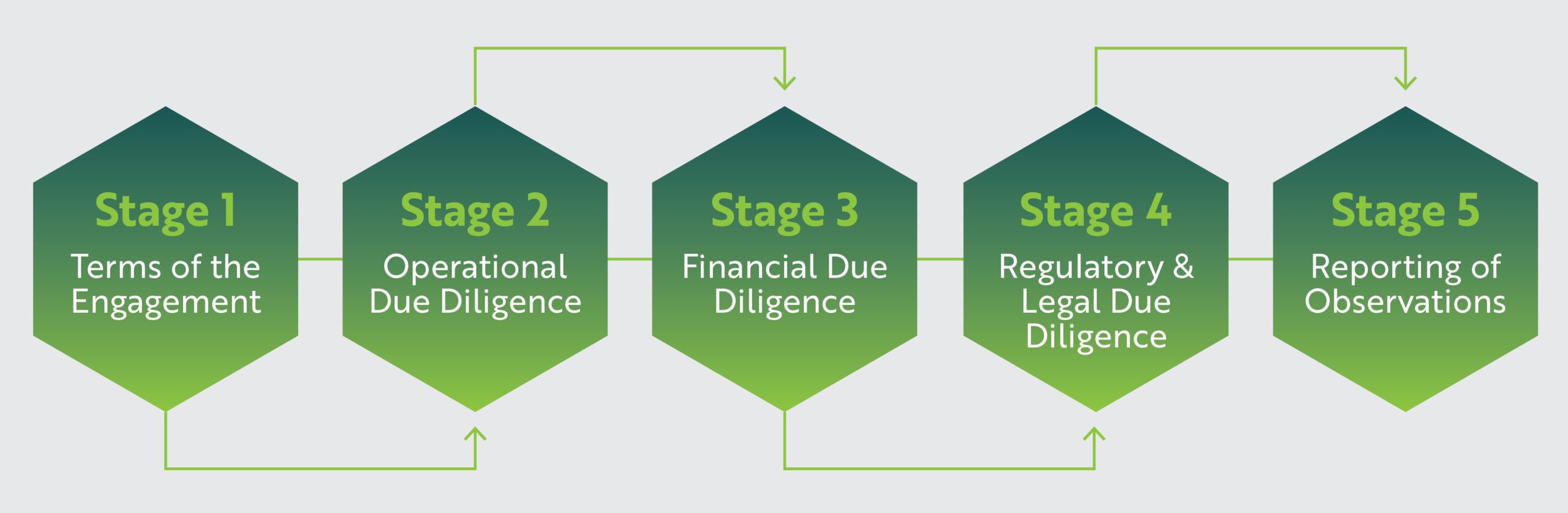
Stage 1: terms of the engagement
Terms of the engagement are discussed and agreed-upon by both parties, this will include a list of all financial information, contracts, licenses, and other documentation to be provided by the Target company. A non-disclosure agreement is signed, after which the review process may commence.
Stage 2: operational due diligence
Operational data and documentation is gathered and provided to the Acquirer’s due diligence team, typically via a data room. The Acquirer’s team then reviews and analyzes the data. This stage should also include on-site reviews of assets/property within the purview of the engagement.
The key here is to understand the effectiveness of the Target company’s operating model. This should include a market analysis that looks outside the Target to identify competitive advantages, market specifics, and the investments necessary to scale operations.
Stage 3: financial due diligence
All relevant audited financial statements, tax documents, records, and projections are reviewed. Emphasis here is on confirming both past performance and the viability of future projections. The process should also include interviews with the Target company’s financial management team and external auditors.
Findings in this stage will provide important information on tax and debt exposures and capital expenditures, while also informing post-transaction net working capital needs.
Stage 4: regulatory/legal due diligence
This stage is focused on identifying any legal exposures or risks, with special focus on the status of licensing and regulatory compliance. This will include a review of licenses, leases, purchases agreements, regulatory reviews and all contracts. Of particularly focus here is the documentation of regulatory reviews and compliance.
Stage 5: reporting of observations
After the review processes are complete, the Acquirer and Target company will meet to discuss the results of the review and the Acquirer will have the opportunity to ask follow-up questions and request more information/documentation.
Specific areas of due diligence for the cannabis and hemp industries
Every industry has unique operating models, financial structures, and legal considerations that must be taken into account when conducting due diligence. In the following we will address some key points that should be examined for transactions in the cannabis and hemp industries.
Enhanced regulatory compliance
The validity of licenses and a company’s ability to meet and maintain regulatory compliance is of the utmost importance when considering an M&A deal in cannabis and hemp. Just because a company is operating, it does not mean it is doing so legally.
There are multiple layers of compliance necessary for operation: including State, Local and Federal. Maintaining compliance with one does not mean the other conditions are met. Diligence relating to state and local law compliance must be tailored to the legal and regulatory specifics of the states and localities where the Target company operates.
Quality of financial documentation
A roadblock encountered in many cannabis transactions can be traced back to an overall lack of accuracy and detail for financial statements and reports. Many smaller cannabis operations simply do not have the back-office resources to produce documentation in accordance with accounting principles and standards.
These circumstances do not necessarily represent an effort to obfuscate or mislead – but all precautions should be taken to avoid potential misrepresentations of transactions. In instances of poor financial documentation, the responsibility of securing and analyzing appropriate documentation falls on the Acquirer.
Contract review
Due to the often times unclear legality of cannabis enterprises, all business relationships demand extensive scrutiny in the cannabis context. These include property leases, vendor and supplier contracts, and insurance policies. Any standard-issue contracts and agreements, which do not explicitly acknowledge and conform to the legality of cannabis operations, often require follow-on agreements.
Ownership transparency
Many cannabis operations have complex corporate structures comprised of affiliates and subsidiaries, especially in the case of multi-state operators. Ownership and control are typically directly tied to the licensing arrangement of a cannabis operation. It is important to conduct diligence to confirm the ownership formation provided by the Target is both accurate, and that the transfer of licenses will not be negated by a change of control.
For example, if a license is issued under “Social Equity” guidelines, those conditions may not apply to the new ownership group, which can cause a variety of post-transaction issues.
Banking and insurance relationships
The fraught legal status of cannabis at the federal level has made access to banking and insurance extremely difficult. When reviewing these relationships, it is important to ascertain that financial services and insurance providers are fully aware of the business conducted by the Target company and the contracts and coverage are appropriate.
Oftentimes, financial institutions and insurance providers will have conducted their own regulatory diligence before entering a relationship with a cannabis company, and their input/assistance can provide valuable insight during your own diligence procedures.
Tax exposure
With the cannabis industry continuing to exist in a legal gray area at the federal level, tax issues are of the utmost importance. Some cannabis operations take a “creative” approach to managing tax exposure, specifically in regards to 280E. When examining financial statements it is important to identify the accounting methods used and confirm whether they are appropriate. All too often cannabis operations are audited and found to be short in tax payments to the tune of millions of dollars. As the Acquirer you do not want to inherit this kind of liability.
Final thoughts: do the homework
Developing and implementing a thorough due diligence process before acquiring a business is simply smart business. While due diligence will not necessarily make a transaction successful, it can help reveal potential threats and risks, and support informed pricing, valuations, or other adjustments later in the transaction process. An extra benefit comes from the ways the information gained during due diligence, especially related to operational specifics and corporate culture, can ease the transition and drive efficiencies during post-transaction integration process.
Catch up on previous articles in this series and see what’s coming next…
]]>Deal structure can be viewed as the “Terms and Conditions” of an M&A deal. It lays out the rights and obligations of both parties, and provides a roadmap for completing the deal successfully. While deal structures are necessarily complex, they typically fall within three overall strategies, each with distinct advantages and disadvantages: Merger, Asset Acquisition and Stock Purchase.
In the following we will address these options, and common alternatives within each category, and provide guidance on their effectiveness in the cannabis and hemp markets.
Key considerations of an M&A structure
Before we get to the actual M&A structure options, it is worth addressing a couple essential factors that play a role in the value of an M&A deal for both sides. Each transaction structure has a unique relationship to these factors and may be advantageous or disadvantageous to both parties.
Transfer of Liabilities: Any company in the legally complex and highly-regulated cannabis and hemp industries bears a certain number of liabilities. When a company is acquired in a stock deal or is merged with, in most cases, the resulting entity takes on those liabilities. The one exception being asset deals, where a buyer purchases all or select assets instead of the equity of the target. In asset deals, liabilities are not required to be transferred.
Shareholder/Third-Party Consent: A layer of complexity for all transaction structures is presented by the need to get consent from related parties. Some degree of shareholder consent is a requirement for mergers and stock/share purchase agreements, and depending on the Target company, getting consent may be smooth, or so difficult it derails negotiations.
Beyond that initial line of consent, deals are likely to require “third party” consent from the Target company’s existing contract holders – which can include suppliers, landlords, employee unions, etc. This is a particularly important consideration in deals where a “change of control” occurs. When the Target company is dissolved as part of the transaction process, the Acquirer is typically required to re-negotiate or enter into new contracts with third parties. Non-tangible assets, including intellectual property, trademarks and patents, and operating licenses, present a further layer of complexity where the Acquirer is often required to have the ownership of those assets formally transferred to the new entity.
Tax Impact: The structure of a deal will ultimately determine which aspects are taxed and which are tax-free. For example, asset acquisitions and stock/share purchases have tax consequences for both the Acquirer and Target companies. However, some merger types can be structured so that at least a part of the sale proceeds can be tax-deferred.
As this can have a significant impact on the ROI of any deal, a deep dive into tax implications (and liabilities) is a must. In the following, we will address the tax implications of each structure in broad strokes, but for more detail please see our article on M&A Tax Implications (COMING SOON).
Asset acquisitions
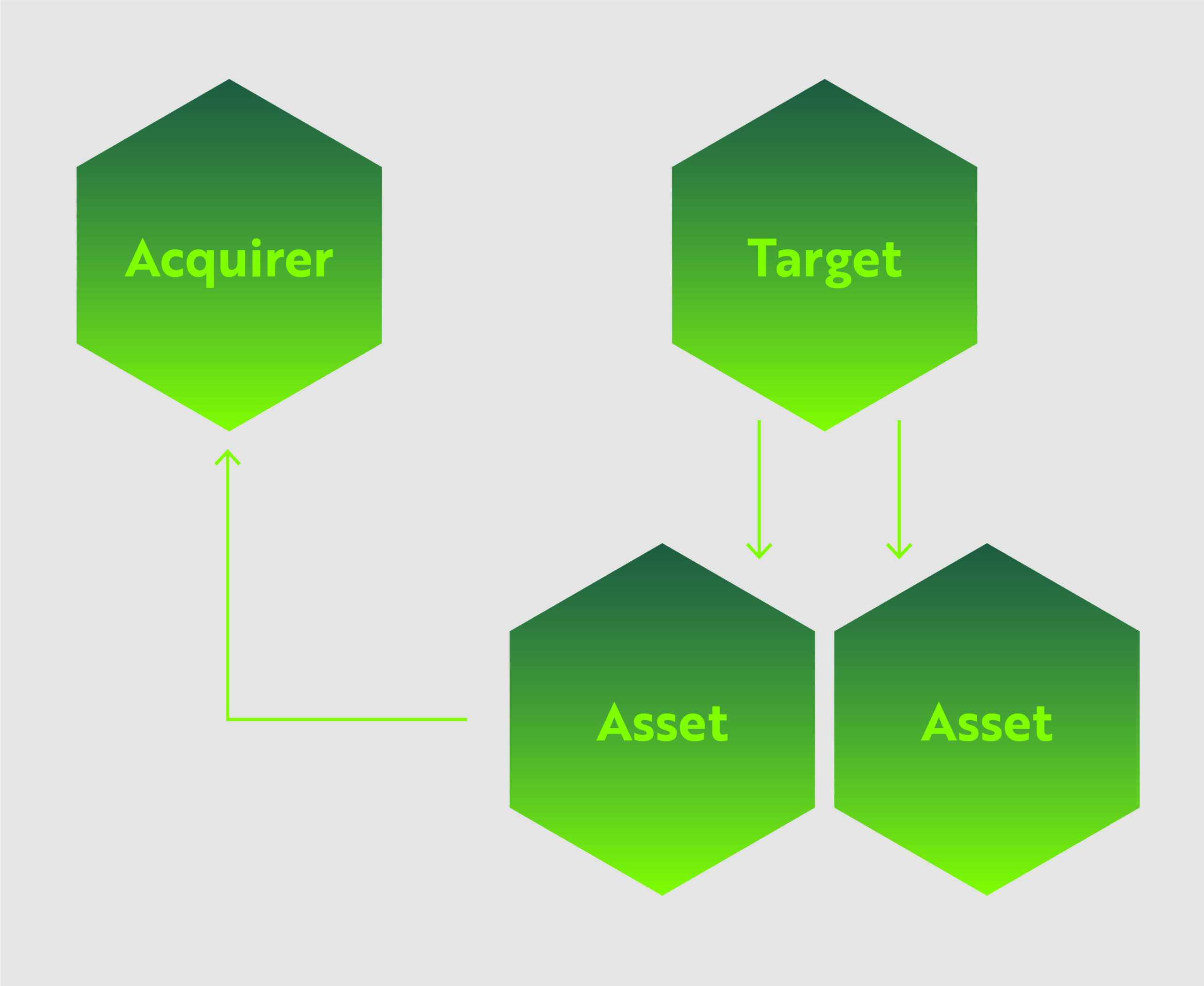
In this structure, the Acquirer identifies specific or all assets held by the Target company, which can include equipment, real estate, leases, inventory, equipment and patents, and pays an agreed-upon value, in cash and/or stock, for those assets. The Target company may continue operation after the deal.
This is one of the most common transaction structures, as the Acquirer can identify the specific assets that match their business plan and avoid burdensome or undesirable aspects of the Target company. From the Target company’s perspective, they can offload under-performing/non-core assets or streamline operations, and either continue operating, pivot, or unwind their company.
For the cannabis industry, asset sales are often preferred as many companies are still working out their operational specifics and the exchange of assets can be mutually beneficial.
Advantages/Disadvantages
Transfer of Liabilities: One of the strongest advantages of an asset deal structure is that the process of negotiating the assets for sale will include discussion of related liabilities. In many cases, the Acquirer can avoid taking on certain liabilities, depending on the types of assets discussed. This gives the Acquirer an added line of defense for protecting itself against inherited liabilities.
Shareholder/Third-Party Consent: Asset acquisitions are unique among the M&A transaction structures in that they do not necessarily require a stockholder majority agreement to conduct the deal.
However, because the entire Target company entity is not transferred in the deal, consent of third-parties can be a major roadblock. Unfortunately, as stated in our M&A Strategy article, many cannabis markets licenses are inextricably linked to the organization/ownership group that applied for and received the license. This means that acquiring an asset, for example a cultivation facility, does not necessarily mean the license to operate the facility can be included in the deal, and would likely require re-application or negotiation with regulatory authorities.
Tax Impact: A major consideration is the potential tax implications of an asset deal. Both the Acquirer and Target company will face immediate tax consequences following the deal. The Acquirer has a slight advantage in that a “step-up” in basis typically occurs, allowing the acquirer to depreciate the assets following the deal. Whereas the Target company is liable for the corporate tax of the sale and will also pay taxes on dividends from the sale.
Stock/share purchase
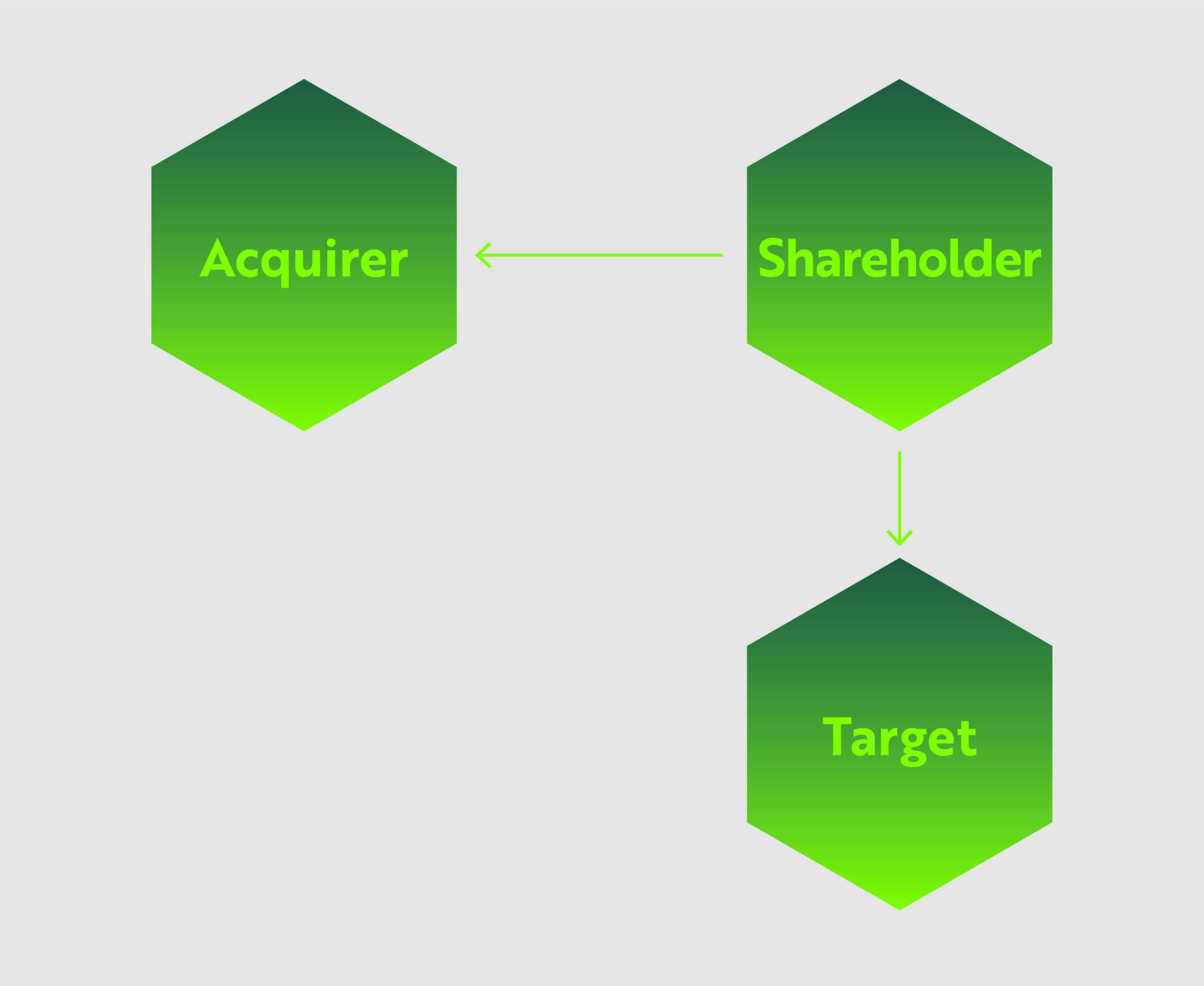
In some ways, a stock/share purchase is a more efficient version of a merger. In this structure, the acquiring company simply purchases the ownership shares of the Target business. The companies do not necessarily merge and the Target company retains its name, structure, operations and business contracts. The Target business simply has a new ownership group.
Advantages/Disadvantages
Transfer of Liabilities: Since the entirety of the company comes under new ownership, all related liabilities are also transferred.
Shareholder/Third Party Consent: To complete a stock deal, the Acquirer needs shareholder approval, which is not problematic in many circumstances. But if the deal is for 100% of a company and/or the Target company has a plenitude of minority shareholders, getting shareholder approval can be difficult, and in some cases, make a deal impossible.
Because assets and contracts remain in the name of the Target company, third party consent is typically not required unless the relevant contracts contain specific prohibitions against assignment when there is a change of control.
Tax Impact: The primary concern for this deal is the unequal tax burdens for the Acquirer vs the Shareholders of the Target company. This structure is ideal for Target company shareholders because it avoids the double taxation that typically occurs with asset sales. Whereas Acquirers face several potentially unfavorable tax outcomes. Firstly, the Target company’s assets do not get adjusted to fair market value, and instead, continue with their historical tax basis. This denies the Acquirer any benefits from depreciation or amortization of the assets (although admittedly not as important in the cannabis industry due to 280E). Additionally, the Acquirer inherits any tax liabilities and uncertain tax positions from the Target company, raising the risk profile of the transaction.
Three types of mergers
1: Direct merger
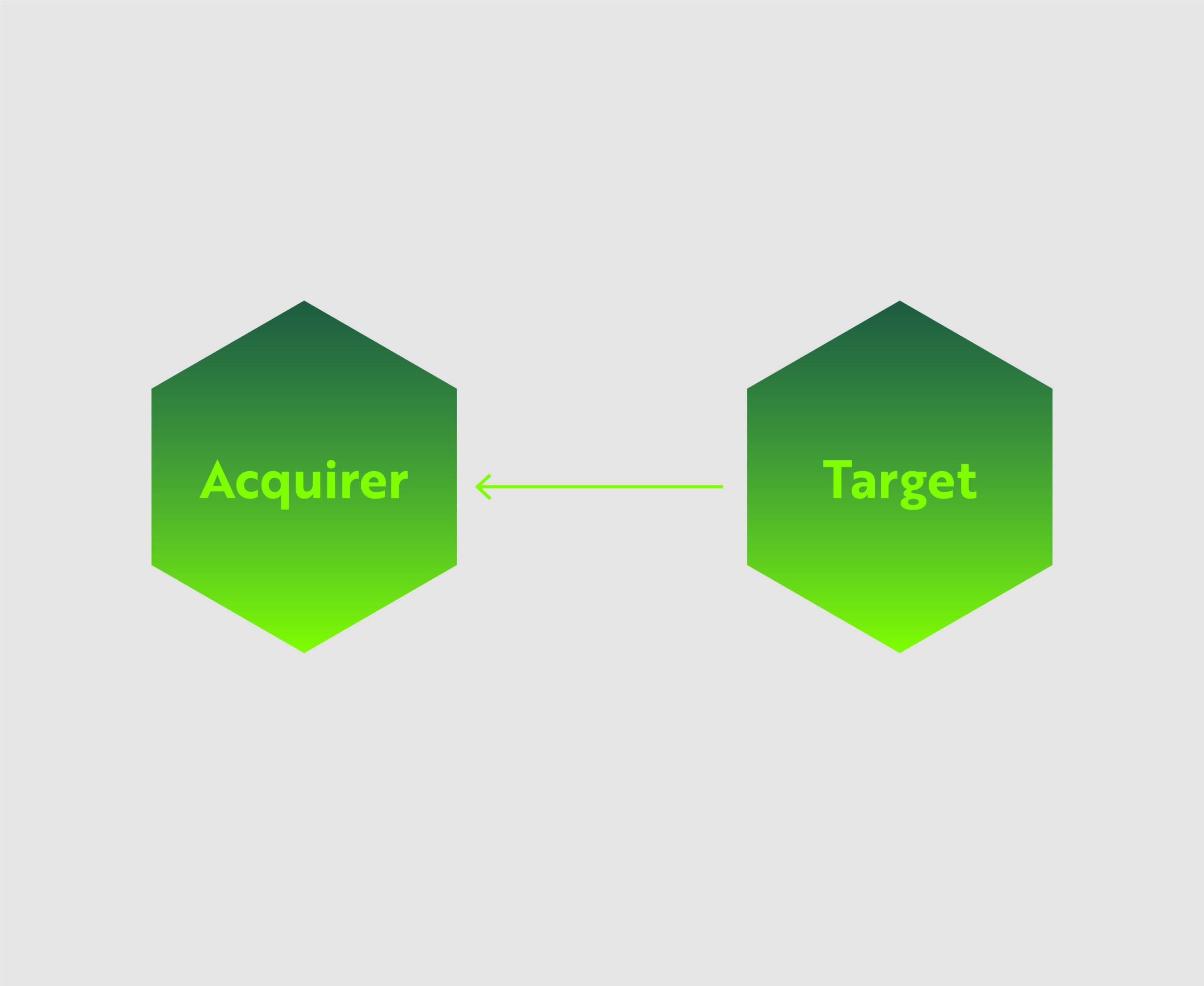
In the most straight-forward option, the Acquiring company simply acquires the entirety of the target company, including all assets and liabilities. Target company shareholders are either bought out of their shares with cash, promissory notes, or given compensatory shares of the Acquiring company. The Target company is then considered dissolved upon completion of the deal.
2: Forward indirect merger
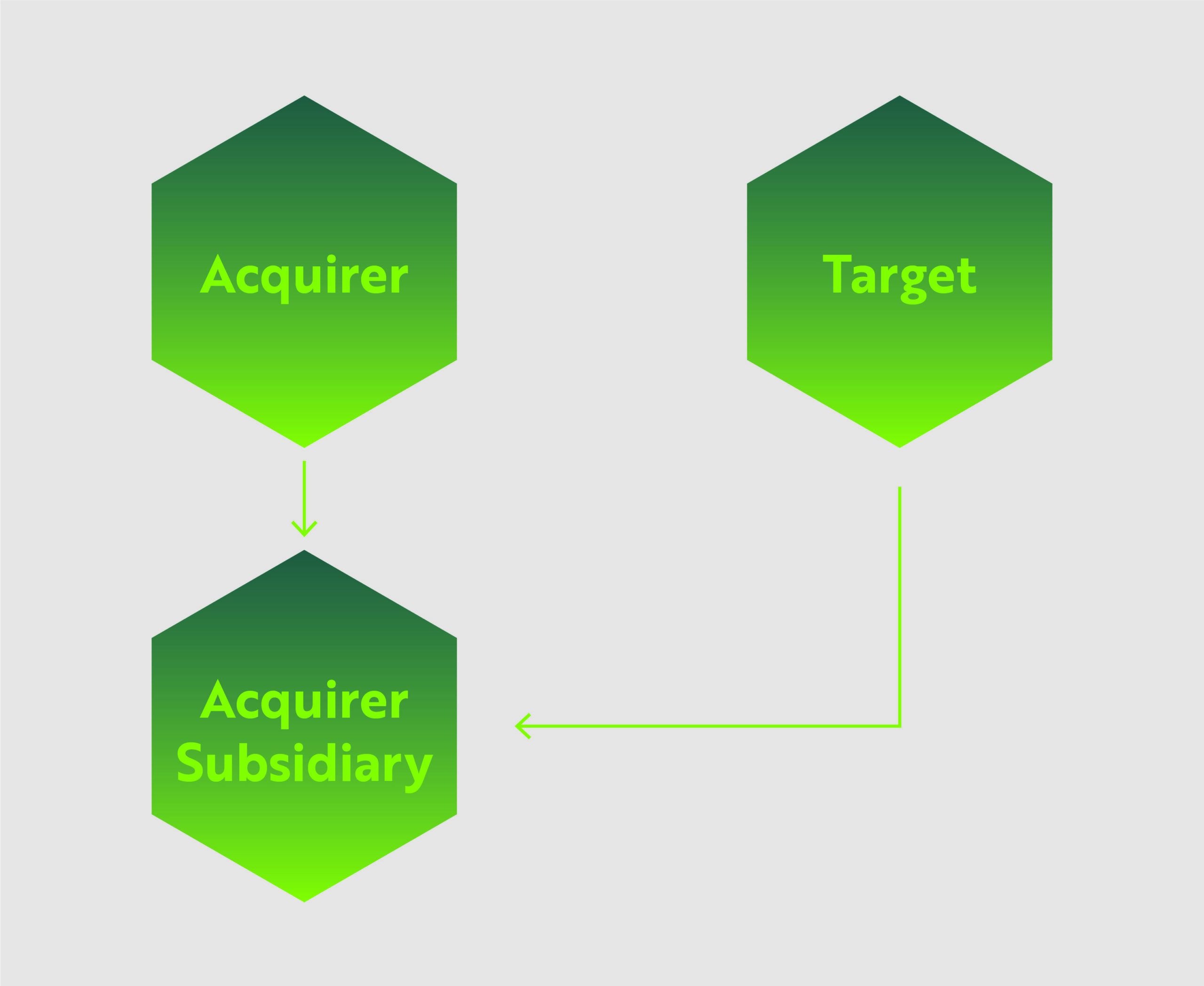
Also known as a forward triangular merger, the Acquiring company merges the Target company into a subsidiary of the Acquirer. The Target company is dissolved upon completion of the deal.
3: Reverse indirect merger
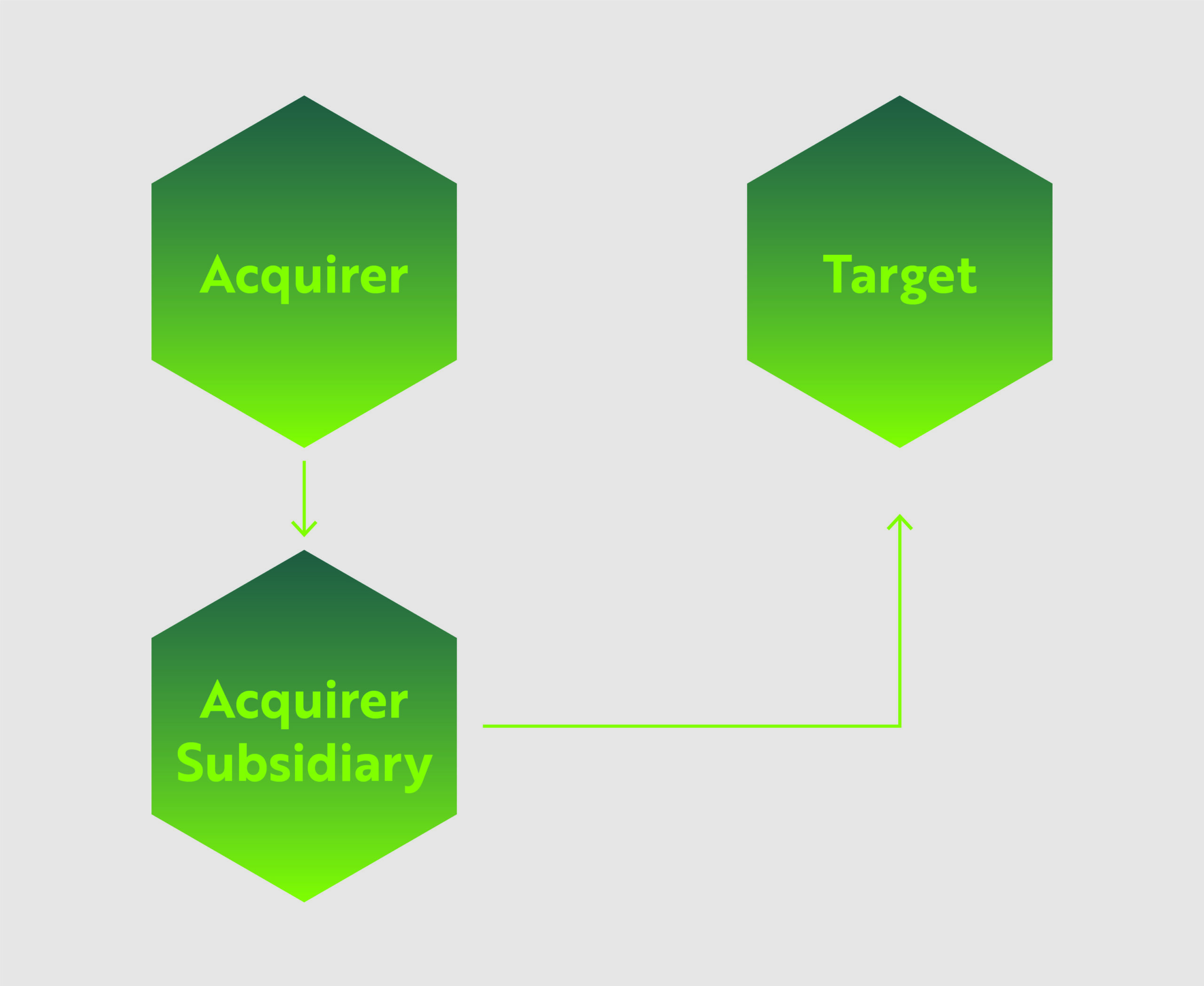
The third merger option is called the reverse triangular merger. In this deal the Acquirer uses a wholly-owned subsidiary to merge with the Target company. In this instance, the Target company is the surviving entity.
This is one of the most common merger types because not only is the Acquirer protected from certain liabilities due to the use of the subsidiary, but the Target company’s assets and contracts are preserved. In the cannabis industry, this is particularly advantageous because Acquirers can avoid a lot of red tape when entering a new market by simply taking up the licenses and business deals of the Target company.
Advantages/Disadvantages
Transfer of Liabilities: In option #1, the acquirer assumes all liabilities from the Target company. Options #2 and #3, provide some protection as the use of the subsidiary helps shield the Acquirer from certain liabilities.
Shareholder/Third Party Consent: Mergers can be performed without 100% shareholder approval. Typically, the Acquirer and Target company leadership will determine a mutually acceptable stockholder approval threshold.
Options #1 and #2, where the Target company is ultimately dissolved, will require re-negotiation of certain contracts and licenses. Whereas in option #3, as long as the Target company remains in operation, the contracts and licenses will likely remain intact, barring any “change of control” conditions.
Tax Impact: Ultimately, the tax implications of the merger options are complex and depend on whether cash or shares are used. Some mergers and reorganizations can be structured so that at least a part of the sale proceeds, in the form of acquirer’s stock, can receive tax-deferred treatment.
In conclusion
Each deal structure comes with its own tax advantages (or disadvantages), business continuity implications, and legal requirements. All of these factors must be considered and balanced during the negotiating process.
Catch up on previous articles in this series and see what’s coming next…
]]>There are as many reasons to seek out a merger and acquisition (M&A) deal as there are companies engaging in these transactions. Through our extensive experience conducting M&A deals in cannabis, and related industries, we advocate a fundamentally sound approach that puts companies on the path to a successful deal.
In the following, we will discuss a general approach to M&A strategy and the unique conditions of the cannabis industry that must be taken into consideration.
In any deal, focus and strategy are the keys
Whether on the buy- or sell-side, a successful M&A strategy must adhere to the same logic that informs a cannabis operation or fund’s long-term strategic goals. Any deal should be the means for achieving these goals. Below are the basic stages of a successful M&A strategy.
Stage 1: Develop Strategic Business Plan and Key Drivers
What are the long-term goals of the organization? Common goals include: increasing revenue/lowering overhead, achieving economies of scale, new product offer/market entry, expanding operations, acquiring technology/Intellectual Property (IP). When it is determined that the goals stakeholders agree on cannot be achieved expeditiously through internal channels, M&A deals should be considered to accelerate timelines.
Stage 2: Understand Financial Limitations
On the acquisition-side, assess the funds or assets available for the deal, this can include cash on hand, stock/debt issuance, and sales of tangible/intangible property. Once known, the blend of what makes up a consideration for a purchase can have a large effect on what bid a seller is willing to take.
For sellers, you must understand your financial position, what you need to achieve your goals, and the market value of your assets. They must align within reasonable expectations before moving forward.
Stage 3: Develop List of M&A Targets
This can be a complex but essential step. Acquirers must perform deep analyses of the market and licensing conditions of the region where they are considering a deal. Sellers need to connect with potential buyers. Involving an investment bank can prove beneficial in identifying targets/sellers and supporting the valuation stage that follows.
Stage 4: Build Valuation Models
At this stage, it is important to lay out the market and financial realities that will drive acquisition costs. Both sides must also account for the returns necessary to provide a positive outcome. Using the valuation models, you also can begin to prioritize candidates based on business impact and deal feasibility.
Stage 5: Review and Approve Strategy
With the previous stages complete it is time to step back and make sure a potential deal aligns with business goals and confirm that critical stakeholders will approve the potential deal.
License acquisition at the center of M&A deals
The regulatory complexity of the cannabis industry in the U.S. has created a unique set of circumstances that add fuel to the drive for M&A deals. While cannabis remains illegal at the Federal level, states and territories are acting to implement state and local laws regarding the lawful use of medical and or/adult-use cannabis.
In the absence of a Federal regulatory framework, a patchwork of state and local regulatory regimes, each with their own complex set of rules and regulations, has emerged. The process of applying for and receiving a license to operate in most of these markets is expensive, time-consuming and subject to unpredictable factors. As a result, licenses have emerged as a type of commodity in the cannabis market. But unlike other intangible property commodities (i.e. intellectual property), most cannabis licenses are inextricably tied to the business unit that holds it. While there are some workarounds, including management agreements, in most markets M&A deals are the most direct way of acquiring licenses.
Considerations for Buyers
The process of seeking to gain new licenses must begin with extensive market research and growth projections for the targeted market. To fully understand the value of a license, you’ll also need to understand the licensing process and ascertain how many are issued per year, whether current caps on licenses exist (or are planned), and whether your competitors already have a foothold in that market.
Once a target company holding licenses is identified, the details of those licenses become paramount. Considerations should include: expiration date of license, process for re-certifying licenses, and whether any conditions the license was issued under would change upon acquisition and potentially invalidate or block the recertification of that license. In many markets, the change of ownership or equity stake in a cannabis business is contingent upon regulatory approval.
Considerations for Sellers
Understanding the real market value of all licenses held is the name of the game. All previously listed factors must be considered. Since, in the majority of cases, you’ll be selling a business unit along with the license, you must also have a firm understanding of the value of that unit and all its tangible and intangible property. The acquirer will also be performing extensive due diligence on you and your business units, so it is best to have financial statements prepared, all regulatory issues up-to-date, etc.
Complexities surrounding increasing operational capacity
Considering the relatively early stage of the cannabis industry, many companies are a long way from their planned operational capacity. Establishing new operations, whether as a cultivator, manufacturer, retailer, vertically integrated operation, requires extensive planning for zoning, licensing and regulatory concerns, a major initial capital outlay, and a long timeframe to build and establish operations.
For many fast-growing companies, the quickest route to expanding operations is to acquire or partner with cannabis companies with already established operational scale.
Considerations for Buyers
A common motivation for acquiring operational capacity is the desire to achieve scales of economy through vertical integration. This is when, for example, a retailer acquires cultivation and manufacturing operations to bring product development under the same roof. By controlling more steps along the supply chain, a great number of financial and operational efficiencies can be achieved. However, these advantages must be weighed against the burden of managing greater regulatory complexity.
Considerations for Sellers
Overextended cannabis operations can achieve greater operational efficiency by off-loading under-performing assets. As related to the sale of licenses, understanding the true value of both tangible property, and the attached license, is key to getting a fair price.
Distressed assets provide buying opportunities
The cannabis industry has endured significant volatility over the past 12-15 month period. One of the results of the turmoil has been a significant dip in valuations, which has limited the capital-raising potential for many operators. A number of organizations that were aggressively expanding their presence during 2017-18, now find themselves overextended with portfolios burdened by under-performing assets. These circumstances have resulted in a “buyer’s market” for cannabis operations and funds with sufficient capital flexibility to be acquisitive in this environment.
Considerations for Buyers
For the first time in the legal cannabis industry’s history, difficult economic conditions can be advantageous for companies with access to capital. The overall dip in valuations and growing number of distressed assets presents a unique opportunity to gain licenses, expand operations, and enter new markets. While we always preach caution and emphasize due diligence in executing M&A deals, now may be one of the rare times it is advantageous to swim against the current and move quickly in acquiring assets and establishing a solid foundation for when economic conditions improve.
Considerations for Sellers
In the absence of other forms of capital-raising, carrying under-performing assets may prove to be a lifeline for many cannabis operations. Finding a buyer for operations in, for example, a market that haven’t yet matured, could provide a “reset” button for over-extended operations. It is essential to take a strategic view and make difficult decisions about the validity of existing operations and business plans.
Final thoughts
The motivations and circumstances surrounding M&A deals are so diverse there is simply no one-size-fits-all approach. What remains consistent is that when a strong business case matches market realities and ultimately produces an M&A deal, the outcome is most likely to be favorable. Stopping at every step to confirm proposed deals align with the overall business strategy will help keep your plan on track.
Catch up on previous articles in this series and see what’s coming next…
]]>