While it appears that several of the more disadvantageous provisions targeting businesses won’t make it into the final bill, others may. In addition, some temporary provisions are coming to an end, requiring businesses to take action before year end to capitalize on them. As Congress continues to negotiate the final bill, here are some areas where you could act now to reduce your business’s 2021 tax bill.
Research and experimentation
Section 174 research and experimental (R&E) expenditures generally refer to research and development costs in the experimental or laboratory sense. They include costs related to activities intended to uncover information that would eliminate uncertainty about the development or improvement of a product.
Currently, businesses can deduct R&E expenditures in the year they’re incurred or paid. Alternatively, they can capitalize and amortize the costs over at least five years. Software development costs also can be immediately expensed, amortized over five years from the date of completion or amortized over three years from the date the software is placed in service.
However, under the Tax Cuts and Jobs Act (TCJA), that tax treatment is scheduled to expire after 2021. Beginning next year, you can’t deduct R&E costs in the year incurred. Instead, you must amortize such expenses incurred in the United States over five years and expenses incurred outside the country over 15 years. In addition, the TCJA requires that software development costs be treated as Sec. 174 expenses.
The BBBA may include a provision that delays the capitalization and amortization requirements to 2026, but it’s far from a sure thing. You might consider accelerating research expenses into 2021 to maximize your deductions and reduce the amount you may need to begin to capitalize starting next year.
Income and expense timing
Accelerating expenses into the current tax year and deferring income until the next year is a tried-and-true tax reduction strategy for businesses that use cash-basis accounting. These businesses might, for example, delay billing until later in December than they usually do, stock up on supplies and expedite bonus payments.
But the strategy is advised only for businesses that expect to be in the same or a lower tax bracket the following year — and you may expect greater profits in 2022, as the pandemic hopefully winds down. If that’s the case, your deductions could be worth more next year, so you’d want to delay expenses, while accelerating your collection of income. Moreover, under some proposed provisions in the BBBA, certain businesses may find themselves facing higher tax rates in 2022.
For example, the BBBA may expand the net investment income tax (NIIT) to include active business income from pass-through businesses. The owners of pass-through businesses — who report their business income on their individual income tax returns — also could be subject to a new 5% “surtax” on modified adjusted gross income (MAGI) that exceeds $10 million, with an additional 3% on income of more than $25 million.
Capital assets
The traditional approach of making capital purchases before year-end remains effective for reducing taxes in 2021, bearing in mind the timing issues discussed above. Businesses can deduct 100% of the cost of new and used (subject to certain conditions) qualified property in the year the property is placed in service.
You can take advantage of this bonus depreciation by purchasing computer systems, software, vehicles, machinery, equipment and office furniture, among other items. Bonus depreciation also is available for qualified improvement property (generally, interior improvements to nonresidential real property) placed in service this year. Special rules apply to property with a longer production period.
Of course, if you face higher tax rates going forward, depreciation deductions would be worth more in the future. The good news is that you can purchase qualifying property before year-end but wait until your tax filing deadline, including extensions, to determine the optimal approach.
You can also cut your taxes in 2021 with Sec. 179 expensing (deducting the entire cost). It’s available for several types of improvements to nonresidential real property, including roofs, HVAC, fire protection systems, alarm systems and security systems.
The maximum deduction for 2021 is $1.05 million (the maximum deduction also is limited to the amount of income from business activity). The deduction begins phasing out on a dollar-for-dollar basis when qualifying property placed in service this year exceeds $2.62 million. Again, you needn’t decide whether to take the immediate deduction until filing time.
Business meals
Not every tax-cutting tactic has to be dry and dull. One temporary tax provision gives you an incentive to enjoy a little fun.
For 2021 and 2022, businesses can generally deduct 100% (compared with the normal 50%) of qualifying business meals. In addition to meals incurred at and provided by restaurants, qualifying expenses include those for company events, such as holiday parties. As many employees and customers return to the workplace for the first time after extended pandemic-related absences, a company celebration could reap you both a tax break and a valuable chance to reconnect and re-engage.
Stay tuned
The TCJA was signed into law with little more than a week left in 2017. It’s possible the BBBA similarly could come down to the wire, so be prepared to take quick action in the waning days of 2021. Turn to us for the latest information.
]]>Because of these newly tightened conditions, companies may face challenges when raising capital, forcing them to adopt a more thoughtful approach to seek funding. Likewise, investors will want to ensure their priorities are protected and their returns met. The combination of a given borrower’s need for capital and a financer’s desire to seek favorable returns may lead to the creation of agreements that have characteristics of both debt and equity. As such, it is crucial for all parties involved to understand the resulting tax classification and the treatment of these arrangements, so all expectations are met.
The taxation of debt and equity
For borrowers, the difference between debt and equity can be critical because interest payments are generally tax deductible and subject to certain limitations. Dividends or other payments related to equity would not be deductible for U.S. federal income tax purposes.
Enacted as part of the Tax Cuts and Job Act (TCJA) of 2017, one main limit on interest deductibility is the IRC 163(j) limit on the amount of business interest that can be deducted each year. This limit is calculated as 30 percent of adjusted taxable income, which prior to the 2022 tax year closely resembled earnings before interest, taxes, depreciation, and amortization (EBITDA). However, starting with the 2022 tax year adjusted taxable income excludes depreciation and amortization, becoming EBIT. This should result in a lower limit on the amount of interest expense that can be deducted each year. Any interest expense exceeding this annual limit can be carried forward to future years.
Determining if an arrangement is debt or equity for federal income tax purposes
Classifying an arrangement as debt or equity is made on a case-by-case basis depending on the facts and circumstances of a given agreement. While there is currently little guidance in this area beyond case law, the Internal Revenue Service (IRS) has issued a list of factors to consider when questioning whether something is debt or equity. (Keep in mind, however, that the IRS states not one factor is conclusive.) The factors include whether:
- An agreement contains an unconditional promise to pay a sum certain on demand or at maturity,
- A lender can enforce the payment of principal and interest by the borrower, and
- A borrower is thinly capitalized.
The courts have also established a broader — but similar — list of factors to consider when determining whether an instrument should be treated as debt or equity. Both the IRS and the courts have generally placed more weight on whether an instrument provides for the rights and remedies of a creditor, whether the parties intend to establish a debtor-creditor relationship, and if the intent is economically feasible. Some factors include:
- Participation in management (as a result of advances),
- Identity of interest between creditor and stockholder,
- Thinness of capital structure in relation to debt, and
- Ability of a corporation to obtain credit from outside sources.
For international companies, the characterization of debt or equity when considered in a cross-border funding arrangement is important, as withholding tax rates may apply to interest payments and may differ from tax rates applied to dividends. Further, withholding tax obligations occurs when a cash payment is made. If you have a cross-border arrangement, it is crucial to know if you have debt or equity on your hands.
Special rules related to payment-in-kind
Once it is determined that an agreement should be classified as debt for U.S. federal income tax purposes, some borrowers may prefer to set aside interest payments or pay interest with securities, which is often referred to as payment-in-kind (PIK). This is generally done to preserve cash flow for operations and growth of the business. When a borrower chooses this route, U.S. federal income tax rules will impute an interest payment to the lender.
While using a PIK mechanism will not automatically result in the debt being recharacterized as equity for federal income tax purposes, it can support viewing the instrument as equity.
Limits to deductible debt interest
There are limitations that can apply to interest deductibility. As noted above, IRC 163(j) limits deductibility of business interest; for a corporation, this is deemed to be all interest regardless of use. Another provision that can result in interest deductibility limitation is IRC 163(l), which applies to certain convertible notes and similar instruments held by corporations.
For cannabis operators, it is important to consider that IRC 280E disallows interest deductions. Hence, it is highly detrimental for cannabis operators to issue debt from entities that are cannabis plant-touching.
How we can help
Due to the nature of the debt versus equity analysis, companies thinking about fundraising should plan on how they intend to perform the raise and whether to have the raise treated as equity or debt. If debt classification is desired, a borrower should take the steps needed to strengthen the facts of the transaction to support the arrangement as a debt instrument.
MGO’s dedicated tax team has extensive experience advising companies across industries on capital-raising, debt refinancing and restructuring, recapitalizations, and other tax transactions. If you are planning to fundraise, or you are currently in the process of conducting a debt versus equity analysis, contact us today.
About the authors
Maryam Nicholes is a director and the national leader of MGO’s M&A Tax Advisory Services group. She has more than 13 years of experience advising on a wide range of clients, consulting on structuring and implementation of transactions including mergers, acquisitions and dispositions, global reorganizations, and new investment platforms. She also provides planning and related deal modeling regarding global cash tax exposures, repatriation planning, and related debt structuring and workout. Contact Maryam at MNicholes@mgocpa.com.
Matt Sapowith is a tax partner at MGO. He has more than 14 years of tax planning and compliance experience in areas including corporate and partnership taxation, international tax, M&A transaction advisory, transfer pricing, state and local tax, R&D credit, and compensation planning. He assists companies with structuring for multiple business lines, excise tax and sales tax planning and compliance in a variety of industries including technology, financial services, manufacturing and distribution, professional services, retail and consumer goods, cannabis, and cryptocurrency. Contact Matt at MSapowith@mgocpa.com.
]]>Here’s a summary of many of the proposals that could change the tax landscape soon.
Proposed tax provisions for businesses
The BBBA and BIB would also bring dramatic changes to the tax landscape for some businesses. Their tax bills could be influenced by proposals related to the following:
The corporate tax rate. The BBBA would replace the TCJA’s flat rate of 21% with a graduated rate structure. The first $400,000 of income would be subject to an 18% rate, with the 21% rate retained for income between $400,000 and $5 million. The graduated corporate rate would max out at 26.5% for income exceeding $5 million.
Personal service corporations and corporations with taxable income exceeding $10 million would be subject to a flat 26.5% rate. The pre-TCJA top corporate tax rate was 35%.
Excess business losses. The TCJA limits the amount of excess business losses that pass-through entities and sole proprietors can use to offset ordinary income to $250,000, or $500,000 for married taxpayers filing jointly, adjusted for inflation. The limit is set to expire at the end of 2025, but the BBBA would make it permanent.
The bill also would create a new carry forward for unused excess business losses, rather than carrying them forward as net operating losses.
The business interest deduction. Internal Revenue Code Section 163(j) limits the deduction for business interest incurred by both corporate and noncorporate taxpayers. Under the proposal, the limit wouldn’t apply to partnerships and S corporations at the entity level. It instead would apply to the partners and shareholders.
Research and experimentation expenses. Under the TCJA, research and experimentation expenditures incurred in 2022 and later years aren’t immediately deductible; rather, they generally must be amortized over five years. The BBBA would delay the effective date for the amortization requirement to 2026.
The employee retention credit. The BIB would terminate this credit earlier than originally planned. Instead of being available for all of 2021, it would no longer be available for the fourth quarter, except for recovery startup businesses.
Carried interest. Currently, carried interests are taxed as short-term capital gains unless the gains were on property held for at least three years. The BBBA would extend the holding period to qualify for long-term capital gain treatment to five years — except for real estate businesses and taxpayers with less than $400,000 of AGI. The carried interest rules also would be expanded to cover all property treated as generating capital gains.
International transactions. The BBBA includes numerous proposals that would change the taxation of cross-border transactions and trim some of the tax advantages enjoyed by multinational corporations. For example, it would reduce the deductions for global intangible low-taxed income (GILTI) and foreign-derived intangible income. It would determine GILTI and foreign tax credit limits on a country-by-country basis. It also would make changes to the base erosion and anti-abuse tax.
Interest Expense Deduction Limits. Proposed provisions would limit interest deduction if a U.S. parent and foreign subsidiaries are in the same International Financial Reporting Group for financial reporting purposes. This is defined as a group of 2 or more corporations, one of which is non-U.S. based, that prepares a GAAP or IFRS financial statement for non-tax purposes—the third-party debt is sent to foreign subsidiaries, and the group nets an interest expense of more than $12M for a 3-year period.
Foreign Tax Credit. One of the biggest changes is that credits will now be calculated on a country-by-country basis, which means there will be no more netting. Essentially, the FTC computation will assign income and loss to the taxable unit depending on which country the taxpayer is a tax resident in—or where it has a presence. It’s now time to look at Permanent Establishment. The degree to which excess credits can be used to offset tax liabilities in the present and the future has changed as well—the carry forward period of excess credits has been reduced from 10 years to 5 years, and there is no longer a one-year carryback allowance of FTCs.
Foreign-Derived Intangible Income (FDDII) Deduction. Any U.S. companies that export intangible goods like software outside the country and currently receive a reduced tax rate will be affected, as the new effective tax rate for FDII will increase to 20.7% under this reform. The BBA will also modify income eligible for treatment under the FDII, potentially impacting royalty income earned by foreign subsidiaries.
Estate tax provisions
The BBBA would be much less taxpayer-friendly than the TCJA when it comes to gift and estate taxes and strategies. Most notably:
The gift and estate tax exemption. The TCJA doubled the gift and estate tax exemption to $10 million through 2025. That amount is annually adjusted for inflation (for 2021, it’s $11.7 million). The BBBA would return the exemption to its pre-TCJA limit of $5 million in 2022. The amount would continue to be adjusted annually for inflation.
Grantor trusts. The assets in these trusts would no longer be excluded from a taxable estate if the deceased is deemed the owner of the trust. In addition, sales between individuals and their grantor trusts would be taxed as if they were transfers between the individual and a third party. And distributions from a grantor trust to an individual other than the grantor or the grantor’s spouse would be treated as a taxable gift from the grantor.
Valuation discounts. Taxpayers would no longer be able to claim discounts for gift and estate tax purposes on transfers of interests in entities that hold nonbusiness assets (that is, passive assets held for the production of income and not used for an active trade or business). For example, discounts couldn’t be used to reduce the value of transferred interests in family-owned entities that hold securities.
Note: An earlier proposal to end the stepped-up basis tax break on inherited assets is no longer in the current version of the BBBA.
Proposed tax provisions for individual tax payers
The current version of the BBBA includes several provisions that could affect the tax liability of individual taxpayers in ways both positive and negative, depending largely on their taxable income. Among other areas, the legislation addresses:
Individual tax rates. The top marginal tax rate would return to 39.6%, the rate that was in effect before the Tax Cuts and Jobs Act (TCJA) cut it to 37% beginning in 2018. This rate would apply to the taxable income of married couples that exceeds $450,000, single filers that exceeds $400,000 and married individuals filing separately that exceeds $225,000.
A surcharge on high-income taxpayers. The BBBA would establish a new 3% tax on modified adjusted gross income above $5 million for married taxpayers filing jointly and single filers and above $2.5 million for married individuals filing separately.
The capital gains and qualified dividends tax rate. The maximum rate would increase from 20% to 25% for taxpayers in the 39.6% tax bracket. The Biden administration earlier had proposed to raise it as high as 39.6%.
The net investment income tax (NIIT). The BBBA would expand the NIIT to apply to the trade or business income of high-income individuals, regardless of whether they’re actively involved in the business. The NIIT currently applies to certain investment income and business income only if it’s passive. As a result, active business income would go from being taxed at a maximum rate of 37% under the TCJA to a maximum rate of 46.4% (the 39.6% individual income tax rate plus the 3.8% NIIT plus the 3% high-income surcharge).
This change would apply when adjusted gross income (AGI) exceeds $500,000 for married couples filing jointly, $250,000 for married couples filing separately and $400,000 for other taxpayers. Business income subject to self-employment tax would be excluded.
The qualified business income (QBI) deduction. The Section 199A deduction for pass-through entities would be limited to $500,000 for married taxpayers filing jointly, $400,000 for single filers and $250,000 for married taxpayers filing separately.
The qualified small business stock (QSBS) exclusion. Capital gains from the sale of QSBS held more than five years currently are 100% excludable from gross income. The BBBA would limit the exclusion to 50% for taxpayers with an AGI over $400,000, regardless of filing status.
Retirement planning. The BBBA would prohibit IRA contributions by taxpayers whose 1) aggregate IRA and other account balances exceed $10 million and 2) taxable income exceeds $450,000 for married couples filing jointly or $400,000 for single filers or married taxpayers filing separately. These taxpayers also would have to take required minimum distributions equal to 50% of the value that exceeds $10 million and 100% of any amount over $20 million.
Roth IRA conversions. The BBBA would prohibit certain taxpayers from first making a nondeductible contribution to a traditional IRA and then converting it to a Roth IRA (to get around restrictions on who can contribute to a Roth IRA). The proposal would apply to taxpayers with taxable income exceeding $450,000 for married taxpayers filing jointly and $400,000 for single filers and married taxpayers filing separately.
Child and dependent care tax credits. The American Rescue Plan Act (ARPA), enacted earlier this year, temporarily expanded both the Child Tax Credit (CTC) and the Dependent Care Tax Credit (DCTC). The BBBA would extend the CTC through 2025 and make permanent the DCTC.
Premium tax credits (PTCs). The ARPA also expanded the availability of PTCs to subsidize the purchase of health insurance for 2021 and 2022. The BBBA would permanently expand the credits.
Banking activity reporting. The Biden administration has proposed requiring financial institutions to annually report the total amount of funds that go in and out of bank, loan and investment accounts (personal and business) that hold a value of at least $600. Reporting also would be required if the aggregate flow in and out of an account is at least $600 in a year.
As Democrats weigh including this proposal in one of the bills, it has received pushback from banks and privacy advocates. A revised version includes a $10,000 threshold, and exemptions for some common transactions, such as payments from payroll processors and mortgage payments, also are under consideration.
Stay tuned
It’s impossible to say which proposals will survive the ongoing negotiations intact. We’ll keep you up to date if and when the final legislation is enacted. In the meantime, contact us if you have concerns about how the proposed tax provisions may affect you personally or your business.
]]>Also, keep in mind that, under the Tax Cuts and Jobs Act (TCJA), annual inflation adjustments are calculated using the chained consumer price index (also known as C-CPI-U). This increases tax bracket thresholds, the standard deduction, certain exemptions and other figures at a slower rate than was the case with the consumer price index previously used, potentially pushing taxpayers into higher tax brackets and making various breaks worth less over time. The TCJA adopts the C-CPI-U on a permanent basis.
Individual income taxes
Tax-bracket thresholds increase for each filing status but, because they’re based on percentages, they increase more significantly for the higher brackets. For example, the top of the 10% bracket increases by $325 to $650, depending on filing status, but the top of the 35% bracket increases by $16,300 to $19,550, again depending on filing status.
The TCJA suspended personal exemptions through 2025. However, it nearly doubled the standard deduction, indexed annually for inflation through 2025. For 2022, the standard deduction is $25,900 (married couples filing jointly), $19,400 (heads of households), and $12,950 (singles and married couples filing separately). After 2025, standard deduction amounts are scheduled to drop back to the amounts under pre-TCJA law unless Congress extends the current rules or revises them.
Changes to the standard deduction could help some taxpayers make up for the loss of personal exemptions. But it might not help taxpayers who typically used to itemize deductions.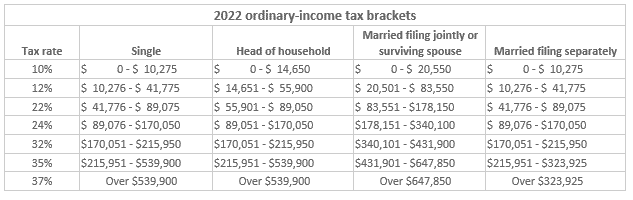
Alternative minimum tax
The alternative minimum tax (AMT) is a separate tax system that limits some deductions, doesn’t permit others and treats certain income items differently. If your AMT liability is greater than your regular tax liability, you must pay the AMT.
Like the regular tax brackets, the AMT brackets are annually indexed for inflation. For 2022, the threshold for the 28% bracket increased by $6,200 for all filing statuses except married filing separately, which increased by half that amount.
The AMT exemptions and exemption phaseouts are also indexed. The exemption amounts for 2022 are $75,900 for singles and heads of households and $118,100 for joint filers, increasing by $2,300 and $3,500, respectively, over 2021 amounts. The inflation-adjusted phaseout ranges for 2022 are $539,900–$843,500 (singles and heads of households) and $1,079,800–$1,552,200 (joint filers). Amounts for separate filers are half of those for joint filers.
Education and child-related breaks
The maximum benefits of certain education and child-related breaks generally remain the same for 2022. But most of these breaks are limited based on a taxpayer’s modified adjusted gross income (MAGI). Taxpayers whose MAGIs are within an applicable phaseout range are eligible for a partial break — and breaks are eliminated for those whose MAGIs exceed the top of the range.
The MAGI phaseout ranges generally remain the same or increase modestly for 2022, depending on the break. For example:
The American Opportunity credit. For tax years beginning after December 31, 2020, the MAGI amount used by joint filers to determine the reduction in the American Opportunity credit isn’t adjusted for inflation. The credit is phased out for taxpayers with MAGI in excess of $80,000 ($160,000 for joint returns). The maximum credit per eligible student is $2,500.
The Lifetime Learning credit. For tax years beginning after December 31, 2020, the MAGI amount used by joint filers to determine the reduction in the Lifetime Learning credit isn’t adjusted for inflation. The credit is phased out for taxpayers with MAGI in excess of $80,000 ($160,000 for joint returns). The maximum credit is $2,000 per tax return.
The adoption credit. The phaseout ranges for eligible taxpayers adopting a child will also increase for 2022 — by $6,750 to $223,410–$263,410 for joint, head-of-household and single filers. The maximum credit increases by $450, to $14,890 for 2022.
(Note: Married couples filing separately generally aren’t eligible for these credits.)
These are only some of the education and child-related breaks that may benefit you. Keep in mind that, if your MAGI is too high for you to qualify for a break for your child’s education, your child might be eligible to claim one on his or her tax return.
Gift and estate taxes
The unified gift and estate tax exemption and the generation-skipping transfer (GST) tax exemption are both adjusted annually for inflation. For 2022, the amount is $12.060 million (up from $11.70 million for 2021).
The annual gift tax exclusion increases by $1,000 to $16,000 for 2022.
Retirement plans
Not all of the retirement-plan-related limits increase for 2022. Thus, depending on the type of plan you have, you may have limited opportunities to increase your retirement savings if you’ve already been contributing the maximum amount allowed.
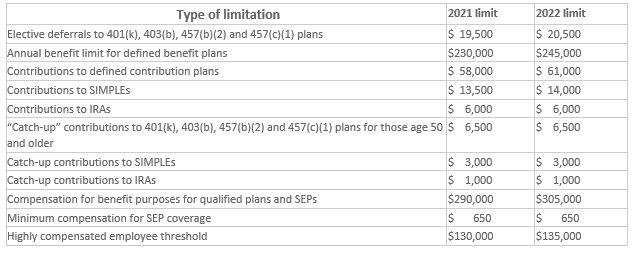
Your MAGI may reduce or even eliminate your ability to take advantage of IRAs. Fortunately, IRA-related MAGI phaseout range limits all will increase for 2022:
Traditional IRAs. MAGI phaseout ranges apply to the deductibility of contributions if a taxpayer (or his or her spouse) participates in an employer-sponsored retirement plan:
- For married taxpayers filing jointly, the phaseout range is specific to each spouse based on whether he or she is a participant in an employer-sponsored plan:
- For a spouse who participates, the 2022 phaseout range limits increase by $4,000, to $109,000–$129,000.
- For a spouse who doesn’t participate, the 2022 phaseout range limits increase by $6,000, to $204,000–$214,000.
- For single and head-of-household taxpayers participating in an employer-sponsored plan, the 2022 phaseout range limits increase by $2,000, to $68,000–$78,000.
Taxpayers with MAGIs in the applicable range can deduct a partial contribution; those with MAGIs exceeding the applicable range can’t deduct any IRA contribution.
But a taxpayer whose deduction is reduced or eliminated can make nondeductible traditional IRA contributions. The $6,000 contribution limit (plus $1,000 catch-up if applicable and reduced by any Roth IRA contributions) still applies. Nondeductible traditional IRA contributions may be beneficial if your MAGI is also too high for you to contribute (or fully contribute) to a Roth IRA.
Roth IRAs. Whether you participate in an employer-sponsored plan doesn’t affect your ability to contribute to a Roth IRA, but MAGI limits may reduce or eliminate your ability to contribute:
- For married taxpayers filing jointly, the 2022 phaseout range limits increase by $6,000, to $204,000–$214,000.
- For single and head-of-household taxpayers, the 2022 phaseout range limits increase by $4,000, to $129,000–$144,000.
You can make a partial contribution if your MAGI falls within the applicable range, but no contribution if it exceeds the top of the range.
(Note: Married taxpayers filing separately are subject to much lower phaseout ranges for both traditional and Roth IRAs.)
2022 cost-of-living adjustments and tax planning
With many of the 2022 cost-of-living adjustment amounts trending higher, you have an opportunity to realize some tax relief next year. In addition, with certain retirement-plan-related limits also increasing, you have the chance to boost your retirement savings. If you have questions on the best tax-saving strategies to implement based on the 2022 numbers, please give us a call. We’d be happy to help.
]]>With economic and tax policy a primary focus during the 2020 election, the
winning candidate/party will play a central role in pushing further economic
stimulus forward and determining long-term course for recovery following the
economic fall-out from the COVID-19 pandemic.
With the Biden campaign all but wrapping up the presidential election, businesses
and individuals with overseas concerns must pay close attention to how the
proposed policies of the candidate/party will affect their total tax liability and be prepared to make any changes or updates, in some cases, during the two months
ending the 2020 tax year.
2020 prospective results overview
Biden Victory | 50/50 Senate Split
In the case of a 50/50 split in the Senate, the tie-breaking vote goes to the Vice President, giving de facto Senate leadership to the party in the White House.
The Biden campaign’s proposed tax plan focuses on rolling back tax breaks and “loopholes” for corporations and high-net-worth individuals, specifically related to changes made in the 2017 Tax Cuts and Jobs Act (TCJA). Biden also proposed a number of significant tax breaks and stimulus efforts targeted at spurring growth in historically-disadvantaged communities and the renewable energy sector, while simultaneously rolling back fossil fuel industry subsidies.
Economic Stimulus
In the case of a Biden/Democratic win, it seems unlikely that an out-going President Trump will be motivated to support a new COVID-19 economic stimulus plan before leaving office. On the other hand, an incoming President Biden will likely immediately push for stimulus upon taking office, and will be successful with control over the Senate.
Biden Victory | Republican Senate Majority
Any outcome that has White House and Senate leadership at loggerheads will likely result in the blocking of any major economic and tax policy changes. With Senate Majority Leader Mitch McConnell’s re-election, there is little reason to suspect he’ll alter his long-standing obstructionist stance against Democrat-sponsored and supported bills.
Tax planning considerations
Increase in GILTI Tax Rate
- Accelerate income in 2020 under preferable tax rate.
- Defer deductions until after tax rate is raised.
Changes to Offshoring Tax Breaks and Penalties
- Accelerate overseas manufacturing and imports before tax plans change.
- Consider delaying launching U.S.-based manufacturing expansion until tax benefits are put into place.
Changes to Repatriation Tax Breaks and Penalties
Accelerate plans to move operations overseas before proposed tax penalties can be installed.
Final thoughts
It may be weeks before the full outcome of the election is determined and agreed-upon. This delay could create difficulties for corporations and individuals with overseas interests seeking to avoid tax penalties that could follow a Biden presidency. It is recommended to begin planning for all likely outcomes as soon as possible.
]]>Download PDF for tax policy comparison >>
Tax and economic policies have been a major campaign focus during the 2020
election. Tax policy is a core driver of business decisions and the winning
candidate/party will play a central role in pushing further stimulus
forward and determining the long-term course for recovery following the
economic fall-out from the COVID-19 pandemic.
Businesses must pay close attention to how the proposed policies of the
candidate/party will affect their total tax liability and be prepared to make any
changes or updates, in some cases, during the two months ending the 2020 tax
year.
With the Presidential Election largely decided, but considerable uncertainty
regarding leadership of the Senate, we can begin to consider the potential impact
on tax and economic planning the rest of 2020 and into 2021.
2020 prospective results overview
Biden Victory | 50/50 Senate Split
In the case of a 50/50 split in the Senate, the tie-breaking vote goes to the Vice President, giving de facto Senate leadership to the party in the White House.
The Biden campaign’s proposed tax plan focused on rolling back tax breaks and
“loopholes” for corporations, specifically related to changes made in the 2017 Tax Cuts and Jobs Act (TCJA). Biden also proposed a number of significant tax breaks and stimulus efforts targeted at spurring growth in historically-disadvantaged communities and the renewable energy sector, while simultaneously rolling back fossil fuel industry subsidies.
Economic Stimulus
In the case of a Biden/Democratic win, it seems unlikely that an out-going President Trump will be motivated to support a new COVID-19 economic stimulus plan before leaving office. On the other hand, an incoming President Biden will likely immediately push for stimulus upon taking office, and will be successful with control over the Senate.
Biden Victory | Republican Senate Majority
Any outcome that has White House and Senate leadership at loggerheads will likely result in the blocking of any major economic and tax policy changes. With Senate Majority Leader Mitch McConnell’s re-election, there is little reason to suspect he’ll alter his long-standing obstructionist stance against Democrat-sponsored and supported bills.
Tax planning considerations
Increase in Corporate Tax Rate
- Accelerate income in 2020 under preferable tax rate
- Defer deductions until after tax rate is raised
- Revisit tax accounting methods
- Elect out of bonus depreciation to defer the deductions
- Capitalize R&D expenses
- Avoid accelerating deduction of prepaid expenses
- Time the recognition of gains/losses
Social Security Tax Expansion
Reorganize or elect to be taxed as a C-Corporation
- C-corp owners with $400,000 -$1,000,000 of income could have an effective rate on dividends of 45.1%
- C-corp owners with greater than $1,000,000 of income could have an effective rate on dividends of 51.9%
Executive Compensation
- Incentive Stock Options (ISOs) – No FICA tax on option spread
- Non-Qualified Stock Options (NQSOs) – FICA tax on option spread is delayed until exercise
- Deferred Compensation – There may be timing benefits down the road
Final thoughts
A Democrat-led White House and Congress has the most drastic potential impact on immediate tax planning. However, pressure to create a COVID-19 relief bill will likely be the priority for the in-coming administration, pushing any substantive tax reform to an effective date after 2022. Even so, understanding proposed changes and early planning are recommended to minimize any negative impact stemming from tax reform.
]]>Of the long list of relief efforts, one of the most significant changes for businesses small and large was not something new, but rather a correction to the Tax Cuts and Jobs Act (TCJA) of 2018 regarding qualified improvement property (QIP). Here’s why that minor fix could have a major impact by providing much-needed liquidity in the midst of a pandemic.
Understanding the “Retail Glitch”
As the TCJA came together, Congress added language that renewed 100% bonus depreciation for QIP that was acquired after September 23, 2018, and began being used by January 1, 2023. This is depreciation that included properties that had a life of up to 20 years. During the whirlwind drafting sessions that took place before the bill was finalized, drafters failed to include an amendment that included a 15-year recovery period for QIP, even though it was clear they had intended to do so. The omission, known as the “Retail Glitch,” meant that QIP was subject to a 39-year recovery period rather than the intended 15, and that businesses would not be able to write it off.
Fixing the glitch
The CARES Act addressed the error in the TCJA by including QIP as a 15-year MACRS asset and 20-year ADS asset, allowing businesses in hard-hit industries like hospitality, retail, and restaurants, to retroactively write-off any investments they have made into their spaces dating back to the enactment of the TCJA on December 22, 2017. The impact of this is significant, as fixing the error allows leaseholders and building owners to immediately retrieve the costs of improvement-related investments they have made in their property since December 2017, which are now classified as bonus depreciation under the CARES Act.
Why QIP changes are critical
This provision of the CARES Act is so important because it is an immediate injection of cash to thousands of businesses who are likely experiencing severe cash flow issues. The QIP classification includes any renovation to the interior of a non-domicile property that was made after the building began business use and applies mostly to industries that often revamp their facilities. Additionally, because the bill is retroactive, it is likely that many businesses will be able to access liquidity from several past projects, allowing them to potentially further ease financial burdens.
Getting the cash
As with any major piece of legislation, specifics on how to access the depreciation that the CARES Act entitles business owners to is scarce. However, industry professionals have found several methods to file for the money, the simplest of which is to work with your tax services provider to file amended returns for tax years 2018 and 2019. Other options exist as well, including filing superseding returns or filing a Form 3115, which is an application for change in accounting method. Because the QIP change will have widespread effects, it is anticipated that when the IRS issues formal guidance they will automatically allow the change to be made.
Small businesses and corporate America alike are struggling at this moment, and the future is uncertain. Taking advantage of the QIP amendment to the tax code is strategically imperative for any business that needs a boost in financial health in the short and long term.
For guidance applying the new QIP changes or filing amended tax returns, please reach out to schedule a consultation.
]]>This is exactly what our Tax Planning Guide is designed to help you do. To view it, click on the link to visit our website, where you can navigate to the guide and learn important tax law changes and ways to minimize your income tax liability.
As you look through the guide, please not the strategies and tax law provisions that apply to your situation or that you would like to know more about. Then contact us with any questions you may have about these or other tax matters.
We are familiar with the latest tax law developments and tax-reduction strategies, and are eager to help you take full advantage of them. Please reply or call me today to schedule a time to talk about ways to lighten your tax burden and better achieve your financial objectives.
Go to the Tax Planning Guide >
]]>The credit was permanently extended with the passing of the Protecting Americans from Tax Hikes Act of 2015, a welcome reprieve from the credit’s history, where it often expired only to later be temporarily extended, sometimes retroactively. Now that the credit is permanent and has been expanded to benefit certain small businesses and startups, government contractors can incorporate the credit into their tax planning discussions.
Federal tax changes boost R&D
Recently, the value of the credit was enhanced by the Tax Cuts and Jobs Act of 2017 (TCJA), as reflected in BDO’s Tax Outlook Survey.
By reducing the maximum corporate tax rate from 35 to 21 percent, the TCJA effectively increased the credit’s value by 22 percent, from 65 percent when the maximum corporate rate was 35 percent, to 79 percent today.
In addition, by eliminating the corporate Alternative Minimum Tax (AMT), the TCJA affords AMT taxpayers, who generally couldn’t use the credit against their AMT, the opportunity to use their credits down to 25 percent of the amount their net regular tax liability exceeds $25,000. Changes to the AMT regime for individual taxpayers could also increase the amount of benefit allowed to owners of pass-through entities.
Not all contracts limit eligibility
A common misconception in the government contracting industry is that activities don’t qualify for the credit if the government or a third-party finances a contractor’s R&D activities. This isn’t always true: if the contract with the government or other third-party provides that the contractor bears the economic risk if the work fails and that the contractor retains substantial rights in the work’s results, the contractor’s activities can still qualify even if reimbursed by the government or another unrelated third-party.
Don’t overlook software
More good news for government contractors arrived with the Treasury’s final regulations in late 2016. These regulations narrowed the definition of “internal use software” (IUS) activities, which generally must meet a higher standard to qualify. Now, the development of more software, including software to provide services, can qualify more easily, without meeting the higher IUS standards.
MGO’s take
If government contractors pay employees or contractors who are software developers, process engineers, energy consultants, mechanical designers, or other technical personnel, they’re likely to be eligible for the credit. The same is true for government contractors who are trying to develop or improve cybersecurity solutions, aerospace equipment, defense components, cloud computing solutions, and the like.
With the recent taxpayer-friendly developments around the credit and U.S. taxes in general, government contractors should consider how they are impacted and whether they’re missing out on a significant tax-savings opportunity.
This article originally appeared in BDO USA, LLP’s “Government Contracting” newsletter (Summer 2018). Copyright © 2018 BDO USA, LLP. All rights reserved. www.bdo.com
]]>This Tax Alert provides an overview of some of the most significant modifications to the U.S. international tax provisions affecting businesses and individuals. We urge clients to evaluate the impact of tax reform and discuss relevant changes with their tax advisors since many of the new provisions may bring about unintended tax consequences with respect to properly implemented structures under the previous U.S. international tax regime. Overall, the changes expand the base of cross-border income to which current U.S. taxation applies.
Additional tax alerts for Individuals | Business
Details of international provisions
Introduction of Participation Exemption System for foreign income
The Act introduces a dividend exemption system that applies to distributions made after December 31, 2017, which generally provides for a 100% dividend received deduction (“DRD”) for the foreign-sourced portion of dividends received by a domestic C corporation from a specified 10%-owned foreign corporation (other than a Passive Foreign Investment Company – “PFIC”) of which it is a U.S. shareholder, provided certain conditions are satisfied. The DRD is available only to C corporations that are not regulated investment companies (“RICs”) or real estate investment trusts (“REITs”).
Note that dividends received from PFICs do not qualify for the DRD and domestic C corporations may not claim foreign tax credits or a deduction for foreign taxes paid or accrued with respect to any dividend allowed the DRD.
To the extent earnings of foreign corporations are neither subpart F income nor subject to the minimum tax rule discussed below, the new participation exemption system moves the U.S. away from a worldwide taxation system towards a territorial tax system for earnings of foreign corporations.
Sales or transfers involving specified 10%-owned foreign corporations
Certain deemed dividends under Code section 1248 – resulting from the sale or exchange of stock of a specified 10%-owned foreign corporation held for over one year – qualify for the 100% DRD under the new law.
The provision also allows a U.S. shareholder to claim a 100% DRD on deemed dividends under section 964(e) resulting from the gain on the sale of foreign stock by a controlled foreign corporation (“CFC”).
Two new loss limitation rules are included in the provision, which are applicable to transfers and distributions made after December 31, 2017:
- A domestic corporation that is allowed a DRD is required to reduce its basis in the stock of the foreign corporation by an amount equal to the DRD, solely for purposes of determining the domestic corporation’s loss on the sale of stock of the foreign corporation.
- A domestic corporation is required to recapture certain foreign branch losses if it transfers substantially all of the assets of a foreign branch to a 10%-owned foreign corporation of which it is a United States shareholder after the transfer. The active trade or business exception of section 367(a)(3) is repealed for transfers made after December 31, 2017, which disfavors the use of foreign branches.
New mandatory repatriation
As a transition to the new participation exemption regime, a mandatory repatriation provision is included targeting previously untaxed earnings and increasing subpart F income by the shareholder’s pro rata share of each specified foreign corporation’s net untaxed post-’86 historical E&P, determined as of November 2 or December 31, 2017 (a measuring date). However, this mandatory inclusion is reduced (but not below zero) by an allocable portion of the taxpayer’s share of foreign E&P deficit of each specified foreign corporation and the taxpayer’s share of its affiliated group’s aggregate unused E&P deficit. Earnings attributable to the shareholder’s aggregate foreign cash position or liquid assets are subject to tax at a 15.5% rate, while earnings attributable to illiquid assets are subject to tax at an 8% rate.
The tax liability is payable over a period of up to eight years, at the election of the U.S. shareholder.
A special rule applies to S corporations under the mandatory repatriation provisions. S corporation shareholders may elect to continue to defer taxation of such foreign income until the S corporation changes its status, sells a substantial amount of its assets, ceases to conduct business, or the electing shareholder transfers their S corporation stock.
Non-corporate U.S. shareholders are exposed to the new mandatory repatriation rule if the specified foreign corporation is a CFC or any foreign corporation with at least one domestic corporate U.S. shareholder, even though the 100% dividend received deduction from foreign subsidiaries only applies to corporate U.S. shareholders under the Act.
Foreign tax credits and sourcing of income modifications
Foreign tax credits are allowed under the new law only with respect to foreign income taxes associated with the taxable portion of the U.S. shareholder’s net mandatory inclusion. Foreign tax credits are disallowed with respect to foreign income taxes attributable to the participation deduction. Taxpayers may not elect to take a deduction for foreign taxes that are disallowed as foreign tax credits.
The U.S. shareholder’s section 78 gross-up should also reflect the portion of foreign taxes attributable to the U.S. shareholder’s net mandatory inclusion.
The deemed paid foreign tax credit provisions under Code Section 902 are repealed while the deemed paid foreign tax credit provisions for subpart F inclusions under Code Section 960 are retained but modified, providing a credit on a current year basis. Foreign tax credits will be counted on an annual basis and will no longer be pooled.
Foreign taxes attributable to distributions of previously taxed income (“PTI”) are also regulated under the Act
The Act also revises the sourcing rules for income from inventory sales. Income from inventory sales is now sourced entirely based on the place of production and not allocated 50/50 to the place of production and the place of sale (based on title passage).
A separate foreign tax credit limitation basket is created under the new law for foreign branch income.
The Act repeals the fair market value method of interest expense apportionment. Taxpayers are now required to allocate and apportion interest expense of members of an affiliated group using the adjusted basis of assets.
New provisions regarding foreign passive and intangible income
The Act has new provisions that adopt a minimum tax on “global intangible low-taxed income” (“GILTI”) and a new special deduction for certain “foreign-derived intangible income” (“FDII”), subject to certain exceptions.
Regardless of whether distributions are actually made by a CFC during the tax year and similarly to the manner in which subpart F income inclusions operate, a U.S. shareholder of a CFC is now required to include in income its pro rata share of GILTI allocated to the CFC for the CFC’s tax year that ends with or within its own tax year.
GILTI provisions target a portion of the CFCs’ active (non-Subpart F) income and tax it at an effective tax rate of 10.5% prior to 2026 — generally speaking, the targeted portion is equal to the net income over a routine or ordinary return, defined as the excess of an implied 10% rate of return on the adjusted basis of the CFC’s tangible depreciable property used in generating the active income.
In conjunction with the new minimum GILTI tax regime, excess returns earned directly by a U.S. corporation from foreign sales (including licenses and leases) or services defined as FDII are now also subject to a 13.125% effective tax rate (increased to 16.406% starting in 2026). FDII is the amount of a U.S. corporation’s “deemed intangible income” that is attributable to sales of property (including licenses and leases) to foreign persons for use outside the U.S. or the performance of services for foreign persons or with respect to property outside the U.S.
Corporate shareholders are allowed a deduction equal to maximum 50% of GILTI (reduced to 37.5% starting in 2026) plus any corresponding Code section 78 gross-up plus maximum 37.5% of taxpayer’s FDII (reduced to 21.875% starting in 2026) – combined, these three components comprise the GILTI deduction. Not that the total GILTI deduction cannot exceed a corporation’s taxable income. S corporations or domestic corporations that are RICs or REITs are not allowed to claim this deduction. Transfers to foreign related persons generally do not qualify for FDII benefits.
U.S. shareholders can make a Code Section 962 election with respect to GILTI inclusions, which subjects the shareholder to tax on the GILTI inclusion based on corporate rates, and allows the electing shareholder to claim foreign tax credits on the inclusion as if the shareholder were a domestic corporation.
Modification to subpart F rules
The inclusion based on the withdrawal of previously excluded subpart F income from qualified investment is repealed.
The provision that provides for the inclusion of foreign base company oil-related income is repealed; hence, previously excluded foreign shipping income of a foreign subsidiary is no longer subject to current U.S. taxation under the subpart F rules if there is a net decrease in qualified shipping investments.
Stock attribution rules for determining status of a foreign corporation as a CFC are modified, which makes it more likely for a foreign corporation to be treated as a CFC as a result of the stock of certain related foreign persons being attributed downward to a U.S. citizen. As a result, for example, stock owned by a foreign corporation would be treated as constructively owned by its wholly-owned domestic subsidiary for purposes of determining the U.S. shareholder status of the subsidiary and the CFC status of the foreign corporation.
The new law eliminates the requirement that a corporation be a CFC for 30 days before subpart F inclusions apply.
Prevention of base erosion
The Act includes additional anti-base erosion measures, including a Base Erosion Anti- Abuse Tax (“BEAT”) for certain payments paid or accrued in tax years beginning after December 31, 2017. In general, the BEAT imposes a minimum tax on certain deductible payments made to foreign affiliates, including royalties and management fees, but excluding cost of goods sold.
Income shifting through intangible property transfers is further limited. This includes treating goodwill and going concern value and workforce in place as section 936(h)(3)(B) intangibles and, requiring the use of the aggregate basis valuation method in the case of transfers of multiple intangible properties in one or more related transactions. This applies if it is determined that an aggregate basis achieves a more reliable result than an asset-by-asset approach.
Deductions for certain related party interest or royalty payments paid or accrued in certain hybrid transactions or with certain hybrid entities are now disallowed under certain circumstances. The Act provides that the Secretary of State shall issue regulations or other guidance as may be necessary or appropriate to carry out the purposes of the provision for branches (domestic or foreign) and domestic entities, even if such branches or entities do not meet the statutory definition of a hybrid entity.
New rules were incorporated to limit the deductibility of interest within a corporate group.
Surrogate foreign corporations are not eligible for the reduced rate on dividends under the Act.
MGO insights
The Tax Cuts and Jobs Act is the largest overhaul of the tax system in over three decades and will have a significant impact on U.S.-based multinational companies as well as inbound businesses. The bill fundamentally changes the landscape of U.S. international taxation. We recommend that companies, individuals, and flow through entities engaged in cross border business discuss their specific situation with MGO’s experienced international tax professionals and consultants – we are here to help you navigate the changes of this comprehensive tax reform.
]]>