Executive Summary:
- A reverse sales and use tax audit is a proactive measure to help your organization identify and recover overpayments, and devise strategies to reduce future sales and use tax burdens.
- Sales and use tax requirements and exemptions vary from jurisdiction to jurisdiction, but your purchases may qualify for a full- or partial-tax exemption.
- Conducting a reverse audit can positively impact your organization’s bottom line, improve compliance processes, and lead to more informed decision-making.
Sales and use tax rates and regulations change often, and the rules vary widely from state to state. As a result, you may find yourself “over-complying” with sales tax rules and neglecting potential savings when it comes to purchase exemptions.
For example, many states provide agricultural and manufacturing exemptions from sales and use taxes, which you can take advantage of by presenting the appropriate sales tax exemption certificate form to your vendors. And for taxes that have already been paid (and that are still within the statute of limitations), you can submit a claim for refund — through a process that is often referred to as a “reverse audit.”
Good candidates for a sales and use tax audit include any business with multistate operations or large fixed asset investments — including cannabis cultivators, manufacturers, construction companies, or any entity in consumer products, healthcare, research and development, and agriculture.
Let’s explore how our State and Local Tax team can leverage exemptions and perform a reverse audit to improve your bottom line.
Understanding Reverse Sales Tax Audits
Sales tax rates and exemptions vary by state and are frequently impacted by evolving department of revenue interpretations and legislative changes at the state and local levels. This makes compliance challenging, and it’s not uncommon for companies to misapply regulations, remit tax at a higher rate, or miss out on potential full or partial tax exemptions.
During a reverse sales tax audit, members of our State and Local Tax team conduct an in-depth review to identify overpayments of sales and use taxes. This process involves examining your purchase records and tax returns to uncover instances where tax was overpaid or erroneously paid.
Once we determine how much tax was overpaid, we prepare the paperwork to request refunds from the appropriate jurisdictions. Most importantly, we train your team to better understand the sales tax and use laws, rates, and exemptions to prevent costly mistakes in the future.
Key Components of the Audit Process
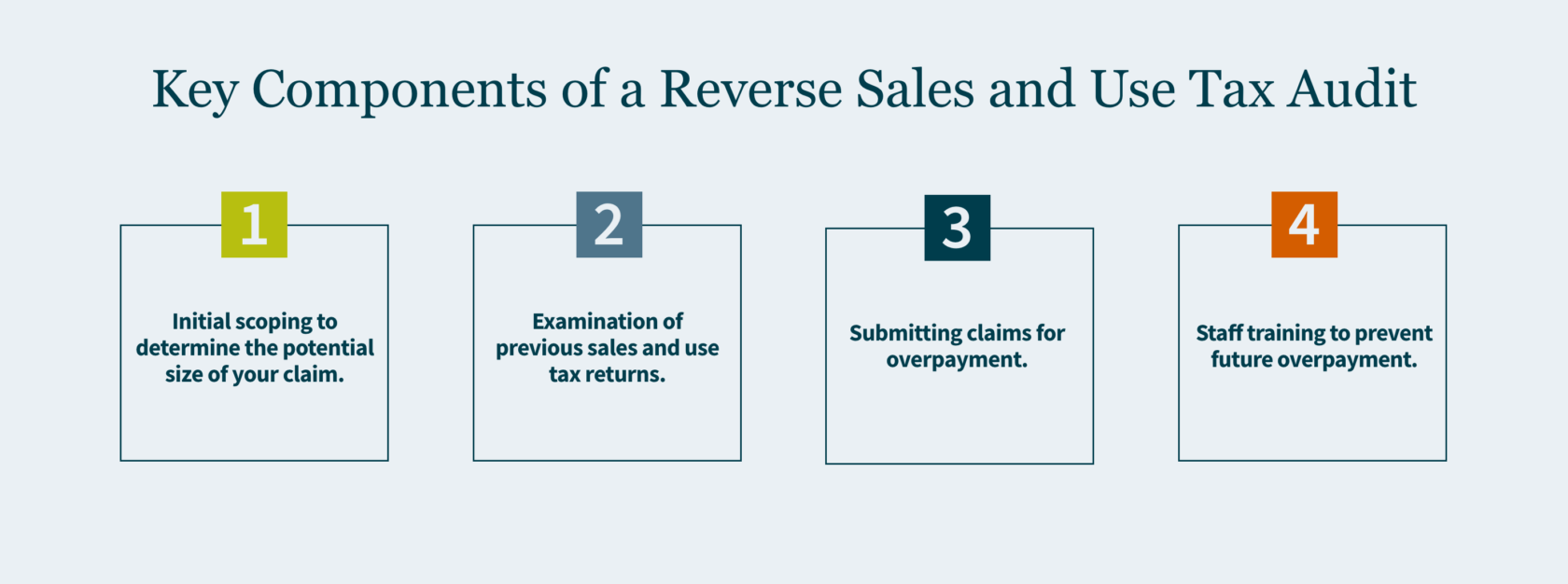
While the term “audit” might have a negative connotation for business owners, a reverse audit isn’t about uncovering wrongdoing but helping your organization locate and uncover potential savings. Although the specific steps for a reverse sales and use tax audit will depend on your business’s unique attributes, the process typically looks something like this:
- Initial scoping to determine the potential size of your claim. We gain an understanding of your business, the jurisdictions you operate in, and your purchasing processes to determine how you were charged tax by vendors and estimate the potential refund we might be able to claim as a result of the reverse audit.
- Examination of previous sales and use tax returns. We review your past returns, invoices, accruals, and other documentation to identify discrepancies and potential overpayments. This involves a line-by-line analysis to confirm tax calculations align with the prevailing tax laws and detect instances where sales tax was paid on non-taxable items or where full- or partial-tax exemptions were overlooked. We also confirm valid exemption certificates are in place and have been correctly applied to qualifying transactions.
- Submitting claims for overpayment. We prepare and submit refund claims to the relevant authorities (keeping in mind the statute of limitations periods, which can vary from state to state). Each state has its own forms and procedures for submitting refund claims. Refunds can also offset audit assessments from state and local governments. This reduces the liability imposed and lowers the amount on which penalties and interest are calculated.
- Train your staff. Finally, we train your team members to identify potential tax-exempt purchases and how to be sure vendors do not charge tax on exempt items. We also provide instruction on proper tax exemption certificate documentation and storage in the event of a future state tax audit. This helps make sure your organization won’t overpay sales and use taxes going forward.
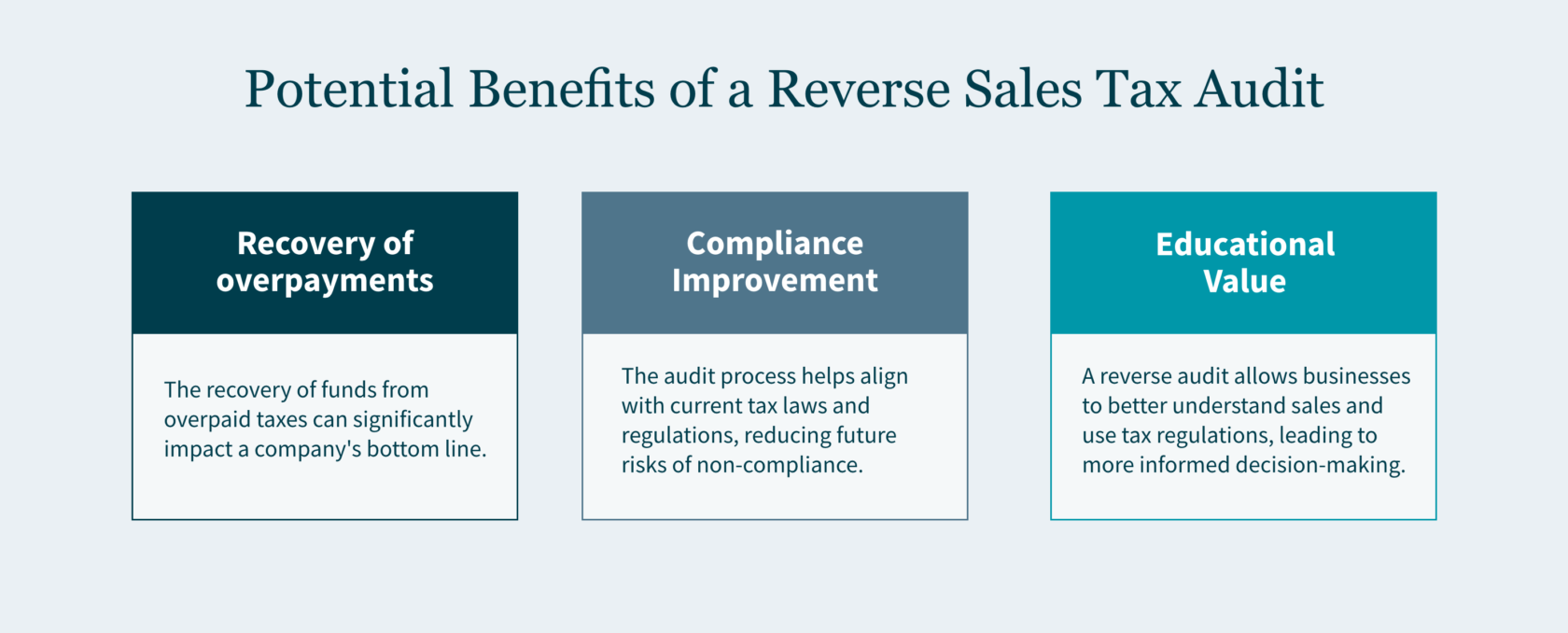
- Recovery of overpayments: The primary benefit is the recovery of funds from overpaid taxes, which can significantly impact your company’s bottom line.
- Compliance improvement: The audit process helps align with current tax laws and regulations, reducing future risks of non-compliance.
- Educational value: A reverse audit helps businesses better understand sales and use tax regulations, leading to more informed decision-making.
Potential Benefits of a Reverse Sales Tax Audit
Key benefits of a reverse audit include:
How MGO Can Help
A reverse sales tax audit is not merely a financial recovery tool but a strategic approach to confirm compliance and optimize tax positions.
To explore how a reverse sales tax audit can benefit your business, contact MGO today. Our team of professionals can discuss your company’s purchases, potential exemptions, and the reverse audit process to determine whether the potential financial opportunities outweigh the time and effort required for the audit.
]]>The SEEF tax rate is $1.10 per ounce of adult-use cannabis sold. New Jersey cultivators must also file the SF-100 monthly tax return to report the amount of usable ounces sold for the adult-use market (even if no sales or transfers of cannabis occur).
This first SEEF payment will cover less than two weeks of the sales made from the start date on March 18, 2022. Moving forward, the SEEF payment is always due by 11:59 p.m. on the 20th day of the month after the end of the previous filing period. If the due date falls on a weekend or legal holiday, the return and payment are due the following business day.
Letters with instructions for making the tax filings were sent out to the licensees in early May.
Some technicalities to keep in mind as you prepare to file:
- Medical cannabis is NOT subject to SEEF.
- SEEF is solely imposed on the Cultivator and is not due again on sales from manufacturers, processors, or retailer sales.
- It will not be paid again at another license level, regardless of whether the cannabis is later for sale as-is or if it has been converted to edible form.
- All cannabis types and categories are subject to the same SEEF rate when sold by a cultivator, no matter the strain, potency, trim or shake — anything that falls under the definition of “usable” cannabis.
In addition to the SEEF, NJ Cannabis operators will also need to contend with sales taxes and locally imposed gross receipts taxes:
- Retail sales of recreational cannabis are subject to the state’s ordinary sales tax under N.J.S.A. 54:32B-3(a). Sales of medical cannabis are not subject to sales tax, but are subject to a special 2% tax until the end of June.
- Depending on the locality, cannabis operators may be subject to the following gross receipts tax rates:
- Cultivation, Manufacturer, Retail – 2%
- Wholesale (Distribution) – 1%
- Returns are generally due quarterly in April, July, October, and January.
If you have any questions about calculating or paying NJ cannabis taxes, or any other state’s cannabis tax, please reach out to our leading cannabis tax practice.
]]>Details of California’s nexus law
California used the South Dakota law as a relative guide, where the threshold – or nexus – for collecting taxes by online retailers begins once sales reach $100,000 or 200 transactions in the state. California instructs retailers to begin collecting the 7.25% state tax on the sale of tangible personal property for delivery into the California once sales reach $500,000, but with no transaction threshold.
Furthermore, Special Notice L-591 was issued by the CDTFA to also take effect on April 1. This notice requires retailers to collect local use taxes once a threshold of $100,000 or 200 transactions has been reached within that locality or district, regardless of sales or transactions in another district within the state.
Another component of the new law addresses the sale of goods to California residents through platforms such as Amazon, eBay, Etsy and others, where the platform or “marketplace” facilitates the transaction. The marketplace facilitator must register as a seller with the CDTFA, collect sales tax on behalf of the seller, and remit the tax to the California tax department. This particular phase of the law is not scheduled to become effective until October 1, 2019.
Although the new California law will undoubtedly impact many online retailers, there is a provision that may provide some relief to smaller businesses. The temporary provision states that for businesses selling tangible personal property into California that is less than $1 million through the tax period ending December 31, 2022, taxes and fees may be waived by the CDFTA if the retailer registers with the state and was not required to do so prior to the law becoming effective.
More complications for retailers
It is estimated that anywhere from $1 billion to $2 billion of tax revenue went uncollected from out of state retailers and that the new law could provide an additional $500 million in tax revenue to the state.
Much of this depends on how simple California makes the tracking, reporting and payment of tax revenue by online retailers. While the collection of revenue based on a single, state-wide tax rate might be simple enough, the additional district taxes may potentially add complexity to the issue, making it more difficult to collect. Some states are offering allowances when retailers use automated tax software to track and collect taxes and not holding the retailer accountable if mistakes are made due to the software. This may be relatively easy at the state level but difficult at the district level, as every address must adhere to the latest zoning requirements for specific districts while also ensuring alignment according to the tax software being used.
What consumers must understand
For consumers in California, there may not be a significant change in the rate in which they buy online, as many are already paying sales tax on goods purchased this way. Any concern consumers have regarding a revoking of the Internet Tax Freedom Act (ITFA) should be alleviated, as the ITFA only prohibits states from levying tax on internet access, not the sale of tangible personal property.
It is likely that California will see additional tax revenue with the implementation of this new law. How much revenue will remain to be seen, especially with the $500,000 threshold as well as the provisional leniency for smaller businesses until 2022.
]]>