- Internal controls, especially around fraud prevention, are essential for limiting losses, driving efficiency, improving accountability, and boosting company value during investments or M&A deals.
- The “tone at the top” from leadership in fostering an ethical environment, along with proper segregation of duties, are key elements for fraud prevention and strong internal controls.
- Well-established policies and procedures, like Delegation of Authority rules and restricted system access protocols, are also vital for maintaining adequate controls to enable company growth.
~
As the economy stands on shaky legs, private equity and venture capital firms are necessarily careful and strategic when assessing potential investment opportunities. Whether your long-term plan includes acquiring another company, selling your business, or seeking new capital, strengthening your internal control environment — with a focus on preventing fraud — is a powerful way to increase actual and perceived value.
In the following, we will lay out the reasons why fraud prevention is an essential element to proper corporate governance and illustrate key areas to examine whether your internal control environment is built to help your operation succeed.
The Importance of Internal Controls in Fraud Prevention
A robust internal control system is the first step toward managing, mitigating, and uncovering fraud. A strong internal control environment will:
Protect your company’s assets by reducing the risk of theft or misappropriation of cash, inventory, equipment, and intellectual property.
Detect fraudulent activities or irregularities early on and deter employees from attempting fraud in the first place.
Provide cost savings by limiting opportunities for financial losses, costly investigations, and legal expenses associated with fraud.
Drive operational efficiency by providing clear processes and guidelines that reduce the risk of errors or inefficiencies in day-to-day operations.
Improve employee accountability by implementing checks and balances that discourage unethical behavior.
When seeking an investment or undertaking a significant M&A deal, you should have a firm grasp of the strength and quality of your internal control environment. Not only will you reduce the risk of fraud in the near term, but you will also cultivate confidence with potential investors and M&A partners.
Fraud Prevention Starts with the “Tone at the Top”
The first key element to look for in measuring the strength of your internal controls is ensuring a clear and proactive “tone at the top”, meaning an ethical environment fostered by the board of directors, audit committee, and senior management. A good tone at the top encourages positive behavior and helps prevent fraud and other unethical practices.
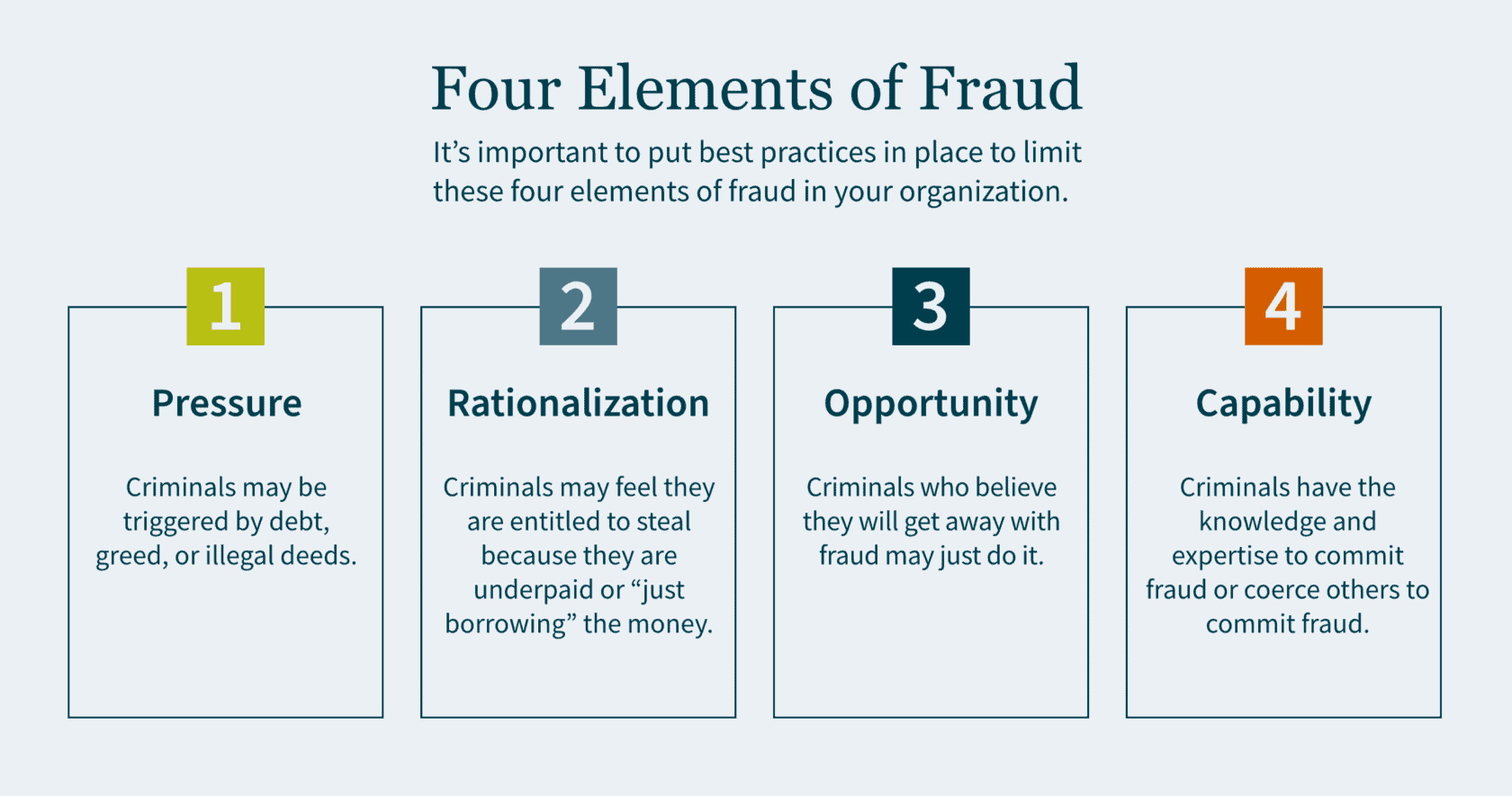
There are four elements to fraud: pressure, rationalization, opportunity and capability.
Pressure motivates crime. This could be triggered by debt, greed, or illegal deeds. Individuals who have financial problems and commit financial crimes tend to rationalize their actions. Criminals may feel that they are entitled to the money they are stealing, because they believe they are underpaid. In some cases, they simply rationalize to themselves that they are only “borrowing” the money and have every intention of paying it back.
Criminals who can commit fraud and believe they will get away with it may just do it. Capability means the criminal has the expertise as well as the intelligence to coerce others into committing fraud. The board of directors is responsible for selecting and monitoring executive management to ensure best practices are in place to limit the motivations of all four elements of fraud.
Proper Segregation of Duties for Internal Controls
The second key element to look for in your internal controls is a well-established segregation of duties. The idea is to establish controls so that no single person has the ability that would allow them the opportunity to commit fraud. Companies must make it extremely difficult for any single employee to have the opportunity to perpetrate a crime and subsequently cover it up.
Fraud Controls
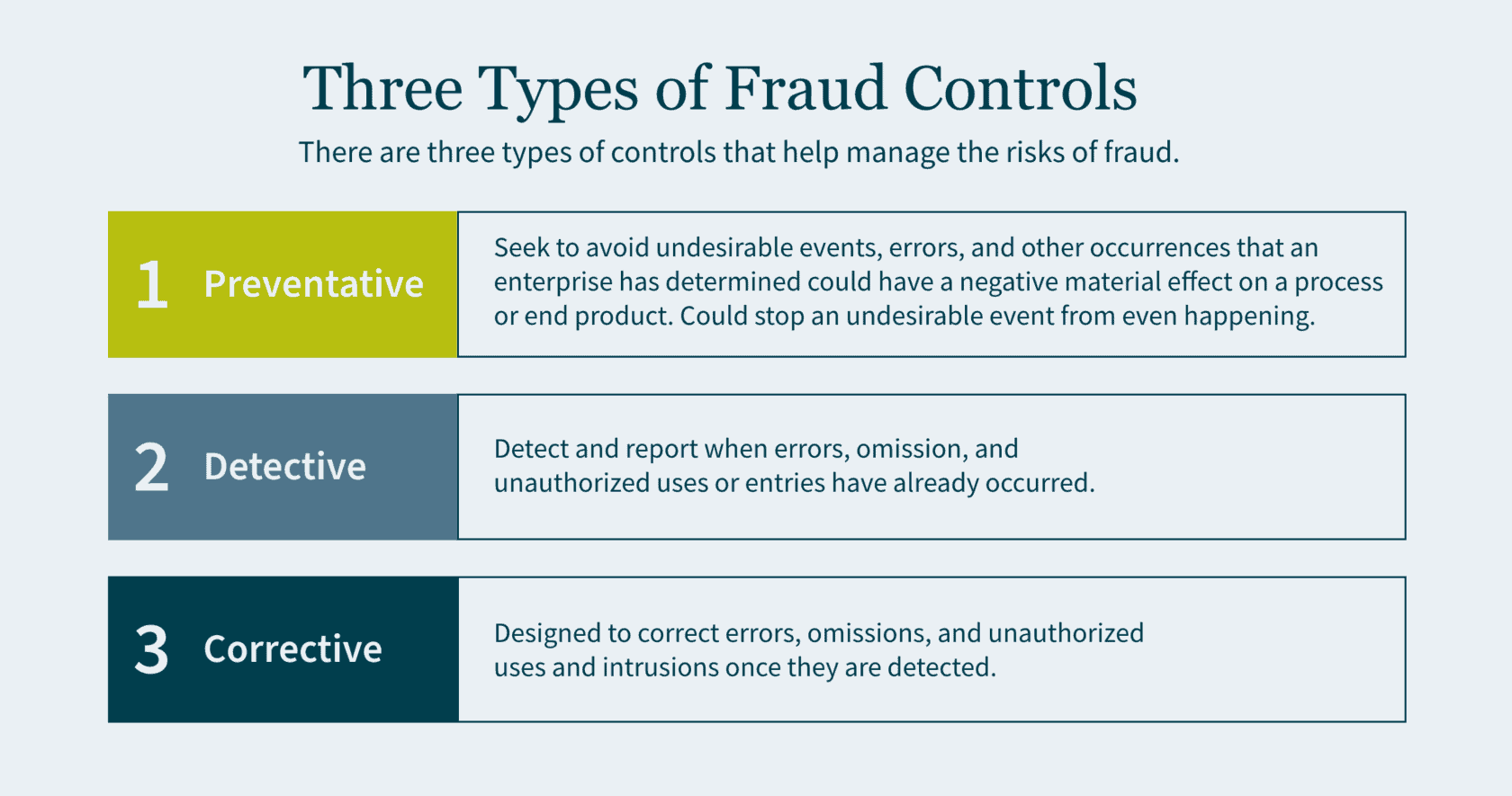
There are three types of controls that help manage the risks of fraud: preventative, detective, and corrective.
- Preventative controls seek to avoid undesirable events, errors, and other occurrences that an enterprise has determined could have a negative material effect on a process or end product. Preventative controls are the best of the three as they are the first line of defense and a backstop to fraud. If designed correctly, preventative controls stop an undesirable event from even happening.
- Detective controls exist to detect and report when errors, omission, and unauthorized uses or entries have already occurred. Although it is important to identify these adverse events, you are doing so after the fraud has already been committed.
- Corrective (also referred to as compensating) controls are designed to correct errors, omissions, and unauthorized uses and intrusions once they are detected.
Preventing Misappropriation of Assets
An important component of segregation of duties is to prevent the misappropriation of assets and reduce fraud risk. Below are some examples of best practices for various types of assets:
- Cash Receipt: segregate the receipt of cash/checks and the recording of the journal entry in the accounting system into two roles.
- Accounts Receivable: segregate the responsibilities of recording cash received from customers and providing credit memos to customers. (If one person performs both functions, it creates the opportunity to divert payments from the customer to the employee and then cover the theft with a matching credit to the customer’s account).
- Cash Reconciliation: the individuals who authorize, process, or record cash should not perform the bank reconciliation to the general ledger.
- Inventory: individuals who order goods from the suppliers should not have the ability to log the goods received in the accounting system.
- Payroll: segregate the responsibilities of compiling gross and net pay for payroll, with the responsibilities of verifying the calculation. (If a single individual performs both functions, it allows for the opportunity to increase personal compensation and the compensation of others without authorization. It also provides an opportunity to create a fictitious payee and make corresponding payroll checks).
The Importance of Policies and Procedures
The third key element to look for in your investees is well-established policies and procedures. Make sure that any company you consider acquiring has basic policies and procedures in place, such as Delegation of Authority (DOA).
The DOA is a policy where the executive team delegates authority to the management of the company. Individuals should be considered appropriate to fulfill delegated roles and responsibilities. The DOA should be reviewed at least annually. Subsequently, it is important to ensure that the DOA is being followed, and that approvals do not deviate from it. Any such anomalies should be rare and, when they do occur, they need to be reviewed and approved. Constant deviations from the DOA may be a sign that the DOA needs to be restructured.
A second essential policy and procedure is restricted computer and application access. This is to protect sensitive company financials and proprietary data. The company should have a robust control environment and maintain computer logins and password access on a need-to-know basis. Access should only be granted by the owner of the application or system and subsequently logged by the administrator. Now more than ever companies are hiring remote employees. This shift in the dynamic workspace further emphasizes the need for a quality IT controls environment.
How We Can Help
As you prepare your company for future growth, getting an impartial third-party opinion on your internal control environment can be a powerful tool for finding gaps and inefficiencies, and implementing value-added changes.
Our dedicated Public Company teams offer a deep level of industry experience and technical skills. We can help prepare your company for a major capital raise, including going public via an IPO or RTO. Or we can help optimize value for an M&A deal, whether you are buying or selling. Contact us today to access an external, holistic vision focused on helping you grow and succeed
]]>- State and local governments need defensive strategies to protect against risks like fraud, financial loss, and reputational damage, and checks to ensure those strategies are working.
- The Three Lines Model executes three levels of protection designed to prevent risks from disrupting your operations and causing damage or loss.
- As the third-line defense, internal auditing analyzes the entire field to identify potential weaknesses and ensure your defensive strategies are effective at averting risks.
~
At the start of the football season, sports analysts spend a lot of time talking about who will be the player to lead their team to a championship. Yet, as we learn year after year, championships are not won by a single player. It is a collective effort, based on an assembly of individuals pooling their talents together in pursuit of a common goal.
In sports, the common goal is a championship. In business, the goal is to generate profit by establishing customer loyalty for your products or services. In government, the goal is to make our communities ideal places to live, work, and play. To win in all these instances, you need a strong team with contributions from every player.
Football fans often hear the refrain, “offense wins games, but defense wins championships.” Government teams looking to achieve their goals should not overlook the necessity of a robust defense — with internal auditing giving you the upper hand over your opponent.
What is Internal Auditing?
According to The Institute of Internal Auditors (IIA), internal auditing is an independent, objective assurance and consulting activity designed to add value and improve an organization’s operations. Internal auditing provides a systematic approach to evaluating and improving the effectiveness of governance, risk management, and controls processes.
To simplify: Your organization has goals (objectives). However, obstacles (risks) may exist that keep your organization from reaching its goals. You should develop strategies (internal controls) to prevent those obstacles from occurring, and continuously check to make sure your strategies are working properly (monitoring). To avoid confirmation bias — where you only seek and accept information that supports your goals — you should seek validation from an objective entity (internal audit) to evaluate if your strategies truly position your organization to succeed.
To accomplish all this, you need a coalition of talented individuals that can identify risks, strategize against them, prevent or detect risk infiltration, and consistently monitor emerging risks to provide guidance on how to stay ahead of the curve. In football terms, you need a strong defensive line!
Three Lines of Defense
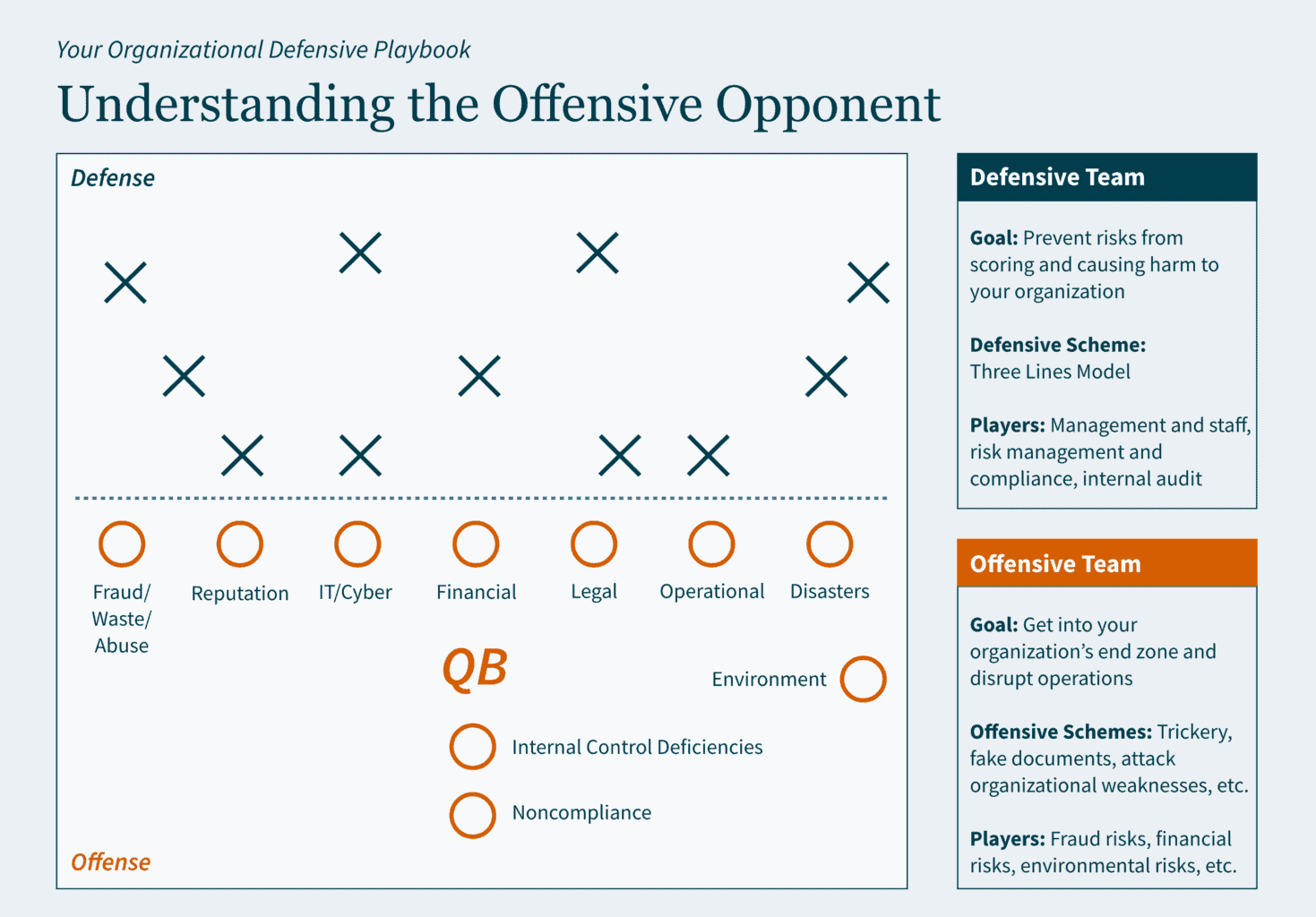
Let’s say that risk is the offensive team. Its goal is to get into your organization’s end zone to disrupt operations. The quarterback could be a hacker, fraudster, or unintentional human error. The offensive team also has other formidable players: fraud risks, cyber-attack risks, liquidity risks, etc.
Organizations need a more skilled, agile, and experienced defensive team to counteract the activity of the risk offense. Enter IIA’s Three Lines Model. This defensive strategy executes three levels of protection designed to keep risk from causing extreme financial or other damage.
The Three Lines Model defines defensive roles and responsibilities as follows:
- First Line of Defense – develops strategies to address risks
- Second Line of Defense – monitors strategies
- Third Line of Defense – provides assurance that strategies are truly effective at mitigating risks
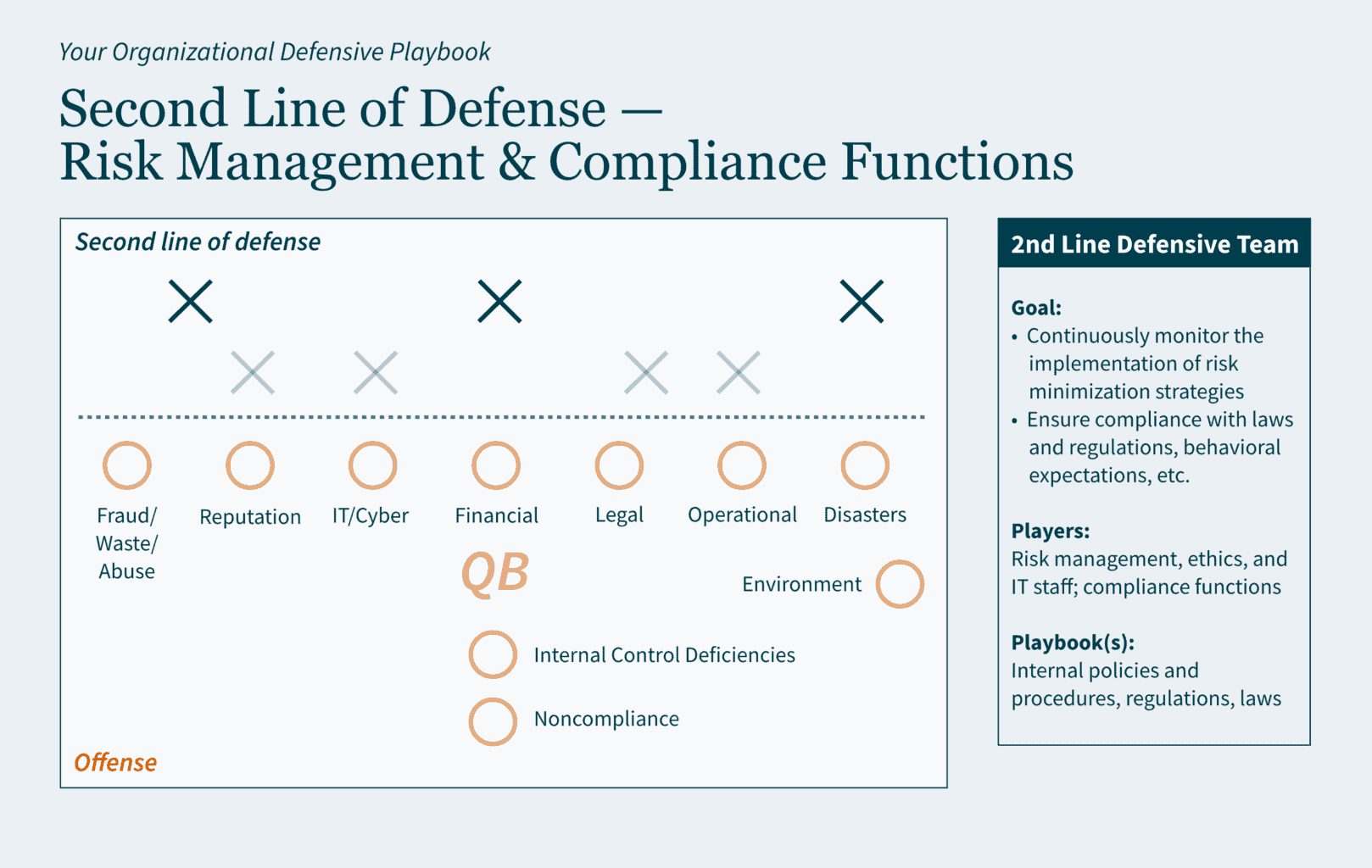
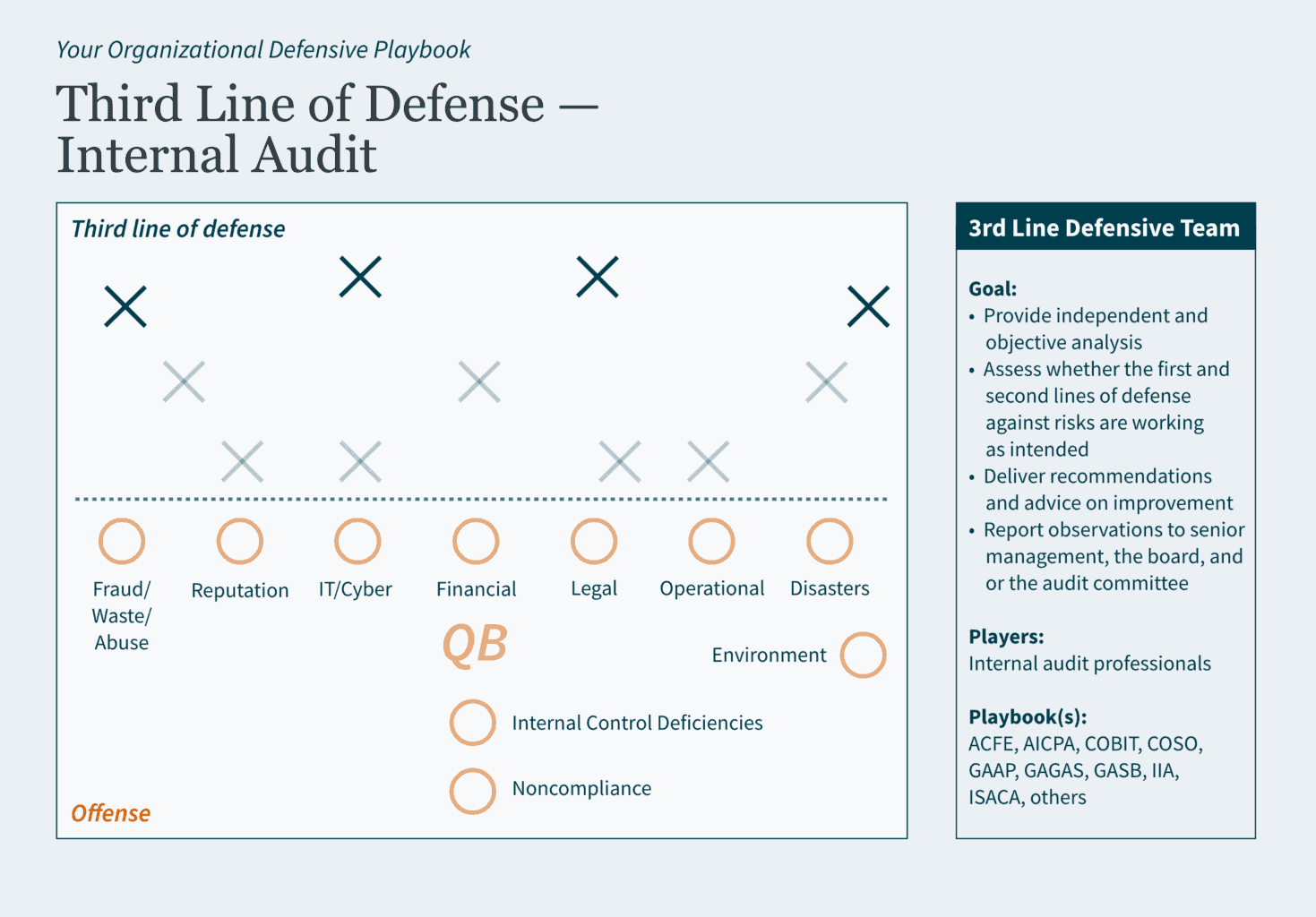
Let’s look at the organizational playbook to understand the goals of the offensive and defensive teams and the Three Lines defensive strategy.
Understanding the Offensive Opponent
Organizations are trying to prevent risks from disrupting operations and causing financial and/or other damages. If the risk team scores in your end zone, that means they have exposed a weakness in your organization. Depending on the weakness, it could cost you a little (inefficient operations) or it could cost you a lot (major cyberbreach with financial and reputational damages) … but it will cost you!
Defining Each Line of Defense
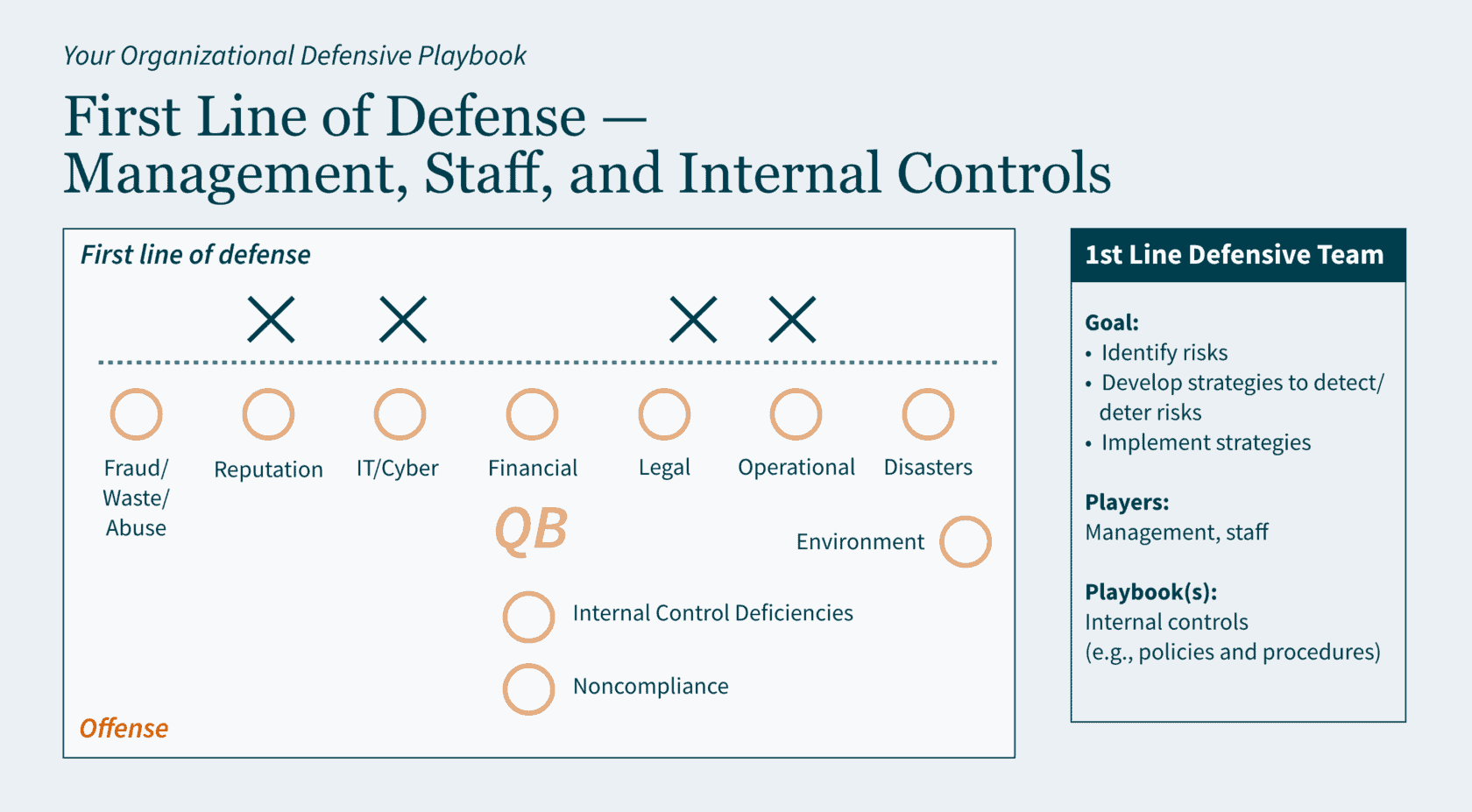
First Line of Defense: Management, Staff, and Internal Controls
The first line of defense consists of the organizational staff associated with daily operations, delivery of goods and services, and identifying and addressing risks. For example, to minimize the risk of hacking via password breaches, this line would create a password policy and accompanying procedure, set up systems requirements accordingly, and follow the policy and procedures in daily operations.
Second Line of Defense: Risk Management and Compliance Functions
The second line of defense consists of the organizational staff that monitor your organization’s adherence to its own policies and procedures and other required guidance (e.g., regulations, laws, etc.). For example, to ensure that your organization is following its policies and procedures for minimizing hacking via password breaches, this line would periodically analyze data to ensure compliance with internal guidance, industry best practices, etc.
Third Line of Defense: Internal Audit
The third line of defense consists of internal audit professionals with knowledge in various industries. Internal audit conducts real-time assessments and communicates any weaknesses in the first two lines. Using the prevention of hacking example from above, in addition to assessing password protocols and practice, internal audit may identify that your organization has improper access controls that increase the risk of hackers infiltrating your organization’s systems. Internal audit would provide recommendations for improvement and express urgency for corrective action.
Defensive Benefits of Internal Auditing
Internal audit is not an adversary, it is part of your team. Internal audit collaborates with your management and staff, in real time, to understand your organizational goals, concerns, strengths, and weaknesses. Where external audit provides your management with an analysis of a snapshot in time, internal audit continuously and systematically provides value-added feedback to your management and your board and/or audit committee.
Internal audit assists with ensuring your organizational playbook(s) remain relevant. As the third or last line of defense, it analyzes the entire field (the organization) to make sure your defensive strategies (internal controls) are effective at averting risks from scoring (causing financial, operational, reputational, etc., losses).
Part of the analyses conducted by internal audit include (but are not limited to):
- Conducting risk assessments to identify the likelihood and potential impact of risks to assist the organization in focusing resources on prioritized areas for improvement.
- Assessing your information technology and cybersecurity environments to identify and advise on protecting organizational data, improving IT infrastructure, preparing disaster recovery strategies, etc.
- Assisting in preparing for external audits by assessing if the organization’s financial statements are accurate, complete, compliant with regulations, and free from material misstatement.
- Conducting performance assessments to identify areas for efficiency and effectiveness improvements.
Internal audit strengthens your organization’s improvement efforts by bringing reinforcements to your already stellar team. The internal audit group delivers additional resource capacity, skills, and perspectives — including extensive knowledge about various industry standards as internal audit professionals are required to maintain continuing education in their specific areas of focus.
How MGO Can Strengthen Your Team’s Defense
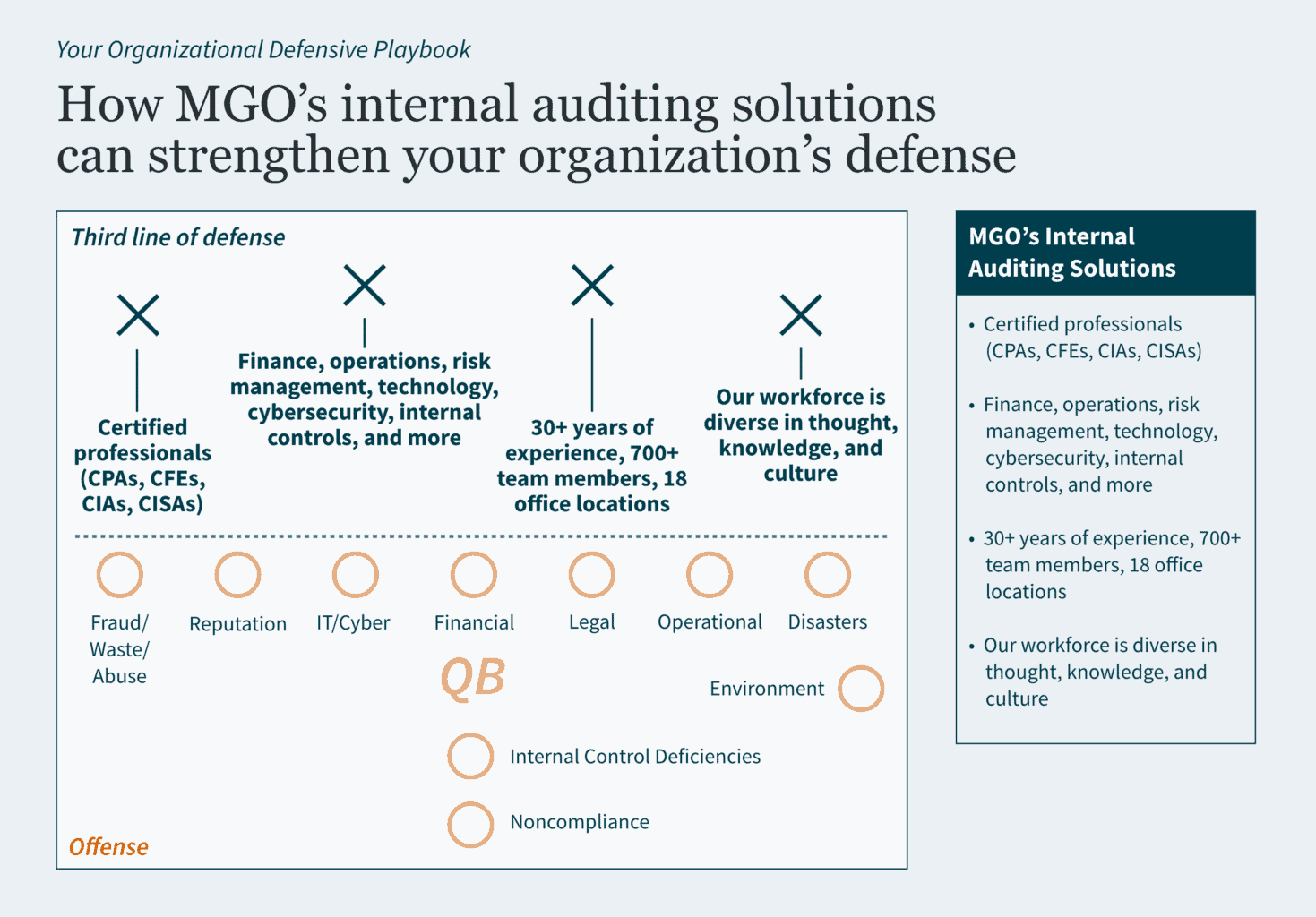
MGO has a defensive line that is ready and motivated to support your organization. Stacked with professionals experienced in areas like state and local government, fraud, audit and assurance, government audit, and cybersecurity, our team is diverse in thought, knowledge, and culture — and we bring those perspectives to the field for you. Contact us today to learn how our internal auditing solutions can boost your organization’s defense.
Executive Summary:
- The Sarbanes-Oxley (SOX) Act established stricter financial reporting requirements for public companies, leading to increased scrutiny of Information Produced by the Entity (IPE).
- IPE carries different levels of risk depending on whether it is system-generated and manually prepared IPE. Strong documentation is key to validating completeness and accuracy of IPE.
- Best practices for IPE documentation include identifying the source, parameters, and format of reports; validating totals and counts; retaining screenshots; and having knowledgeable reviewers.
~
Passed by Congress in 2002, the Sarbanes-Oxley (SOX) Act revolutionized public company audits by introducing financial reporting requirements aimed at increasing transparency and preventing fraud. Most notably, the SOX Act established the Public Company Accounting Oversight Board (PCAOB), a nonprofit organization that oversees the audits of public companies to protect investors and further the public interest in the preparation of informative, accurate, and independent audit reports.
The PCAOB refines its auditing standards annually and, in recent years, the organization has placed greater scrutiny on the work of external auditors. To keep up with PCAOB compliance, external auditors have imposed more rigorous documentation requirements on companies. As a result, companies have felt pressure to provide more expansive Information Produced by the Entity (IPE).
If external auditors have applied greater scrutiny on your reporting, you may be wondering: What level of documentation is sufficient? How can you improve your documentation to avoid deficiencies and provide greater clarity? In this article, we will discuss: 1) what IPE is, 2) the risks associated with different IPE, and 3) how to document your IPE thoroughly.
What is IPE?
IPE is any information created by a company used as part of audit evidence. Audit evidence may be used to support an underlying internal control or as part of a substantive audit. Although there are documentation and risk severity differences between system-generated and manually prepared IPE, the fundamental questions that need to be addressed are the same:
- Is the data complete?
- Is the data accurate?
Risk Levels of Different IPE
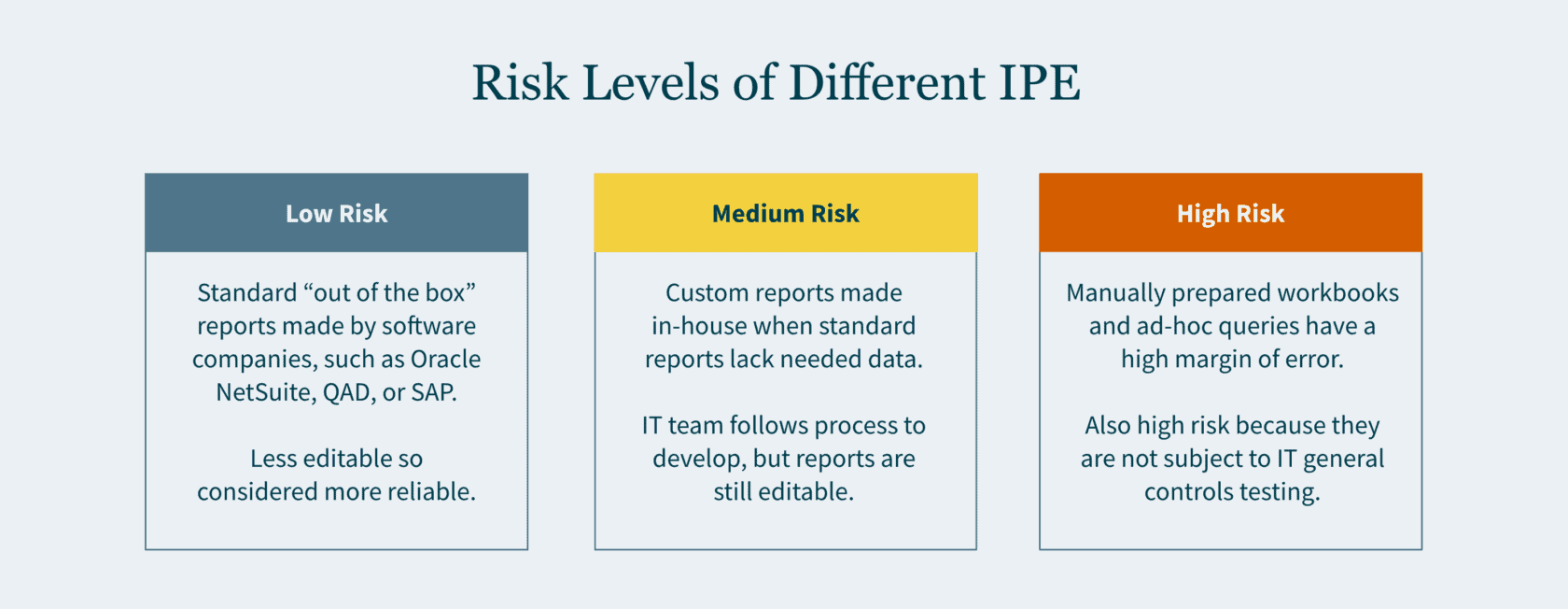
Here is an overview of how risk levels vary for different types of information you report to auditors:
Low Risk
“Out of the box” reports carry the lowest risk. These reports are also referred to as “standard” or “canned” reports. Standard reports have been developed by software companies — such as Oracle NetSuite, QAD, or SAP — as part of their enterprise resource planning (ERP) systems. Typically, the end user (you) and even your IT team cannot modify these reports. Given the constrained editability, greater reliance is placed on these reports.
Medium Risk
Custom reports are typically driven by the business team and developed in-house by your company’s IT team. When your company’s ERP system does not have a report that would provide sufficient data, the in-house developers create a custom report. The IT team follows their change management process when developing the request report. If the report results do not align with your business team’s expectations, the query is refined, and the process is repeated until it does.
High Risk
A manually prepared workbook or an ad-hoc query are inherently the riskiest documentation. A manually prepared workbook may be a debt reconciliation prepared by your staff accountant, or a list of litigations the company is involved in drafted by your legal department. Given that these are manually drafted, the margin of error may be high.
An ad-hoc query is considered high risk since the report is not subject to IT General Controls (ITGC) testing. The end user may input any parameters to generate the report. Since no control testing is performed by your company, external auditors would need to rely on their own IT team to vet the nonstandard query.
How to Document IPE?
Your documentation will vary to a certain degree depending on whether the IPE is manually prepared or system generated. In either case, it is important to be as thorough as possible when documenting your procedures.
Manual IPE
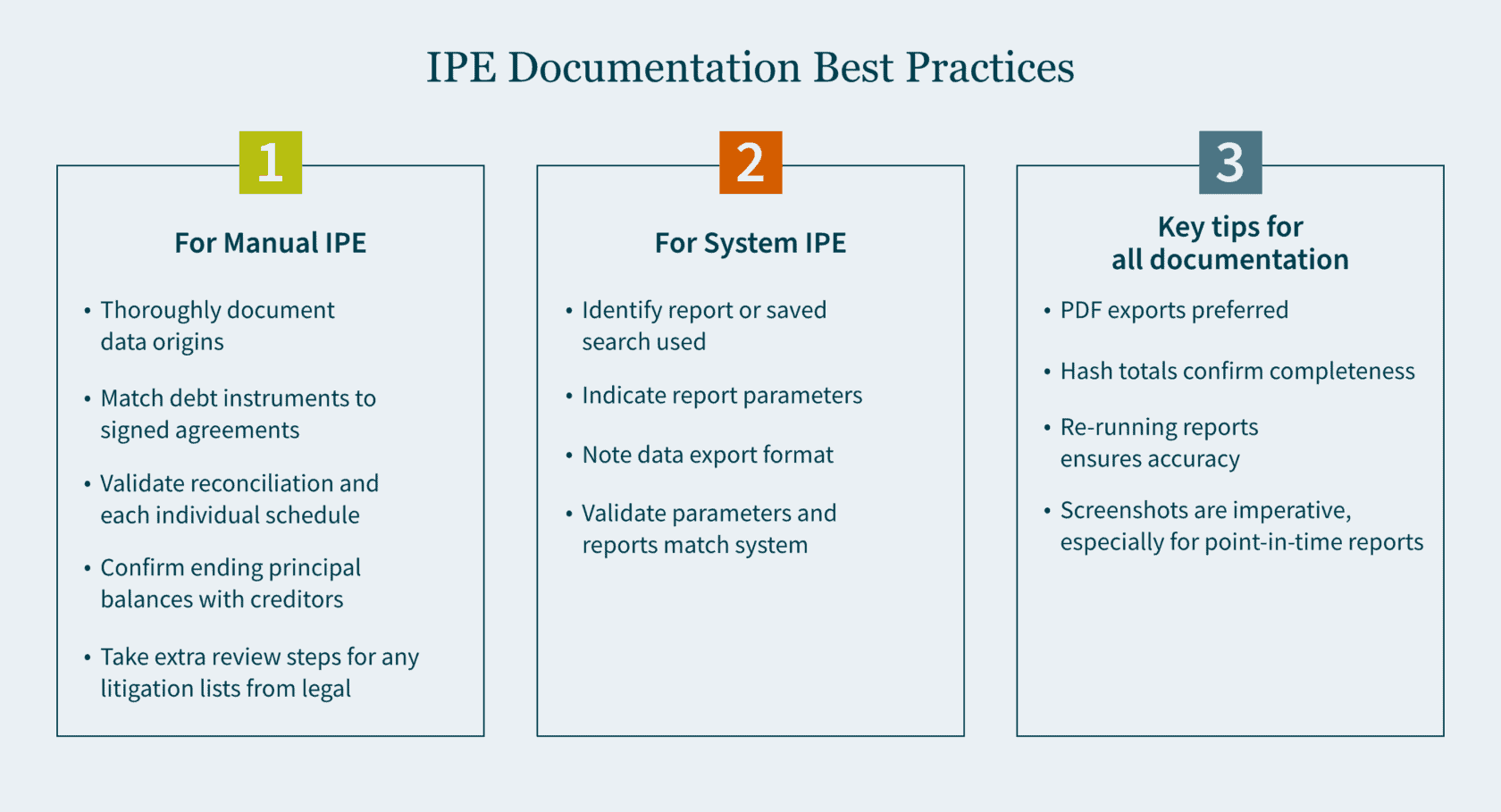
For a manually prepared workbook, provide thorough documentation about the origins of the data. It is ideal to have someone who is privy to the information review the workbook.
When the reconciliation is comprised of debt instruments, the reviewer should do the following:
- Match the list of individual debt instruments to the signed agreements.
- Validate the reconciliation and each individual schedule for mathematical accuracy.
- Confirm ending principal balances with creditors (where possible).
If the list consists of litigations compiled by the legal department, the reviewer should do the following:
- Send confirmations to outside counsel (where possible).
- Obtain a list of commitments and contingency journal entries made to an accrual.
These additional steps provide greater comfort that the list compiled is complete and accurate.
System-Generated IPE
For system-generated IPE, there are a handful of questions to keep in mind:
- Have you identified the report or saved search that was used?
- What parameters were used to generate this report?
- In what format is the data exported?
- After you run your report and confirm the parameters are correct, what format should be utilized for your export?
Exported Data
Most ERP systems allow the exporting of data in the following four formats:
- PDF (portable document format)
- Excel
- CSV (comma-separated values)
- Text file
One major drawback in an Excel, CSV, and text file is that, by their nature, they are editable upon export. An additional drawback of a text file is that it does not contain formatting. As the volume of data grows, proving out the completeness and accuracy becomes more challenging. For these reasons, a PDF export is typically preferred.
After the data is exported in one of the four formats, you want to ensure that it agrees back to the system (completeness and accuracy). Here are a few ways to do that:
- Does the exported data have dollar amount totals? If so, agree the total dollar amount to the system.
- Does the exported data have hash totals? An example of a hash total is employee ID numbers which in aggregate have no real value other than providing confirmation that the data is complete and accurate.
- Does the report have a total line count? If totals are not available, line counts may be used. However, it is important to note that while the line count may agree, the data itself could have still been inadvertently manipulated.
Screenshots of Data
Retaining screenshots is imperative for documentation. A detailed screenshot should include some (if not all) of the following:
- Totals (dollar amounts, hash amounts, etc.)
- Lines count
- Parameters utilized
- Time and date stamp
The first three items validate the completeness and accuracy of the exported data. The fourth item confirms when the report was run and if it was timely. There are many reports that are point-in-time and may not be recreated at a future date. Knowing the constraints of the reports you use is important. Retaining screenshots cannot be overemphasized, especially for point-in-time reports.
Certain ERP systems or online portals do not provide a preview of the report prior to the export. This puts a constraint on the validation of completeness and accuracy, as it inhibits screenshots from being taken. In this case, as part of the review, the reviewer should re-run the report and validate that the original report used matches the information in the re-run report.
Strengthen Your SOX Compliance by Implementing Best Practices
There is no perfect science to IPE documentation. But the end goal is to be as detailed as possible. By simply focusing on the fundamental questions and ensuring that your documentation addresses them, your documentation will inevitably improve.
Developing best practices for your team is the cornerstone for any successful audit. Ensure you have the right guidance to make it happen. Our Audit and Assurance team can tailor a SOX environment to meet your needs. Contact us today to learn more.
]]>The coronavirus probably has not hit its peak yet, but every facet of daily life has already been affected. Many companies are actively reaching out to their customers to ensure operations will continue under the best of circumstances and as government regulations allow. For many companies this means supporting a widely spread remote worforce.
As we are already in the midst of this crisis, the chance for your firm to proactively prepare for disrupted operations has passed, but this does not mean there is nothing that can be done. Thanks to the plethora of cloud-based processing options, it is still possible to fully secure resources for the majority of your staff to work remotely. It may be more expensive right now, but that is still a better alternative than shuttering operations entirely. For companies that have already gone remote, you have probably deployed your remote desktop connections, trained your staff on remote conferencing options, and made sure your phone data plans are paid up for any type of mobile device solution you choose to use. Now that these features are fully deployed, this is a great time to review them for potential cybersecurity risk factors.
As is the case with on premise work, cybersecurity has no ‘one size fits all’ solution for remote environments. Each company is going to be different and will require its own strategy to mitigate risk. However, there are some basic steps companies can take to ensure that their cyber risk is limited as much as possible during this time of remote work.
Risks of relying on public internet
The single largest risk factor for remote work is the public internet that is being used by your staff to access your company data, but there are some simple steps you can take to mitigate risk from the largely unsecured public internet.
First and foremost is the securing and monitoring of all connections into your infrastructure. Think of all connections to your data, from any location, as a phone call. A device calls into the physical location of your data to access it, process it, and possibly transfer it to another location, much as you would see with a phone call or fax machine. The key is to identify the various points from which these devices can ‘call into’ your physical infrastructure and then limit the number of devices that can actually make this call. Identifying and securing the remote access points of your company data or network infrastructure is most likely the easier of the these two tasks as in most circumstances you should have near full control over the physical space in which your data storage device resides.
Establishing a secure infrastructure
From here, the simplest and most effective means of protection is to erect a firewall to keep out unauthorized calls. Step two is to do as much as you can to secure the connections that you want to allow through the firewall. The simplest means to accomplish this is through a Virtual Private Network (VPN) that will not only provide verification of the authorized connections past your firewall, but will also create a secure tunnel by which the call into your data can travel.
The VPN will compensate for most security provisions your staff’s at home internet might or might not have. From there, you will need to look carefully at which devices you actually will allow in through your firewall. It would be prudent to direct your technical team or IT Vendor to create a list of approved devices that is as small as possible. You should limit approved devices to company issued laptops and mobile handsets. You can expand this list to employee owned devices, but this should only be done with the advent of a Mobile Device Manager (MDM) solution. While a VPN will compensate for an insecure connection, an MDM will compensate for the lack of cybersecurity protection an employee owned device may or may not have. At this point, you might be asking, where can I find VPNs, MDMs, etc. Thankfully there are plenty of businesses on the open market that have these tools, and even technical staff, setup and ready to deploy and are just waiting for a company like yours to engage them for assistance. By employing these two relatively simple steps, your company can create remote work infrastructure that will significantly cut down on the risks of employees working from home over the open internet.
Vigilant infrastructure maintenance
Now that we have looked at what infrastructure should be put in place, we next need to look at how to properly maintain the infrastructure. As with the technical tools listed above, the market has plenty of Managed Service Providers (MSPs), such as MGO Technology Group, that are ready to engage and provide you with the technical staff and tools your company will need to effectively continue operations during this crisis. Make no mistake about it, your remote work environment is going to require some form of troubleshooting, either in the form of equipment malfunction or staff training on how to properly use the tools mentioned above. This is where having a good level one (L1) IT support staff comes into play in your cybersecurity strategy. In order to properly mitigate the risks of data breach or leakage, your staff will need to correctly use the tools you have put into place. Never underestimate how far a well-trained and well-equipped IT support staff can go in correcting the human errors not caught by your VPNs, Firewalls, and MDMs.
Access professional guidance
In order to weather this crisis or any over further disruption your company might experience, you are going to need good equipment and knowledgeable people to install and maintain this equipment. Finding, maintaining, and retaining the equipment and staff can be a difficult and time consuming endeavor. As mentioned above, you may want to consider engaging with technical MSPs who have the training and resources in order to install and maintain the infrastructure your company will need to not only allow your employees to work from home, but to also switch back to working on premise as soon as the situation improves.
For more guidance or to schedule a consultation, contact us here.
]]>Every organization needs a mobile device strategy for its employees. There is no way around it and there is no way to avoid it. Your organization must develop a clear policy for how your employees will use mobile devices to interact with your IT environment. Having no policy is no longer an option as it will open up your firm to exposure from so-called ‘Shadow IT’ as users will circumnavigate your IT infrastructure and e-mail documents over non-sanctioned channels so they can continue to work on their own mobile devices. Granted, a fully implemented mobile device policy may not eliminate these risks entirely, but it will go a long way toward reducing your organization’s overall risk exposure to a potential data breach. The first step of developing this policy is to answer a not so simple question; will your firm issue it’s own devices to employees or allow them to Bring Their Own Device (BYOD)?
Upsides and downsides of mobile device programs
There are two potential mobile devices programs; BYOD and Corporate Owned Devices (COD). Since every organization is unique, we do not intend to make a recommendation as to which strategy might be better. Our intent is to examine both polices and help you identify if one might be a better fit for your organization.
Before either of these programs is implemented, your organization will need Mobile Device Management (MDM) software. MDM is a crucial element to centrally manage and monitor any mobile devices that interact with your infrastructure. Your MDM must be in place before any device is allowed access to your network.
Examining a corporate-owned device policy
With COD your firm issues devices to your employees for corporate use and completely disallows the use of non-corporate device within your corporate infrastructure. Your firm takes responsibility for the devices’ setup, maintenance, and troubleshooting. While this policy does increase the setup time to make an employee fully ‘active’ within your IT setup, it allows for complete control of the hardware and associated software that is allowed within your firewall.
This setup has the advantage of having the lower overall security concerns of the two polices. You can chose every feature that is allowed on the device, right down to personal logons, and the actual applications allowed on the device. Since your organization owns the devices, they will already fall under any established guidelines the firm may have for governance of IT assets and thus minimize or eliminate the need for any extra work from your legal department to govern employee behavior.
While COD does allow for increased security and governance, it also has an overall higher price tag as your organization will be required to own every part of the mobile devices’ lifecycle — right down to maintaining a relationship with a cell phone provider to provide data services for the devices. As a result, the COD approach has the highest cost outlay between the two polices. COD will also have a higher cost to internal IT resources as they will be called upon to maintain the device inventory, train the users if needed, troubleshoot, reclaim the devices from departing employees, and repurpose them for the next user as you would with any other end user IT assets. This is time that your IT department could be dedicating to other activities so you will have to decide if you want to add this responsibility to their overall work load.
The benefits and downsides of “Bring Your Own Device” policies
BYOD, as the name states, allows your employees to add their own devices to your corporate infrastructure. This approach eliminates many of the costs listed above, such as the outlay needed to procure and maintain devices of your own along with the need to maintain data plans for the devices. However, given the variety of handsets available to users in today’s market your organization will have to spend more time setting up the actual policy to ensure your firm maintains a secure environment before actually rolling it out to your employees.
Beyond setting up the MDM, you will need to decide which devices, operating systems, and setups you will allow in your BYOD program. For example, you may be willing to allow iPhones and Samsung handsets into the program without additional security enhancements, but may require other Android based handsets to be encrypted before allowing them onto your BYOD program. You will have to designate a team to continuously evaluate new handsets as they reach the market to see what setup changes might be needed to allow these devices onto your program.
In addition to researching and choosing the allowed hardware policy, your firm will also have to establish the BYOD onboarding policy for each individual device operating system to be distributed to the users once they agree to join the BYOD policy. Your IT department will have to assist the users in onboarding the device and will have to continue to troubleshoot issues such as connectivity to corporate services such as e-mail. Finally, it will be necessary to establish a legal framework beyond your regular IT policy to define the parameters in which your company can monitor and administer the personal devices allowed onto your BYOD policy. Most companies accomplish this by working with their legal department to draw up an agreement to be signed by the user that establishes the rights of the company to monitor, administer, and if need be, completely wipe the device using the MDM.
The most prominent argument in favor of BYOD is that all the costs for resources listed above are up front. Once the MDM, policies, and procedures are in place you need only worry about updating them rather than activity implementing them as you would with a COD policy. All of the other associated costs with the device are still the responsibility of the employee. However, this is also the most prevalent argument against BYOD from a security standpoint. While the MDM and legal agreement will allow your IT department to monitor the device for any potential vulnerabilities, you will generally not be allowed to actively manage it. The onus will still be on the employee to ensure the device is properly updated and that no suspicious software is added to it. While your IT department would be able to inform the employee of suspicious software or activity within the device itself, the only true recourse you would have to protect your environment would be to remove the device from the MDM and thus from the BYOD program.
Making the right choice for your organization
Both programs have their advantages and drawbacks. Both allow for mobile access to various company resources such as e-mail and file sharing. However, there are differences to consider within each program regarding cost outlay, day to day maintenance, and overall security posture. Of course, neither of these polices are set in stone. Many companies are experimenting with a hybrid option that would allow employees to choose between a company device and joining a BYOD program in an attempt to fill the gaps present in both standalone programs. Each policy can be tailored to fit your company’s needs, but your IT department must make sure the proper back end work is done on both the MDM and the devices themselves to ensure that a proper IT security postured is maintained throughout your organization.
]]>What is the cannabis banking crisis?
Very simply put, the conflict between state and local cannabis laws that allow for adult- and medicinal-use of cannabis are in conflict with federal laws that categorize cannabis as a Schedule I controlled substance. As a result, major banking institutions are reluctant to provide traditional banking services to cannabis companies due to the risk of federal prosecution for money laundering or a variety of other offenses.
As a result, the cannabis industry is almost exclusively cash-based. Cannabis business operations – including payroll, rent/lease payments, vendor payments and taxes – are primarily conducted with cash. This results in hundreds of thousands of dollars in cash being moved between locations, simply to pay farms or manufacturers, or even to pay taxes. This inefficient system leads to a wide variety of issues, including significant operational difficulties, and growing risk threats from both untrustworthy employees and out right robbery.
Cannabis businesses have found a number of creative ways to navigate the banking issue. Some business restructure so a professional services firm, not directly touching the cannabis, provides payroll and other financial services. Shops and dispensaries have adopted a variety of debit or gift card payment systems. And finally, a handful of cannabis operators have established relationships with local credit unions willing to work with the industry. But the vast majority of cannabis operators must navigate daily risks related to the collection and remittance of large cash sums.
The banking crisis hearing
“We’re trying to examine how outdated banking regulations on the federal level are hindering reform on the state level when it comes to marijuana,” said Democratic Congressman Gregory Meeks, chairman of the Consumer Protection and Financial Institutions subcommittee, in advance of Wednesday’s hearing. The event brought together a wide range of affected parties, including representatives of credit unions and banks, cannabis industry advocates, and finally government officials advocating for responsible cannabis laws.
The hearing was called to discuss the Secure and Fair Enforcement Banking Act of 2019 (SAFE act). The bill was introduced by a bipartisan coalition that includes Colorado Democratic Rep. Ed Perlmutter, Washington Democratic Rep. Denny Heck and Ohio Republicans, Rep. Steve Stivers and Rep. Warren Davidson. The SAFE act seeks: “To create protections for depository institutions that provide financial services to cannabis-related legitimate businesses, and for other purposes.”
Cannabis banking advocates emerge
Prior to the hearing, the American Bankers Association offered public support for the SAFE act, stating in part: “Simply excluding legal state cannabis activity from the banking sector has not prevented the growth and spread of this industry, but providing access to the banking system could help facilitate public safety, streamline tax payments, and enable effective oversight in the states where voters have chosen to embrace cannabis legalization.”
Fiona Ma, Treasurer for the State of California, offered her support for the bill in a written testimony that reads in part: “an effective safe harbor mechanism in federal law promotes the safety of the public, improves the efficiency of collecting the taxes and fees we use to regulate the industry, and does not allow the banks and credit unions to totally abdicate their responsibilities to know their customers and avoid illicit money laundering.”
“(Current laws) encourage tax fraud, add expensive monitoring and bookkeeping expenses and—most importantly—leave legitimate businesses vulnerable to theft, robbery and the violence that accompany those crimes,” said Maj. Neill Franklin, Executive Director of the Law Enforcement Action Partnership (LEAP). He closed his passionate testimony by stating that the “safety of thousands of employees, business owners, security personnel, police officers and community members is in your hands.”
What can cannabis businesses do until laws change?
The primary purpose of the hearing was to create public momentum for a change in cannabis banking laws. The House Financial Services subcommittee heard hours of public testimony, largely in support of changing federal laws to support the cannabis industry. While nothing concrete emerged from the hearing, allowing so many influential advocates and politicians to publicly support the cannabis industry represents a major step-forward.
It will be a long process before any laws change, but in the meantime there are a number of legal actions a cannabis business can take to alleviate the stress of being denied traditional banking relationships. Most of these, including restructuring a business or implementing alternative payment systems, are complex activities that require professional guidance to execute successfully.
Additionally, there are a number of cash management solutions and internal controls all cannabis businesses should implement to limit opportunities for fraud and criminal abuse, both internally and externally. The MGO | ELLO Cannabis Alliance has long been an advocate for responsible practices regarding cash management in the cannabis industry. The Alliance provides a comprehensive suite of risk management solutions designed to promote operational best practices in the cannabis industry.
For more information or to arrange a consultation, please contact us.
About the author:
Linda Hurley is the leader of the MGO | ELLO Alliance Governance, Risk, and Compliance practice. She has over 20 years of experience providing risk advisory, compliance, accounting, internal audit, and auditing services to a wide variety of public and private companies. She is primarily focused on providing cannabis enterprises with a holistic view of their risk and compliance needs. She designs and implements internal controls, risk management procedures, and governance practices that support every level of a cannabis organization.
]]>