- A growing organization is a positive, but along with it usually comes increasingly complex financial accounting.
- Outsourcing provides businesses of all sizes with an opportunity to manage an array of issues — from staffing shortages or a lack of specific expertise to disorganized or unsecure financial records.
- Benefits of outsourcing include significant cost savings, direct access to specific accounting knowledge, the minimization of turnover, the ability to scale, access to tools and processes, and flexibility.
Many CEOs and business leaders are experiencing challenges in the aftermath of the COVID-19 pandemic, including changing customer trends, aggressive competition, emerging digital technologies, and the new normal of employee expectations for workplace flexibility.
These uncertain economic forces and cultural shifts are putting increased pressure on staffing for organizations of all sizes – especially fast-growing ones. While these difficulties are difficult to overcome, they are also an opportunity to change the “status quo” and level-up back-office performance.
For leaders navigating the uncertain tailwinds of the pandemic and planning to enter a new era of growth, outsourcing represents a powerful opportunity to address any staffing issues or business challenges. It empowers you to access specialized insight on a temporary basis, create value ahead of a major transaction, manage overhead costs, and modernize and revitalize business processes.
A recent study showed that 59% of all businesses utilize outsourced resources and that accounting is the most commonly outsourced function. So, how do you know if outsourcing your accounting function is right for your organization?
In this article we’ll look at five indicators that this strategy might be right for you and detail the key benefits to outsourcing or augmenting your accounting function.
Five signs your business may benefit from outsourced accounting
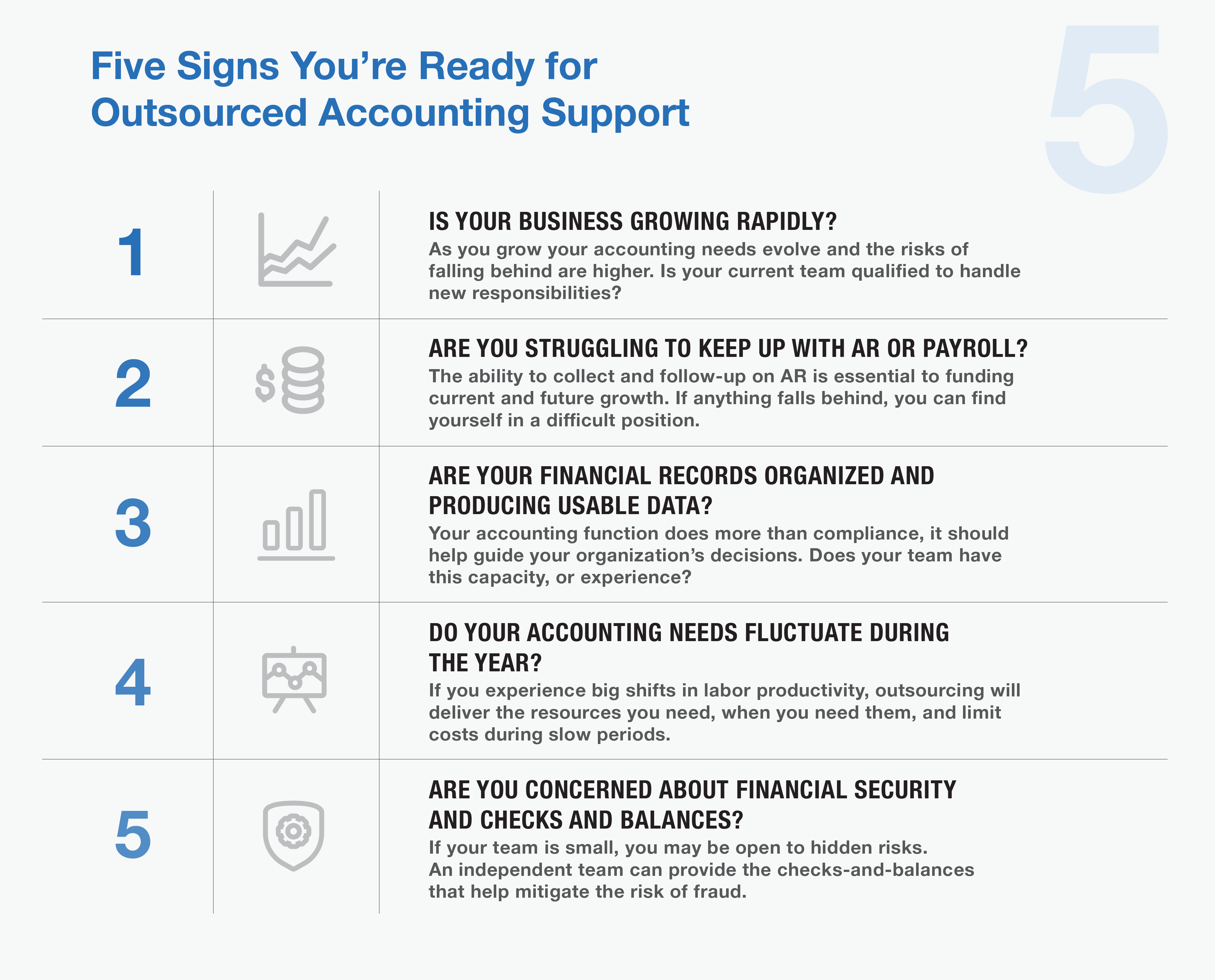
Here are some questions you should ask yourself to determine if your organization would benefit from outsourced accounting services:
- Is your business growing rapidly?
If you’re experiencing a significant influx of revenue, first off, great work! Your business model is proving out and you’re on the fast-track to success. But what is happening to your expenses, profitability and working capital? Depending on your answer it could mean that your accounting needs are evolving, the risks of a breakdown are higher, and overall, there is simply more at stake. It may be time to confirm that your current in-house team is qualified and staffed appropriately to handle these new responsibilities.
- Are you struggling to keep up with your accounts receivable or payroll?
One way to get a firm answer to whether your team is understaffed is if you’re missing key deadlines or struggling to get timely collection of cash from your accounts receivable. The inability to collect and follow-up on AR is essential to funding current and future growth and is directly connected to meeting your payroll commitments – one of the largest expenses of any business. If anything falls behind, you can find yourself in a difficult position if you do not have the ability to access cash or financing.
- Are your financial records organized and producing usable data?
Your accounting function does more than compliance, it should help guide your organization’s financial hygiene. Organized financials tell a clear story of earnings, spending, and investment, so you can make informed decisions. An over-worked or inexperienced accounting team will be working furiously to keep up with compliance and may not have the capacity, or necessary experience, to provide guidance on your financial scorecard to accrete value to the organization.
- Do your accounting needs fluctuate significantly throughout the year?
If your business experiences big shifts in labor productivity based on the calendar year and your taxes filings are late with significant overages from the tax preparers, or your audits have a significant number of adjustments, that may mean your accounting team lacks capability. Striking the right balance between hiring quality talent and the speed of bringing new hires up to date with company procedures can be a challenge. Outsourcing your team can deliver the resources you need, when you need them, and limit costs during the slower periods.
- Are you concerned about financial security and checks and balances?
If your internal accounting team is one or two individuals, you may be open to hidden risks. An independent team can provide the checks-and-balances that help mitigate the risk of fraud and asset misappropriation.
If you answered yes to any of these questions, you should consider outsourcing part or all of your accounting function. With an outsourced accounting team, you gain immediate access to trained, knowledgeable staff with the knowledge you need in technical accounting. The right outsourced resources can help your business grow faster and run more smoothly — often at a lower price than building an internal accounting department.
Benefits of outsourced accounting services
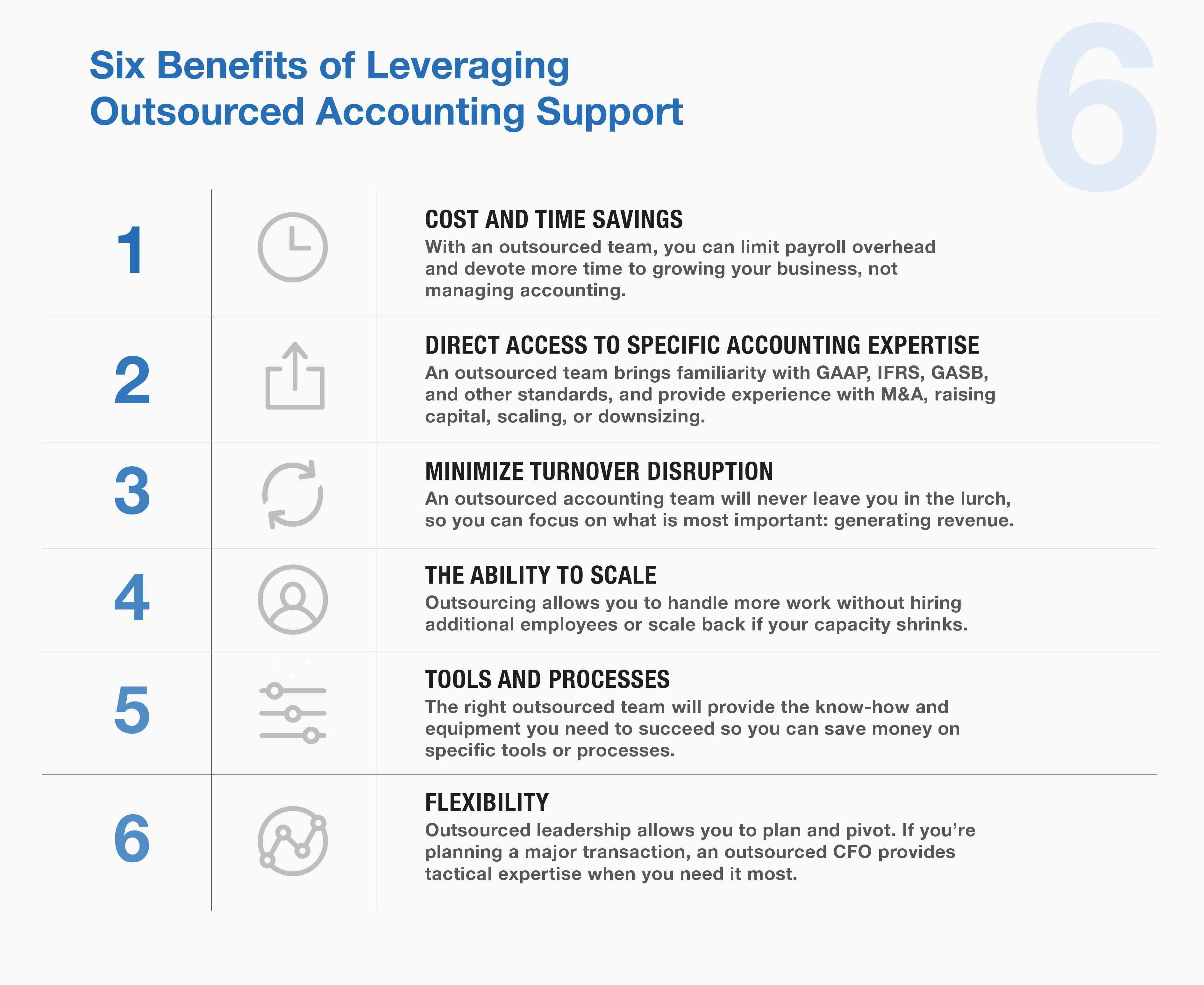
1.Cost and time savings
Maintaining full-time employees can be costly — and for most organizations, labor costs are some of the highest expenses. By relying on an outsourced team, you can devote your time to growing your business and spend less time managing accounting.
- Direct access to specific accounting expertise
Every company is different, which means every company’s needs are different. By outsourcing, you have access to the service you need when you need it. An outsourced team will bring familiarity with an array of accounting and reporting standards, including GAAP, IFRS, GASB, etc. Plus, they can provide specific experience with M&A transactions, raising capital, scaling, or downsizing operations.
- Minimize turnover disruption
In a smaller organization, each employee is vital to the business’s success. When you lose one, the disruption left in their wake can provide additional challenges. An outsourced accounting team will never leave you in the lurch, so you can focus on what is most important: generating revenue.
- The ability to scale
If your organization has grown quickly, you may experience growing pains when your fortunes suddenly shift. In boom times, you may need to hire more staff to meet demand. But that also means you may find yourself laying off employees in a downturn. Outsourcing allows you to handle more work without hiring additional employees or scale back if your capacity shrinks.
- Tools and processes
No matter what your organization’s size, you should always try to keep your overhead costs minimal. By outsourcing, you can save money on specific tools or processes you might otherwise need to function. The right outsourced team will provide the know-how and equipment you need to succeed.
- Flexibility
By outsourcing certain jobs, you can plan — and pivot, as needed — depending on your organization’s needs. This is especially relevant in the case of needing specialized guidance. If you’re planning a major transaction or other market move, an outsourced CFO can provide tactical expertise when and where you need it.
MGO can help
As your organization grows, your financial accounting needs become increasingly complex. Because your in-house accountants may be limited to handle the basics, outsourcing to professional teams with specialized knowledge and experience can provide precisely the kind of service you require — and give you the time you need to focus on the organization’s other needs.
MGO has a robust outsourced accounting team staffed by CPAs with diverse industry background and technical specialties. We’ll provide the right-size solution to your organization’s needs. Areas we support include day-to-day accounting tasks, complex financial systems projects, regulatory compliance demands, and support for M&A deals, raising capital, and other major transactions.
Whether you’re interested in simply augmenting your team with additional financial knowledge, or undertaking a complete accounting transformation, we can help you with the people, processes, and technology you need to move your business forward.
To explore your options and start along the path to organizational change, contact us.
]]>Building strength in recovery
The pandemic is not over yet, but I am grateful that we have reached the milestones necessary to consider the future. I believe that elements of our business world have changed permanently, but that is not necessarily negative. The last year has provided an opportunity to reassess the way we do business. Maybe we needed this profound disruption to alter the way we look at the world and adjust our approach to business.
Leadership through the storm
Leaders have shouldered a lot of responsibility for their organizations during the last year, but the end of the pandemic does not signal a return to business as usual. In fact, in the next few months, leaders will be making some critical decisions about the future. Getting back to our physical workplaces may be one of the first issues we address, but other strategic needs may have become clear in the last year. Formally evaluating your workforce, leadership positions, and organizational structure may be necessary. Prioritizing the processes and positions that need immediate attention is probably the next step. Reviewing your strategic plan in light of what we have learned in the last year will involve a long-term discussion over the next months. So, what can you do to restore a sense of stability in an organization that has gone through such a period of change and, no doubt, some staff turnover?
Strength in finance and accounting positions
Although there were times in 2020 that felt like a seemingly never-ending challenge, the world continued to turn. There were layoffs, retirements, reorganizations, and promotions. Each of those changes provides an opportunity to review organizational structure and consider how people and processes are working. Among other issues, the pandemic has forced all of us to look at succession planning and teams in a whole new way.
This moment is an opportunity for change. You may need to fill some key positions that your operation depends on such as a bookkeeper, controller, or director of finance. These team members are critical to your daily operation and though filling the positions is important, adding the right person to the team is more important, and that may take some time, and perhaps, a national search. For the interim, you might pause, take a deep breath, and use a qualified professional who understands remove work environments, new legislation, restrictions, and regulatory matters that have evolved over the past year.
You might also wonder if your current organizational structure and the processes you have relied on are the most productive and efficient. Now is the time to ask these questions. In viewing your operation from a new perspective, you may find the potential in some reorganization.
Right now, I believe there is an openness to doing business differently. For example, for years there was resistance to working from home. There were concerns about productivity, distractions, and risk management. These are valid concerns that quickly dispersed when there was no choice but to adapt to working outside of the office. Now, the long-term leases and the number of unutilized square footage in office buildings naturally raise questions about how to integrate work-from-home schedules when everyone understands that it is a viable, safe, and secure option. What other issues that we took for granted deserve a new look?
Getting the structure and support you need to grow
The question on many minds right now is this: How stable is the future?
There is no easy answer. Will we ever return to some sense of normalcy? It is a little hard to remember what daily work life used to be like. When is the last time you shook someone’s hand when you met them?
You can’t change all at once, and you don’t have to do it alone. MGO’s outsourced accounting team can help support you through this time of transition. We can provide you with experienced professionals at any level, from to bookkeeper to controller to chief financial officer. The flexibility will allow you a second to breathe while you evaluate your situation, consider some changes, and then confidently move forward into the Post-COVID-19 era of your operation.
]]>This is when bringing in an outsourced CFO makes all the difference. They contribute a wealth of technical skill that eases strain on internal resources, provide a fresh perspective on the opportunities and risks of the current financial situation, and in the end, elevate the team to a whole new level.
In this 36-minute webinar, you will hear real case studies on how building an outsourced team from the scratch can maximize value and bring real expertise to your organization, setting the stage for post-crisis growth.
The topics include:
Duties of an outsourced CFO
Benefits of an outsourced CFO Program
Building your own outsourced team
Harmonizing external resources with internal operations
Charged with the stewardship of the enterprise, CFOs in particular, are expected to create sustainable growth strategies, bring about value and an appropriate return on assets, ensure effective risk management, and more. The finance function faces data proliferation, complex commercial and operating decisions, to find and implement breakthrough technologies, improved people practices, and the adoption of innovative and transformative thinking.
As we try to work smarter, showcase great practices, and be the best example of finance leadership, it’s important to utilize all resources available. While outsourcing is often thought of purely as a cost-cutting measure, organizations are finding a variety unexpected strategic and operational benefits as well. In looking for a framework to improve processes and ensure financial stability, outsourcing offers a compelling approach to drive significant, meaningful solutions.
Scale and efficiency
As a critical member of leadership, you can increase your own efficiency by eliminating time spent to manage staff. You should be able to focus on business functions without conflicting priorities, which can lead to lost business.
Operations will not only be more efficient but will cost less. When you have part-time tasks, an outsourced staff will eliminate lost productivity costs. You won’t need to schedule regular hours for staff, whether the work is there or not, and you’ll save on employee benefits costs as well as office space. When the workload grows to full-time, an outsourced staff provides the ability for fractional increases in staffing and systems. There is also a significant time savings when you forgo written company policies, training manuals and time spent molding an accounting staff.
Strategic and competitive advantage
Having a highly skilled staff with a wide range of experience is at your fingertips when you outsource properly. You gain access to experts with a field of experience related directly to the needs of your organization with the right level of understanding for your specific projects and tasks, not only now, but as your needs evolve. As well as being experienced, an outsourced staff is oriented to deliverables and deadlines. They work with a service mentality.
There is no need to make hefty investments in technology internally and along with outsourced staff comes access to proven, reliable accounting systems, configured to your industry and customized to your business. Data is managed securely and at off-site servers. You don’t need to worry about stable connectivity or additional IT support, plus nightly back-ups and a disaster recovery plan are often part of the package.
Control and stability
When this work is outsourced properly, you no longer need to worry about theft and separation of duties. There is no need to periodically rotate staff and conduct outside reviews or audits. Cash handling and bookkeeping, manager approved write-offs and adjustments, purchasing and credit functions are all separated, bringing confidence to your business functions. You’ll have better accountability and control of company assets.
Ultimately when you outsource finance and accounting functions, you are hiring a company, not a person, which limits risk, avoids the problem of turnover, and provides back-up for many positions. It also gives you access to senior finance professionals who will understand performance, budgeting, cash flow tools, and give advice. You’ll enjoy lower stress, be better able to manage risk, and can enjoy confidence that you will pass audits. Outsourcing your finance and accounting functions means bringing on a partner that will protect your business interests. An outsourced partner can clear obstacles that might otherwise divert time and attention away from strategic objectives and growth initiatives.
There are companies that outsource across the functional landscape and end up with sloppy work produced in remote geographies by unqualified personnel. Outsource intelligently and you’ll balance risk and reward while evaluating what work will be outsourced and what will remain in-house. The scope of services that should be outsourced can vary considerably, but almost any combination will provide significant relief in time and cost savings while delivering measurable value and process improvement.
Many CFOs have already eliminated, consolidated, and standardized many processes and operations. They continue to face expectations for lower cost and higher performance while setting an example in their own operations. Better control, improved efficiency, time and money savings, effortless accountability, and access to critical insight and expertise – all benefits of outsourcing. Outsourcing allows the CFO to act more strategically and make decisions that will support the overall organization rather than a single business function. Overall, the economy has improved, and we are seeing a rise in revenue in human resources, finance, accounting, customer relations management and insurance sectors. Ongoing pressure to optimize business performance has prompted leading CFOs to look for new approaches and solutions.
]]>- Insufficient outreach to vendors
- Lowering of bonding requirements
- Burdensome administrative requirements
- Insufficient segregation of procurement approval and receiving duties
- Lack of cross-department evaluation of vendor proposals
- Inconsistent management and designated authority levels
- Organizations are unaware of procurement process times – from start of requisition until vendors are paid
- Procurement activities are not aligned with overall organizational activities
- Too many sign offs/approvals
If any of these issues sound familiar, or your organization has not reviewed its procurement function in a while, you run the risk that your procurement strategies are inconsistent with organizational needs, which can result in paying higher prices for the goods and services required to run your agency, insufficient number of competitive bids, or worse, violating your grant or service agreements.
IntelliBridge Partners has the expertise to improve the procure to pay cycle through business process reviews, risk assessments, and performance audits. If you would like help with your procurement department, please contact Greg Matayoshi at gmatayoshi@intellibridgepartners.com.
]]>