Private organizations, while not always smaller, often have limited resources in specialty areas, including accounting for income tax. This resource constraint —the work being done outside the core accounting team — combined with the complexity of the issues, means private companies are ideal candidates for, and can achieve significant benefit from, internal controls enhancements. Thinking beyond the present, the following are five reasons private companies may want to adopt public-company-level controls:
1. Future Initial Public Offering (IPO) – Walk before you run! If the company believes an IPO may be in its future, it’s better to “practice” before the company is required to be SOX compliant. A phased approach to implementation can drive important changes in company culture as it prepares to become a public organization. Recently published reports analyzing IPO activity reveal that material weaknesses reported by public companies were disproportionately attributable to recent IPO companies. Making a rapid change to SOX compliance can place a heavy burden on a newly public company.
2. Merger and Acquisition Deals – If the possibility of the company being sold to an M&A deal exists, enhanced financial reporting controls can provide the potential buyer with an added layer of security or comfort regarding the financial position of the company. Further, if the acquiring firm has an exit strategy that involves an IPO, the requirement for strong internal controls may be on the horizon.
3. Rapid Growth – Private companies that are growing rapidly, either organically or through acquisition, are susceptible to errors and fraud. The sophistication of these organizations often outpaces the skills and capacity of their support functions, including accounting, finance, and tax. Standard processes with preventive and detective controls can mitigate the risk that comes with rapid growth.
4. Assurance for Private Investors and Banks – Many users other than public shareholders may rely on financial information. The added security and accountability of having controls in place is a benefit to these users, as the enhanced credibility may impact the cost of borrowing for the organization.
5. Peer-Focused Industries – While not all industries are peer-focused, some place significant weight on the leading practices of their peers. Further, some industries require enhanced levels of security and control. For example, cannabis companies with a heavy regulatory burden, industries with sensitive customer data like lifesciences, and tech companies that handle customer data, often look to their peer group for leading practices, including their control environment. When the peer group is a mix of public and private companies, the private company can benefit from keeping pace with the leading practices of their public peers.
Private companies are not immune from the intense scrutiny of numerous stakeholders over accountability and risk. Companies with a clear understanding of the inherent risks that come from negligible accounting practices demonstrate their ability to think beyond the present, and to be better prepared for future growth or change in ownership.
]]>The trade-off is greater public and regulatory scrutiny, and often, fundamental changes to the way a business operates. We’ve assembled this guide to layout the roadmap for a successful IPO. Utilizing experience gained from years of developing registration statements, auditing and preparing financial statements, and conducting due diligence, we present the core steps and concepts required. The IPO process is complex, resource-intensive, and pocked with pitfalls to the unprepared.
]]>Big earnings do not equal a lifetime of financial comfort
High tier individuals in entertainment can earn more money in a year than the average person makes in a lifetime. Yet, in a Forbes study of 165 talent agents and managers, more than nine out of ten interviewed claim a large percentage of their top tier clients have little or no understanding of wealth or how to handle that wealth for themselves.
As a result, a number of financial perils consistently trap, and occasionally ruin, a number of high-earning individuals. The media and the general public only care about the splashy, flashy tawdry spectacle of a former star down on their luck. That attention only addresses the symptoms of a disease, but never gets to the core cause that would enable a person to find a cure.
The dangers of lavish spending
Many talented individuals make the mistake of buying into media depictions of how people with status in the entertainment industry “should” live and have little or no concept of how to keep themselves financially grounded. Often there is a perception that one should not only live their lives as if they are successful, but there is pressure to show that life to the world at large, most recently through the lens of social media.
Michael Jackson is just one of many celebrities who faced bankruptcy and financial ruin late in his career. The performer had zero self-control when it came to lavish spending. His Neverland Ranch and collection of oddities are a legendary lesson in the danger of excess and paved the road to his financial ruin.
Another behavior pattern that has led to lavish spending is a general negativity attached to money, referred to as “demonized wealth.” In this case, people from a lower income bracket are suddenly thrust into a position of high wealth, and feel that being wealthy is bad, dirty, or somehow embarrassing. This could be due to how they were raised, or gained from observing the behaviors of other wealthy individuals. Demonizing one’s wealth can lead to talent spending money as soon as they earn it, in an attempt to get rid of it, instead of letting it grow.
The risks of poor investments
Many celebrities try to make smart money choices by investing in real estate, emerging companies or other investment vehicles. For every stunning success, like 50 Cent’s famous investment in Vitamin Water, there are countless stories of failed investments. While risk is part of any investment strategy, far too many celebrities over-extend themselves in pursuit of greater wealth.
Kim Basinger and Burt Reynolds, A-List movie stars at the height of their fame, ran into financial distress due to poor investments. In Basinger’s case, the actress invested in a town outside Atlanta, Georgia, intending to turn it into a tourist destination. Just five years later, on the brink of financial ruin, Basinger and the other investors sold the property at a significant loss. For Reynolds the damage of a series of costly divorces was exacerbated by a major investment in a failed restaurant chain.
In both cases, the celebrities where trying to be proactive about securing and growing their personal wealth. But poor advice and over-extending their finances led them to ruin.
Lack of experienced financial guidance
New wealth in Hollywood comes with a wide variety of financial pitfalls and traps. Some celebrities do plan ahead and seek out financial advice early in their careers, but it can often fall severely short of the depth and breadth of options that are available to them. While many are wise enough to work with a “financial advisor” all too often that source of advice is not qualified for the role, or is downright criminally-minded.
R&B singer Toni Braxton placed her financial trust in her manager and his record label only to ultimately lose everything. It is a common story, where a celebrity places financial trust in someone who is either close to them (a friend or relative) or who is a scam artist disguised as a financial advisor. Those advisors then provide poor advice that seemingly enriches everyone else at the expense of the celebrities themselves.
How can talent avoid the financial pitfalls?
We’ll be discussing this in depth in the next installment of this series of articles, but the best thing high-earning talent can do is to find themselves a brilliant financial team to work with and for them. A top tier individual in entertainment should look at the management of their wealth the same way a mid-sized company would. The person earing the income is the CEO of their own business with their name as the brand. They then need a CFO and a team of experts that are the best in their specific fields of wealth management, diversified investing, and financial planning. Proper financial planning with a team can give someone a healthy, prosperous, and well-rounded financial lifestyle; while still enabling them to plan for the future and the security that comes with smart investment moves.
]]>60 speakers were given three minute slots, during which they could make a public statement regarding the treatment of hemp in the Farm Bill. The speakers (selected via a submission process) represented a wide variety of related parties and included: representatives from state-level agriculture, regulatory and law enforcement agencies; private sector business owners and entrepreneurs; Native American tribal leaders; and a variety of other industry advocates and stakeholders.
The diversity of speakers helped represent a broad view of issues and concerns related to the expansion of hemp cultivation. Due to the fact that it was a listening session, the USDA did not respond to any concerns raised. In the following article, we examine a number of recurrent themes raised by speakers, which illustrate concerns regarding the future of industrial hemp production in the US.
Difficulty distinguishing between hemp and cannabis
Hemp and “consumable cannabis” (adult-use or medicinal cannabis) are the same plant, and are only distinguished by the level of THC. Per the Farm Bill’s definition, industrial hemp contains less than 0.3% THC, in contrast to “cannabis,” which can contain up to 20% THC. To sight and smell, the two are indistinguishable, which places a great amount of importance on testing measures for THC.
A recurring issue, raised by both regulatory and law enforcement officials and hemp cultivators and advocates, is the lack of universal testing measures. Officials expressed concern that it was incredibly difficult to test THC content via roadside stops or in customs examinations. This results in delays to traffic and other processes and can lead to unlawful detainment and seizures. On the commercial side, hemp producers don’t want to see their legal shipments delayed or seized.
Speakers from all sides of the issue agreed that for the hemp industry to move forward, the USDA will need to define consistent testing measures and help provide training to officials tasked with regulating the cultivation and transportation of hemp.
Treating hemp as a viable agricultural commodity
The Farm Bill removed industrial hemp (as defined previously) from the Federal Controlled Substances Act, in effect decriminalizing hemp production. And yet, many advocates brought up concerns related to provisions in the Farm Bill that they felt continued to treat hemp as a scheduled drug.
For example, the Farm Bill requires license applications prior to cultivating hemp, which leads to background checks for the licensees. No other commercial crop requires diligent background checks, and subsequent application and processing fees.
Similarly, the Farm Bill did not eliminate the requirement under the Controlled Substances Import and Export Act wherein the importation of hemp seeds requires registration with the DEA. Industrial hemp has a strong history of cultivation in other parts of the world, including Canada and Europe, and the agricultural science and genomics of hemp in these regions are far ahead of the US. Access to advanced genetics in hemp crops is essential to commercial production and the DEA requirement presents a major roadblock to free trade.
These are just two examples of ways in which the specter of hemp’s past as a controlled substance continues to linger. Asking the USDA and other federal agencies to go all the way with decriminalizing every aspect of hemp motivated commentary across a number of regulatory and operational concerns.
Access to financial institutions for hemp growers
Like any other agribusiness, hemp businesses need access to lines of credit, insurance, and other traditional banking relationships. And yet, like the cannabis banking crisis, a number of hemp cultivators expressed concern related to the reluctance of financial institutions to work with them.
Representatives of financial institutions, including banks and credit unions, also made their voice heard, asking for clear protection against liability so they would feel able to serve hemp producers. Both parties concurred in requesting that the USDA make a clear pronunciation regarding access to banking for hemp producers.
While the SAFE Act has made progress in recent months, there are no guarantees about access to banking for all cannabis businesses. In the meantime, the industrial hemp industry seeks clear and strong direction at the federal level to ease the path to traditional banking.
Lack of clarity for Tribal Lands and sovereign nations
A number of Native American communities and leaders were given an opportunity to speak during the listening session and all shared enthusiasm about the potential economic benefits of hemp cultivation on tribal land. And yet, many pointed to a lack of clarity regarding regulation and self-governance for tribal communities in the 2018 Farm Bill.
For example, the management of much tribal land is a complex web of oversight from federal agencies combined with the autonomous control of tribal governments. A number of Native American leaders asked for further guidance regarding hemp production from the USDA so tribal nations can participate in upcoming planting seasons.
The balance of federal and state oversight
The 2014 Farm Bill carried provisions allowing for the creation of hemp-growing pilot programs at the state level. The successful inclusion of hemp production in the 2018 bill owes much to the success of these pilot programs. During the listening session a number of representatives from state agricultural agencies raised their voices to speak to the success of their programs and to support a continued balance between federal and state oversight.
Kentucky, Wisconsin, and Colorado all provided details on the growth of hemp in their respective states and made the case that future USDA laws should not interfere with state’s rights in the matter of hemp. At the same time, they acknowledged the essential role in federal oversight protecting and ensuring factors that include: intra-state commerce, managing import/export laws and enforcement, and the implementation of standardized testing protocols.
What is next for industrial hemp in the US?
The above topics were a sample of the diverse range of issues and concerns that remain undefined under the current wording of the 2018 Farm Bill. In coming months, each state and tribal nation will have the opportunity to submit a regulatory system governing hemp production in their respective jurisdictions. Those proposals will then be reviewed and approved by the USDA.
The USDA also seeks to implement a regulatory system that addresses these concerns, and more, which is scheduled for release in fall of 2019. If all goes well, hemp producers across the nation will have clear guidance to move forward as early as 2020.
]]>The financial perils celebrities face in Hollywood
A professional athlete or a top tier individual in entertainment should look at their expanded wealth and the management of that wealth the same way a mid-sized company would. The person earning the income is the CEO of the business and their name is the brand. They need a CFO to manage finances who is supported by a team of experts who are the best in their fields of wealth management, diversified investing, and financial planning. This team then enables the talent to get the best use out of their wealth while still making provisions for a comfortable future.
A good partnership between a high earning professional and a financial team can yield endless results and allow earners to live comfortably now and long into the future when considering retirement. Trust is the key to a successful working relationship between a high-income client and their financial team. With that trust established; the future of an individual and their family will be assured with strategy, planning, and more than just a bit of market savvy.
The first step in working with a professional financial team is to take ownership of financial awareness and education. It’s important that the earner takes time whether over the phone, remotely through video conference, or when possible in person; to sit and talk to their financial professionals. This will help them understand how and why their money is being managed the way it is.
A financial team needs to be allowed to act as guardians of wealth
High-earning talent must allow their financial team to act as guardians and keepers of their money. In the worlds of sports and entertainment celebrity, very few things are ever denied top-earning talent, and quite often they are not acquainted with the word “no.”
This is where financial teams step in to not only shield talent from financial predators and bad investments, but to also protect the earner’s money from themselves by helping curb extravagant spending and off-the-wall purchases. A good financial professional team is the best line of defense against money disappearing with no return.
Establish current and future goals for the life you want
A series of goals must be set by the earner and their financial professionals to properly plan for the future. Where do you want to be when you retire? What kind of life do you want to have? With the money you have coming in, what sort of plans can you make for yourself and your family? It’s important that individuals set realistic goals that are guided by their financial team, and that they maintain solid credit through their more lucrative years so they have an excellent history to build from.
Work to establish a series of sound and profitable investments
Talent can work with their financial team to establish investments that will earn returns and dividends that they can draw upon once they are no longer working. Municipal Bonds and ETFs in efficient markets are examples of smart investments. There are a multitude of options available, and if your financial team is savvy; they can advise you in the world of alternative investments like casinos, restaurants, hotels, and newer
markets like cannabis.
Get the right insurance for your career and risk profile
The financial team must work to ensure that talent has adequate insurance. Athletes take risks with their bodies all the time, so it is important that a player maintains the correct type of insurance that will cover them if they are injured and are unable to return to playing for a season. Or in a worst case scenario, they are forced into early retirement by an injury. The same can is true for actors, directors, and professionals in the world of entertainment. On-set accidents do happen, and if a person is unable to work in their chosen field; their earnings drop to next to nothing.
There is an energy and synergy to money
There is a synergy and energy to the exchange of money. Money is like an electrical current and a flow must be maintained at all times for wealth to increase in size. There needs to be a give and receive in place when balancing an individuals’ investments and wealth, and there is always the value of giving vs. receiving to consider. This journey to finding a balance with a financial team and a true vision of what a person wants to achieve with their wealth and their life is a much broader topic; which we’ll be discussing soon enough. So, just keep your eyes open for further editorials in this ongoing series!
]]>To help cannabis entrepreneurs and investors keep up with the fast pace of change in the cannabis industry we will be providing monthly summaries of the latest regulatory and legislative news to provide a snapshot of latest happenings while also highlighting matters of interest looking forward.
This month the focus is on prominent federal legislative activity (e.g. the SAFE Act and the STATES Act), state legalization measures (e.g. NJ, NY, IL, and others), and two bills in Colorado that have the potential to attract out-of-state investment to that market.
Changes in federal cannabis legislation
With control of the House of Representatives being transferred to the Democratic party, several bills that have the potential to profoundly impact the cannabis landscape have advanced in Congress. For example, the last week of March saw the House Financial Services Committee move forward the Secure And Fair Enforcement (SAFE) Banking Act to a full House vote, reportedly “within weeks.” Following the momentum of the House bill, U.S. Sens. Jeff Merkley (D-OR) and Cory Gardner (R-CO) have introduced the companion bill in the Senate.
The latest SAFE iteration addresses the cannabis banking crisis and includes amendments that offer protection to insurance companies and other financial services companies.
The banking issue is long-standing and predates even the implementation of recreational cannabis in the US. The lack of straight forward access to fundamental banking services for the cannabis industry creates a multitude of challenges, most notably the operational and financial difficulties of a multi-billion-dollar industry operating almost entirely in cash. This has obvious implications for public safety and potential diversion to the black market, among other concerns.
The inability to access banking services is often identified as a major hindrance to market entry for large and well-resourced corporations and removal of this barrier could herald a seismic shift in investment into the cannabis industry. At time of writing the House Bill had 152 cosponsors, including 12 Republicans, whereas the Senate bill has 20 co-sponsors.
Adding further momentum to the SAFE bill, last week Last week, Secretary Steve Mnuchin offered his support for a legislative fix for the banking issues facing the cannabis industry. “There is not a Treasury solution to this. There is not a regulator solution to this,” he said. “If this is something that Congress wants to look at on a bipartisan basis, I’d encourage you to do this.”
Another potentially substantial piece of legislation is the Strengthening the Tenth Amendment Through Entrusting States Act (STATES Act), which aims to reduce conflict between federal and state laws as they relate to cannabis. The STATES Act is a potential gamechanger for the cannabis industry, allowing legal certainty for companies seeking to operate in dozens of jurisdictions across the US.
Although this legislation stalled in December, it was reintroduced on April 4th, alongside other measures, which include:
- the Ending Federal Marijuana Prohibition Act that would effectively legalize marijuana at the federal level by removing it from the Controlled Substances Act.
- The Marijuana Justice Act of 2019
The extent to which these bills have bipartisan support may be crucial if they are move beyond the House.
Four steps forward and two steps back in state legalization efforts
It has been a mixed month in terms of advancing cannabis legalization measures at the state level. On the one hand, there has been progress in multiple states, such as Connecticut, Illinois, and New Hampshire. While on the other hand there was a couple of snags holding up the implementation of recreational markets in New Jersey and New York.
Recent adult-use cannabis legalization headlines include:
- The New Jersey cannabis legalization bill was pulled due to lack of support although Gov. Murphey (D) reportedly stated he remained committed to getting the bill passed.
- New York dropped cannabis legalization from its budget bill where it was viewed as more likely to pass, however, regulators remain optimistic of progress later in the year. The New York City Council also voted to ban cannabis testing for job applicants.
- A General Law Committee in the Connecticut Legislature approved a bill that would legalize an adult-use cannabis market in the state.
- In New Hampshire, the House Ways and Means Committee approved a vote on the floor on legislation that would legalize an adult-use cannabis market.
- A bill to legalize retail cannabis in Illinois was introduced and passed to a subcommittee for further consideration.
- Governor of Guam signed a bill legalizing cannabis, becoming the first US territory to do so.
Despite the hiccups outlined above, there is a clear trend towards legal cannabis across the US. Moreover, several states took steps towards expansion or liberalization of their medical cannabis markets. Certainly in the long term, the outlook is optimistic for the cannabis industry on a number of fronts.
Back to the future as Colorado looks to position itself as an investment hub for cannabis
When Colorado became the first state to implement an adult-us cannabis framework in 2014, out of state investment was restricted. This allowed the state to build upon its existing medical cannabis market.
The understandable caution has since been questioned, however, and a Bill offering more flexibility in investment passed both the Colorado House and Senate in 2018, only for then Gov. Hickenlooper to veto it. In 2019, a replacement Bill was introduced and has recently passed its third reading in the House unamended.
As an established market with mature regulations and market stability, Colorado has low-risk potential when compared to emerging markets in other states – although competition is likely to be strong, with ever-thinning margins as prices continue to drop in the state.
Out-of-state investors exploring options in Colorado may be interested in acquiring social consumption licenses in Denver, or seek opportunities for market expansion in the delivery segment of the market. If passed, HB19-1234 would allow licensed dispensaries to offer these services for the first time.
]]>GASB 87 readiness
With an effective date within the next year for some governments (i.e., as soon as January 1, 2020, for governments with a calendar year ending December 31, 2020) – the countdown has begun for planning for the impending changes to accounting and reporting for leases.
Under these new rules, the recording of leases, including assumptions, will significantly impact financial statement amounts and disclosures. Because governments use a variety of leasing arrangements to stabilize cash flows and reduce risk and uncertainty, the new requirements have strong accounting and financial reporting implications requiring a readiness plan. But first, why are these changes occurring?
The backstory on GASB 87
It is important to have some context for the impending changes. The new statement was created because leasing guidance for state and local governments, as we know it, predates GASB’s existence. Because of this fact, the GASB’s conceptual framework was not taken into consideration, which includes definitions of assets, deferred outflows of resources, liabilities, and deferred inflows of resources. The updated guidance for lease accounting has rectified the situation, which is currently underreporting the economics of a lease transaction.
The new lease accounting standards will replace the current operating and capital lease categories with a single model for lease accounting, based on the concept that leases are a means to finance the right to use an asset.
Lease assessment timeline
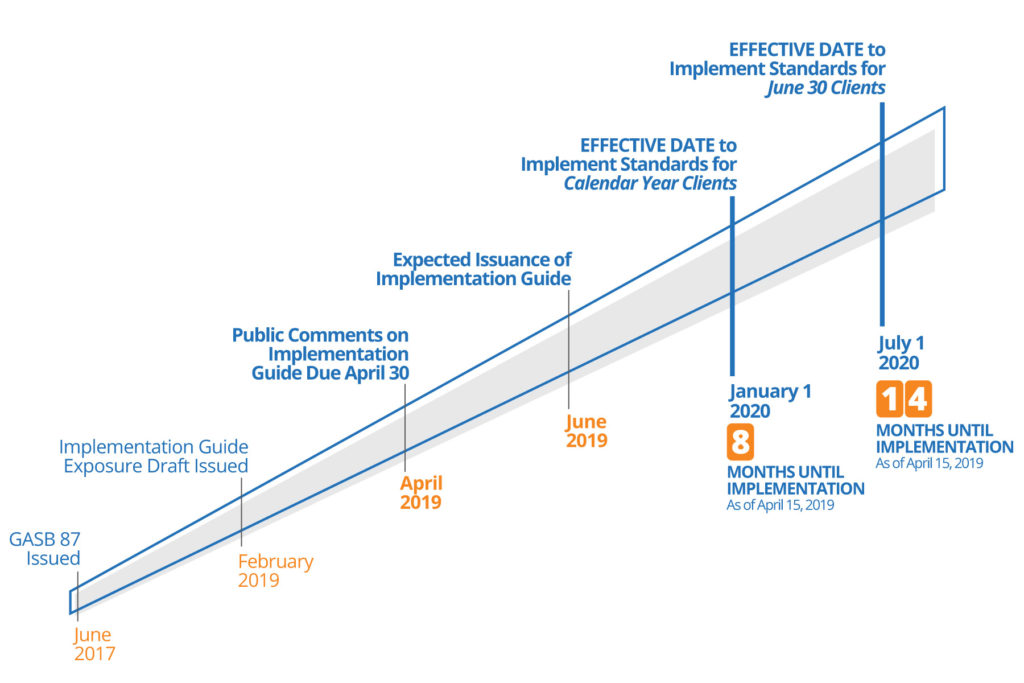
With the effective date approaching quickly, the time to prepare is NOW!
Taking the lead
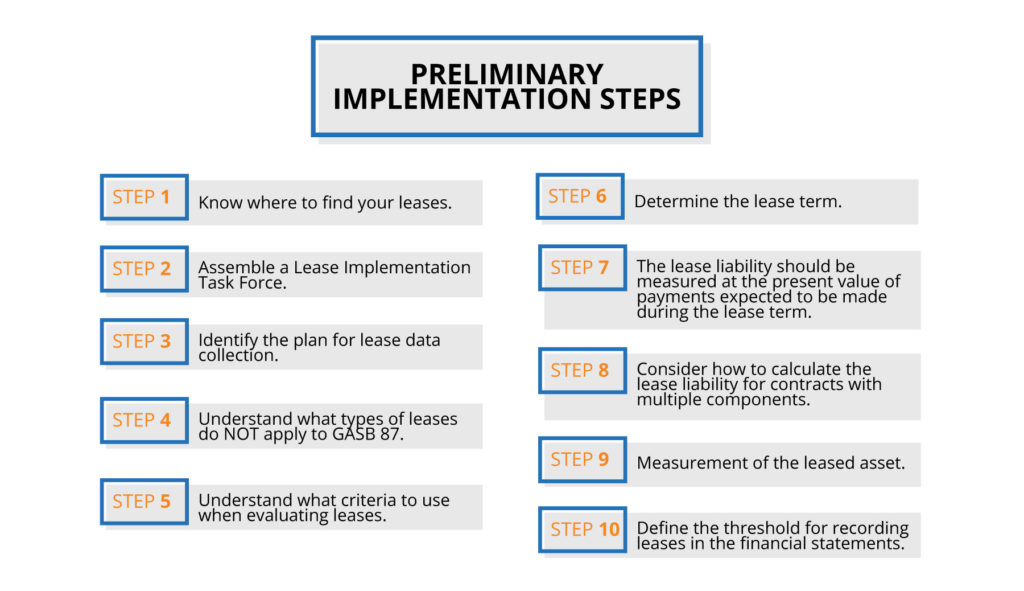
The MGO GASB 87 Implementation Team has created a readiness assessment tool providing 10 preliminary implementation questions for consideration in your planning. These will not only prepare you for the new lease accounting standards, but may uncover matters that were not previously considered or identified.
This 10-step Implementation Plan is more of a general guide designed to assist you in identifying issues and help you organize your implementation process, rather than being an all-inclusive plan with specific technical guidance. As you evaluate the leases that are unique to your organization, you will most likely find that further research and analysis is necessary to ensure proper accounting considerations. For example, if you operate an airport and have aviation leases with air carriers regulated by the U.S. Department of Transportation and the Federal Aviation Administration, it will be necessary to understand how the regulated lease provisions affect your contracts, especially in situations where there are multiple lease components.
Preliminary implementation steps
Step 1. Know where to find your leases.
It may seem obvious, but the first step in managing your leases is knowing where they are and, specifically, who is responsible for maintaining them. A good place to begin is with organizational charts. This is an example for a municipal government.
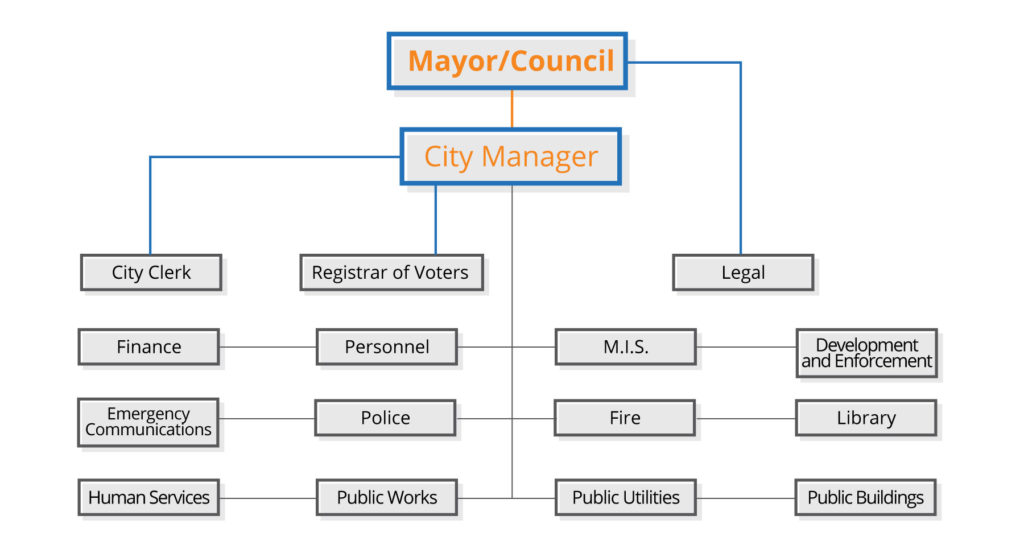
Depending on how your government contracts services, leases may be held centrally within the Finance Department or they may be decentralized in a multitude of departments, and possibly even managed by various entities.
Keep in mind that most leases that were previously expensed as operating leases will need to be accounted for as a lease obligation under the new standards, including option years if you are reasonably certain they will be exercised.
After the “where” has been established you can move into the “what” by identifying the universe of leases for your organization. This can be accomplished by evaluating the general ledger, reviewing contract files and surveying purchasing and operating departments, which leads to assembling a task force and formulating a plan for data collection.
Step 2. Assemble a Lease Implementation Task Force.
Identify people who are critical to a successful implementation. Consider including operational and legal staff who are already familiar with existing lease terms and conditions. The Lease Implementation Task Force should remain in place until the action plan for lease implementation is finalized. The benefits are many, including a collective think tank to evaluate and apply appropriate accounting treatment to each class of leases.
This task force may also be important to developing internal policies and procedures, such as whether or not a materiality threshold is appropriate, and whether or not lease accounting software should be utilized to manage the lease database. Furthermore, the implementation of the lease accounting standards is only a start, proper accounting treatment, including the remeasurement of the initial lease liability when certain lease changes have occurred and the evaluation of new leases subsequent to implementation, will be an on-going requirement.
Step 3. Identify the plan for lease data collection.
Converting your lease data into an organized structure is not without its challenges. You may encounter incomplete lease files, “hard copy versions only” of certain lease agreements, voluminous amendments, and the need to translate data from lease agreements into databases. This is all part of the process leading to a successful implementation of the new standards. Once you complete the database, you’ll then need to properly classify the leases.
Step 4. Understand what types of leases do NOT apply to GASB 87.
While a multitude of leases will be impacted by the new GASB 87 standards, there are several classifications that are not subject to GASB 87, including: intangible assets (such as computer software licenses); biological assets, including timber, plants and animals; inventories; service concession arrangement contracts; leases in which the underlying asset is financed with outstanding conduit debt; and supply contracts, such as power purchase contracts. Additionally, nonexchange agreements are exempt: for example, in the case of leasing property to a school district for a reduced price of $1/year for 30 years.
In the end, it is all about evaluating the leases subject to GASB 87.
Step 5. Understand what criteria to use when evaluating leases.
After eliminating leases that are not subject to GASB 87, as identified in Step 4, further classification of leases is necessary to ensure that the appropriate accounting treatment is applied. Short-term leases, contracts that transfer ownership, leases of assets that are investments (lessors only), and certain regulated leases (lessors only) all qualify as leases, but have differing accounting treatments than the typical long-term, noncancellable leases.
Step 6. Determine the lease term.
A lease term is defined as the period during which a lessee has a noncancellable right to use an underlying asset, plus any extension periods and options that are reasonably certain to be exercised. The GASB wants organizations to consider extension periods and options, so there is no incentive to structure initial lease terms to avoid meeting the definition of a lease. Since month-to-month leases that continue into a holdover period until a new lease is signed are not part of the noncancellable period or a formal extension, there is no basis in the standard for currently including them. Let’s discuss the calculation of the lease liability.
Step 7. The lease liability should be measured at the present value of payments expected to be made during the lease term.
The lessee should initially measure the lease liability at the present value of payments expected to be made during the lease term, which includes the following elements:
- Fixed payments
- Variable payments that depend on an index or a rate, initially measured using the index or rate as of the commencement of the lease term
- Variable payments that are fixed in substance
- Amounts that are reasonably certain of being required to be paid by the lessee under residual value guarantees
- The exercise price of a purchase option if it is reasonably certain that a lessee will exercise that option
- Payments for penalties for terminating the lease, if the lease term reflects the lessee exercising (1) an option to terminate the lease or (2) a fiscal funding or cancellation clause
- Any lease incentives receivable from the lessor
- Any other payments that are reasonably certain of being required based on an assessment of all relevant factors
For additional guidance and context to these bulleted items, refer to GASB 87 paragraph 21. In order to determine the present value, you may need to develop the discount rate.
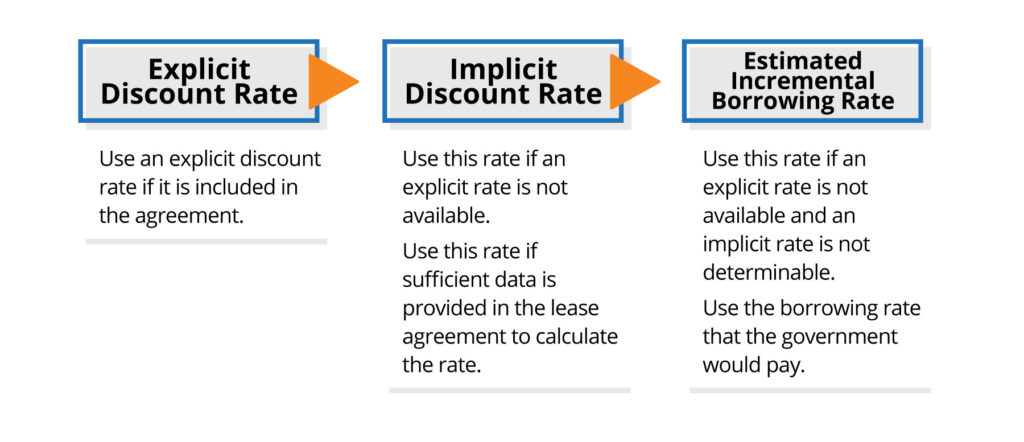
Step 8. Consider how to calculate the lease liability for contracts with multiple components.
Proper classification of leases is not always straightforward when both lease and nonlease components are included in the same contract. What if a building lease has utilities and common area maintenance costs? The answer can be found in guidance covering contracts with multiple components, which identifies maintenance services as a nonlease component. What if a lease involves multiple assets and those assets have different lease terms? The answer can also be found in guidance covering contracts with multiple components, which provides that each asset should be accounted for as a separate lease component. Many rental leases embed the cost of utilities and common area maintenance into the lease payment. Contract components should be separated using the best estimate available based on observable information. If it is not practicable to estimate these separate costs, then account for the contract as a single lease unit (see GASB 87 paragraph 67).
Step 9. Measurement of the leased asset.
The initial measurement of the leased asset should be based on the measurement of the associated lease liability. In the case of contracts with multiple components, the value of the underlying leased asset is not always clearly stated in the agreements, and many lease agreements will not cover the life of the leased asset. Some leased assets may involve proprietary information that lessors are not willing to share. Therefore, determining the value of the underlying asset is not always straightforward in these cases. Whenever possible, identifying comparable assets that are sold in a market transaction is an important part of the process. You can then utilize the knowledge of internal or external experts who can provide a basis for an estimate.
You are now ready for the final step.
Step 10. Define the threshold for recording leases in the financial statements.
Unfortunately, while GASB provides explicit guidance on capitalization thresholds for capital assets, it does not specify any such consideration for lease obligations. Using a threshold may help you avoid recording leases that are immaterial and avoid a mismatch with leased assets that are too small to capitalize. A good starting point may be to use the capitalization thresholds that are already established for your organization. Once you determine your initial criteria for establishing leases, verify that it does not exclude significant leases from application of the new standard. You can revise these thresholds as needed.
Now that we have provided you with our 10-step GASB 87 readiness plan, you should have a fairly good idea what your next steps will be.
So you can plan for compliance, this is an excellent time for the MGO GASB 87 Implementation Team to review your leases. This will ensure that you are ready to take the most important step: Implementation. In addition, we have put together an online readiness assessment that helps you evaluate where you stand in the implementation process.
About the Author:
David Bullock is a thought leader in MGO’s State and Local Government practice. An Assurance and Government Advisory Services Partner with 25 years of professional experience, he currently oversees numerous audits and other services to governmental organizations throughout California. In 2018, David was appointed to the AICPA State and Local Government Expert Panel. He is also on the Governmental Accounting Standards Board’s (GASB) Financial Reporting Model Reexamination Task Force. In 2018, he was appointed to the California Society of CPAs’ Governmental Accounting and Auditing Committee. His numerous presentations cover topics related to generally accepted accounting principles promulgated by the GASB, and auditing standards, promulgated by the AICPA and the GAO.
]]>