- Name, image, and likeness (NIL) deals offer athletes exciting opportunities, but also potential pitfalls if not approached strategically.
- Athletes should educate themselves on taxes, carefully review contracts, and budget with long-term security in mind.
- With guidance on financial obligations, agreements, and smart money management, athletes can maximize NIL benefits while safeguarding their futures.
~
You are a talented young athlete with a growing public profile. You’ve just been offered a Name, Image, and Likeness (NIL) deal, an opportunity that can put some extra money in your pocket or even, in some cases, make a more profound impact on your financial life. It’s an exhilarating time, but it’s also crucial to approach this new chapter with the right knowledge and mindset.
Whether you’re a college or high-school athlete, or the trusted advisor to a young athlete, here are the three most critical actions you should take to avoid common financial pitfalls associated with NIL deals.
1. Recognize Your Tax Obligation
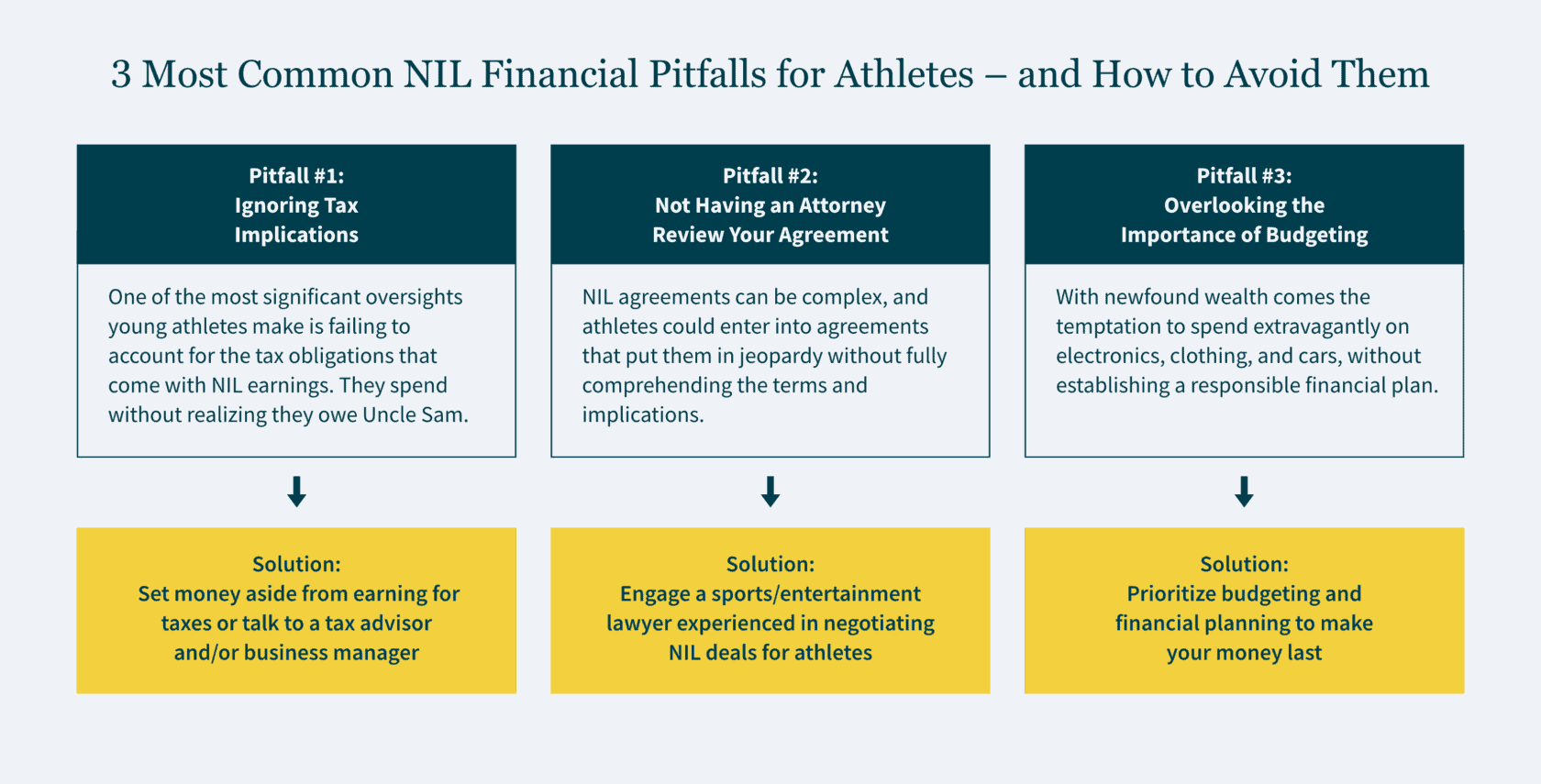
One of the first hurdles you’ll encounter in the world of NIL deals is taxes. It’s essential to understand that the money you earn from these deals is subject to taxation. Many young athletes overlook this, often because they’ve never had to deal with taxes before.
To avoid potential financial trouble down the road, consider these steps:
- Educate Yourself: Young athletes receiving payments from NIL deals are responsible for paying taxes on that income just like professional athletes. Take the time to learn about taxes, especially how they apply to your earnings. Understanding the basics of taxation will empower you to make informed decisions.
- Consult a Tax Professional: Before signing any NIL agreement, consult with an experienced accountant, tax advisor, or business manager. They can help you calculate your tax obligations, identify potential deductions, and develop a tax strategy tailored to your situation. Along with ensuring any federal, state, and local taxes you owe are paid on time (avoiding penalties), a tax professional can also help you navigate more complex situations – such as earning income across multiple states.
- Practice Smart Spending: Resist the urge to splurge on electronics, clothes, or cars as soon as the money starts rolling in. Create a budget that considers your future tax payments, living expenses, and financial goals. Staying disciplined with your spending is key to long-term financial success.
2. Execute Agreements Cautiously
Navigating NIL deals can be tricky. There are various state laws and school policies to consider, along with a number of legal “gotchas” to avoid. Here’s how you can safeguard your interests:
- Seek Legal Advice: Before signing any NIL agreement, engage a lawyer with experience negotiating NIL and brand endorsements for athletes. An attorney with expertise in sports contracts can help you navigate the important terms in an NIL deal, such as money, exclusivity, length of the agreement, how the brand can use your name, image, and likeness, and an athlete’s delivery requirements. An experienced attorney will help you spot potential pitfalls and ensure the agreement aligns with your long-term goals.
- Beware of “Standard” or Simplistic Agreements: When someone refers to a contract as “standard” or provides an overly simplified agreement, that should throw up a red flag. All it takes is the slightest language in your agreement to give a company unfettered rights to use your name, likeness and image in ways you never intended.
- Follow Regulations: An experienced advisor will help you navigate specific laws and policies set by your state, school, and the NCAA regarding NIL deals. For example, you cannot share photos or videos in your team uniform with logos from other brands without first getting permission from your school or the brands.
3. Budget Wisely for the Long Term
While newfound wealth can be exhilarating, it’s crucial to manage your finances wisely:
- Prioritize Needs Over Wants: When it comes to spending, prioritize essential needs over extravagant wants. Understand this financial windfall may be a one-time occurrence, so focus on building a secure future rather than indulging in immediate gratification.
- Future-Proof Your Earnings: Instead of assuming this is a continuous stream of income, treat each deal as if it were your last. Create a budget that accounts for potential future earnings and uncertainties, ensuring you’re prepared for any scenario.
- Explore Tax Mitigation Strategies: Consider tax mitigation strategies, such as retirement planning and deferral opportunities, to minimize your tax burden. Consulting a financial advisor can help you explore these options.
Make the Most of Your NIL Opportunities
The legalization of NIL in college and high school sports represents an exciting shift for young athletes. It can offer game-changing money, enabling you to take care of your financial needs, along with building your brand for future growth. But with great success also comes great responsibility. Even professional athletes who’ve reached the highest pinnacles of their respective sports can end up without the financial resources they need if they don’t plan ahead.
The good news is by recognizing the potential pitfalls and seeking professional guidance early in your NIL journey, you can better position yourself for long-term financial success. Remember, it’s not just about profiting from your name, image, and likeness today, but also securing your financial future for tomorrow.
How We Can Help:
Our Entertainment, Sports, and Media practice understands the unique challenges athletes face at all stages of their financial journey. Whether you need assistance with tax planning, contract negotiations, or financial strategy, we’re here to guide you toward a successful future in the world of sports and NIL deals.
This article was co-authored by Leron E. Rogers, Partner at Fox Rothschild LLP.
]]>Under this Act, foreign companies traded on any U.S. exchanges are required to have their auditors submit to inspection by the Public Company Accounting Oversight Board (PCAOB) in an effort to establish that they’re neither owned nor controlled by a foreign government. With a wealth of Chinese companies trading in the U.S., the legislation is likely to have a significant impact on Chinese companies and their accounting firms, as well as U.S. investors and the capital market, for years to come.
How the HFCAA works
The Act will amend Section 104 the Sarbanes-Oxley Act of 2002, the comprehensive legislation passed by Congress aimed at overseeing the conduct of public companies. Pursuant to the HFCAA, there will be a number of sizable changes.
• First, the Securities and Exchange Commission (SEC) will now be required to identify companies that are utilizing registered public accounting firms located outside the United States that are preventing audits from the PCAOB.
• Additionally, the SEC must prohibit securities trading of these public companies within U.S. markets following three consecutive years of non-inspection. Under the language of the bill, these companies will be prohibited from trading on either a national securities exchange or “through any other method that is within the jurisdiction of the Commission to regulate, including through the method of trading that is commonly referred to as the ‘over-the-counter’ trading of securities.” It should be noted that in the event an issuer receives a trading prohibition, then the issuer is allowed to have the prohibition overturned as long as it is able to retain an accounting firm that can be fully inspected by the PCAOB.
• Also, as part of the Act, there are disclosure requirements for non-inspection years for foreign issuers of securities that utilize firms to prepare audit reports. For instance, they will need to disclose the percentage of shares owned by foreign government entities. They will also need to disclose whether or not foreign government entities have “controlling financial interest with respect to the issue.”
• Finally, there are also disclosure requirements that specifically involve China. According to the Act, the names of each official of the Chinese Communist Party of the board of directors of either the issuer or “the operating entity with respect to the issuer” must be disclosed in their Form 10-K, Form 20-F, and shell company reports. Additionally, it must be disclosed if the issuer’s articles of incorporation (or “equivalent organizing document”) has “any charter of the Chinese Communist Party, including the text of any such charter.”
Potential impact of the HFCAA
While the HFCAA applies to any U.S.-listed company incorporated outside the United States, including Mainland China, Hong Kong, France, and Belgium, it is generally understood as explicitly targeting Chinese companies under the restrictions imposed by the Chinese government.
This Act could lead to an increase in the number Chinese and Hong Kong-based issuers being delisted from U.S. exchanges in the coming years. In fact, according to the list of public companies affected by obstacles to PCAOB inspections, there are more than 200 Chinese companies currently audited by CPA firms in mainland China and Hong Kong that would be negatively impacted. These companies, including popular stocks such as Alibaba Group Holding Ltd – ADR, Baidu Inc, JD.com Inc, and Nio Inc – ADR, could feel the brunt of this new legislation.
Note that the Big Four accounting firms in China are independent from the Big Four in the U.S. and do not meet the audit requirements of the PCAOB since they are under the China’s national security laws and the Chinese Securities Law, which prohibit Chinese companies from providing records “relating to securities business activities” overseas without approval by the Chinese securities regulator. Besides, the imminent enactment would certainly discourage new listing of Chinese companies in the U.S. as it could result in a discount on the trading prices as investors may factor in the potential de-listing risk.
However, it remains to be seen how the SEC implementation will roll out within 90 days of the HFCAA’s enactment, which could be greatly influenced by the new leadership of the SEC. According to Bloomberg, President-elect Joe Biden is expected to pick Gary Gensler to head the SEC.
Additionally, because of the three-year compliance timeline in the Act, Chinese companies may consider several options to mitigate the impending risks. The most likely one is to engage a reputable U.S.-based CPA firm, preferably one that has an established China Group, who understands both the Chinese business climate and the U.S. accounting rules, and most importantly obtain a clean compliance record with PCAOB. Yet, it’s also critical that companies consider other factors such as the investor and make sustainable long-term plan to maintain a legitimate and confident position in US capital markets.
If you have any questions
MGO’s SEC practice has a dedicated China Group experienced with Chinese IPOs, RTOs, M&A deals and the unique characteristics of SPAC acquisitions. To understand your options, and the path ahead, please feel free to reach out to us for a consultation.
Mergers with SPACs have always been an alternative to traditional IPOs. With the IPO market effectively minimized for the time being, SPAC mergers are an increasingly desirable public market liquidity option for private companies.
What the numbers tell us
2020 is a record-shattering year for a revitalized SPAC market. According to data provided by ELLO Capital, there have been 95 SPAC IPOs so far in 2020, raising $37.8 billion (average size: $397 million). That compares with 59 in all of 2019, which raised $13.6 billion (average size: $230 million).
On July 22, 2020, Pershing Square founder Bill Ackman raised $4 billion in the IPO of Pershing Square Tontine Holdings Ltd., the largest SPAC IPO to date. With an initial target of $3 billion, the SPAC included a unique pricing approach: a fixed pool of warrants to be distributed to shareholders who accept a subsequent deal – increasing the take for approvers.
“COVID-19 is likely a direct cause of the acceleration in SPACs this year, as global lockdown policies have restricted travel and the ability to do roadshows. As a result, SPACs have largely replaced traditional IPOs,” said Mark Young, co-founding partner of Bridge Point Capital. “Plus, SPACS appeal to the high-growth technology sector, which has led the market recovery post-February correction, and continue to drive grwoth in the work-from-home economy.”
SPACs: rules of the road
- Speed is the name of the game – Leveraging the market expertise of leadership team, a SPAC can raise funds in a matter of days, without the time and resource demands of a roadshow.
- Minimum value is set – The acquired company/companies must have a minimum value, generally 80% of the fund the SPAC has in escrow following the IPO. Multiple closings, obviously, complicate the otherwise-simple SPAC process and inject completion risk into the transaction.
- The clock is ticking – There’s a deadline reality for both the SPAC and the target: If the SPAC doesn’t close the deal by the deadline, it must return the funds it raised in its offering. On the flip side, getting near the deadline can help give a target company some leverage.
- Valuation risk – Investors in SPACs are very much like IPO investors: there is an expectation that they are buying at a discount and there is significant growth potential around the corner. They are not looking for turnaround stories. In turn, SPACs are perceived as focused on growth verticals.
- Shareholder approval required – The SPAC is a public company that inherits all the baggage – reporting/regulatory demands, liabilities, etc. – of a public company. Approval by target company shareholders likely will be required. And the SPAC would need to file a proxy statement and secure approval from the Securities and Exchange Commission.
- Redemption risk – Here’s an interesting twist: At the time of the transaction, the SPAC’s public shareholders can redeem their stock. The risk: the SPAC’s cash availability – which might be needed to complete the transaction – could take a hit if the redemptions are significant.
- Warrants also in play – Sometimes the purchase price includes stock; the value of those shares are impacted by the associated rights. In most cases, the warrants can be exercised at a premium to the original offering price. What can happen: the valuation of stock included in purchase price may rise above, or fall below, the value of the stock issued to a target. The driving factor: can a deal actually get done.
- Navigate the de-SPAC phase – Definition: the time between the definitive agreement and closing. What needs to be done: communicate details of the transaction to the SPAC’s stakeholders. The goal: optimize the story, educate sales people, engage analysts – protect value.
The record so far
• DraftKings (NASDAQ: DKNG): Shares in the online fantasy and gambling company jumped to $18.69 per share when the merger agreement was announced in December, and then edged up to $19.35 per share on the first day of trading, Since then, the price has climbed to about $44.00 per share before settling back into the $37.00-$40.00 area. Its current market capitalization is over $13.5 billion.
• Virgin Galactic (NYSE: SPCE.N): The Richard Branson-backed competitor to Elon Musk’s SpaceX and Jeff Bezos’ Blue Origin, Virgin Galactic shares currently trade in around $17.00-$20.00, about double their late October day-one level, and more than three times their low of $6.90 per share. The stock has reached a high of $42.49 per share, and the company’s current market capitalization is $3.9 billion.
• Nikola (NASDAQ: NKLA): The green truck company has been on a roller-coaster ride since its late June debut. It has climbed as high as $93.99 at one point and currently trades at about $37.00 per share. Market capitalization is just under $14 billion.
Leading the way is a pending deal from Churchill Capital Corp. III, which has agreed to acquire health-cost management services provider MultiPlan for $11 billion. This would make it the largest ever SPAC deal.
“The healthcare and life sciences industries are two sectors likely to continue driving SPAC growth in the COVID-19 era,” said Nadia Tian, co-founding partner of Bridge Point Capital. “This is because healthcare traditionally outperforms the market in a recession, SPACs allow biotech companies to have more cash on hand than a traditional IPO, and the government and consumers are especially focused on these areas as we search for solutions to the COVID-19 outbreak.”
Final thoughts
Private companies that were planning an IPO or other significant M&A deal before the global economic downturn caused by the COVID-19 pandemic may want to seriously consider a SPAC deal. As with all transactions significant, intensive planning, vetting, due diligence and other considerations must be undertaken.
MGO’s dedicated SEC practice has experience with IPOs, RTOs, M&A deals and the unique characteristics of SPAC acquisitions. To understand your options, and the path ahead, please feel free to reach out to us for a consultation.
]]>Alternative paths to US exchanges
There are a variety of reasons companies would prefer to avoid a traditional IPO. For those entities we provide tailored solutions during the entire go public process – or portions of it – including the pursuit of alternatives such as a Regulation A+ offering and reverse mergers. We help each client find the path that’s right for their unique needs.
Bridging cultures
Our China practice has the language skills and cultural understanding to navigate market complexities. Call or contact us online to find out how we can help you.
]]>