- In April, the U.S. Tax Court made news when it ruled in favor of businessman Alon Farhy, who challenged the Internal Revenue Service (IRS)’s authority to assess penalties for the failure to file IRS Form 5471.
- IRS Form 5471 is the Information Return of U.S. Persons With Respect to Certain Foreign Corporations.
- Taxpayers may be interested in filing protective refunds, and they should start the process sooner rather than later—there is a statute of limitations of two years for claiming refunds.
- This case’s ruling could have reverberating effects when it comes to the IRS collecting additional penalties, but only time will tell.
On April 3, 2023, the U.S. Tax Court came to a decision in the case Farhy v. Commissioner, ruling that the Internal Revenue Service (IRS) does not have the statutory authority to assess penalties for the failure to file IRS Form 5471, or the Information Return of U.S. Persons With Respect to Certain Foreign Corporations, against taxpayers. It also ruled that the IRS cannot administratively collect such penalties via levy.
Now that the IRS doesn’t have the authority to assess certain foreign information return penalties according to the court, affected taxpayers may want to file protective refund claims, even if the case goes to appeals — especially given the short statute of limitations of two years for claiming refunds.
Our Tax Controversy team breaks down the Farhy case, as well as what it may mean for your international filings — and the future of the IRS’s penalty collections.
The case
Alon Farhy owned 100% of a Belize corporation from 2003 until 2010, as well as 100% of another Belize corporation from 2005 until 2010. He admitted he participated in an illegal scheme to reduce his income tax and gained immunity from prosecution. However, throughout the time of his ownership of these two companies, he was required to file IRS Forms 5471 for both — but he didn’t.
The IRS then mailed him a notice in February 2016, alerting him of his failure to file. He still didn’t file, and in November 2018, he assessed $10,000 per failure to file, per year — plus a continuation penalty of $50,000 for each year he failed to file. The IRS determined his failures to file were deliberate, and so the penalties were met with the appropriate approval within the IRS.
Farhy didn’t dispute that he didn’t file. He also didn’t deny he failed to pay. Instead, he challenged the IRS’s legal authority to assess IRC section 6038 penalties.
The court’s ruling
The U.S. Tax Court then held that Congress authorized the assessment for a variety of penalties — namely, those found in subchapter B of chapter 68 of subtitle F — but not for those penalties under IRC sections 6038(b)(1) and (2), which apply to Form 5471. Because these penalties were not assessable, the court decided the IRS was prohibited from proceeding with collection, and the only way the IRS can pursue collection of the taxpayer’s penalties was by 28 U.S.C. Sec. 2461(a) — which allows recovery of any penalty by civil court action.
How this court decision affects your international penalty assessments
This case holds that the IRS may not assess penalties under IRC section 6038(b), or failure to file IRS Form 5471. The case’s ruling doesn’t mean you don’t have an obligation to file IRS Form 5471 — or any other required form.
Ultimately, this decision is expected to have a broad reach and will affect most IRS Form 5471 filers, namely category 1, 4, and 5 filers (but not category 2 and 3 filers, who are subject to penalties under IRC section 6679).
However, the case’s impact could permeate even deeper. For years, some practitioners have spoken out against the IRS’s systemic assessment of international information return (IIR) penalties after a return is filed late, making it impossible for taxpayers to avoid deficiency procedures. The court’s decision now reveals how a taxpayer can be protected by the judicial branch when something is deemed unfair. Farhy took a stand, challenged the system, and won — opening the door for potential challenges in the future.
It’s uncertain as to whether the IRS will appeal the court’s decision. But it seems as though the stakes are too high for the IRS not to appeal. While we don’t know what will happen, a former IRS official has stated he expects that, for cases currently pending review by IRS Appeals, Farhy will not be viewed as controlling law yet.
The impact of the ruling is clear and will most likely impact many taxpayers who are contesting — or who have already paid — IRC 6038 penalties. It may also affect other civil penalties where Congress has not prescribed the method of assessment in the future.
How you should respond to the court’s decision
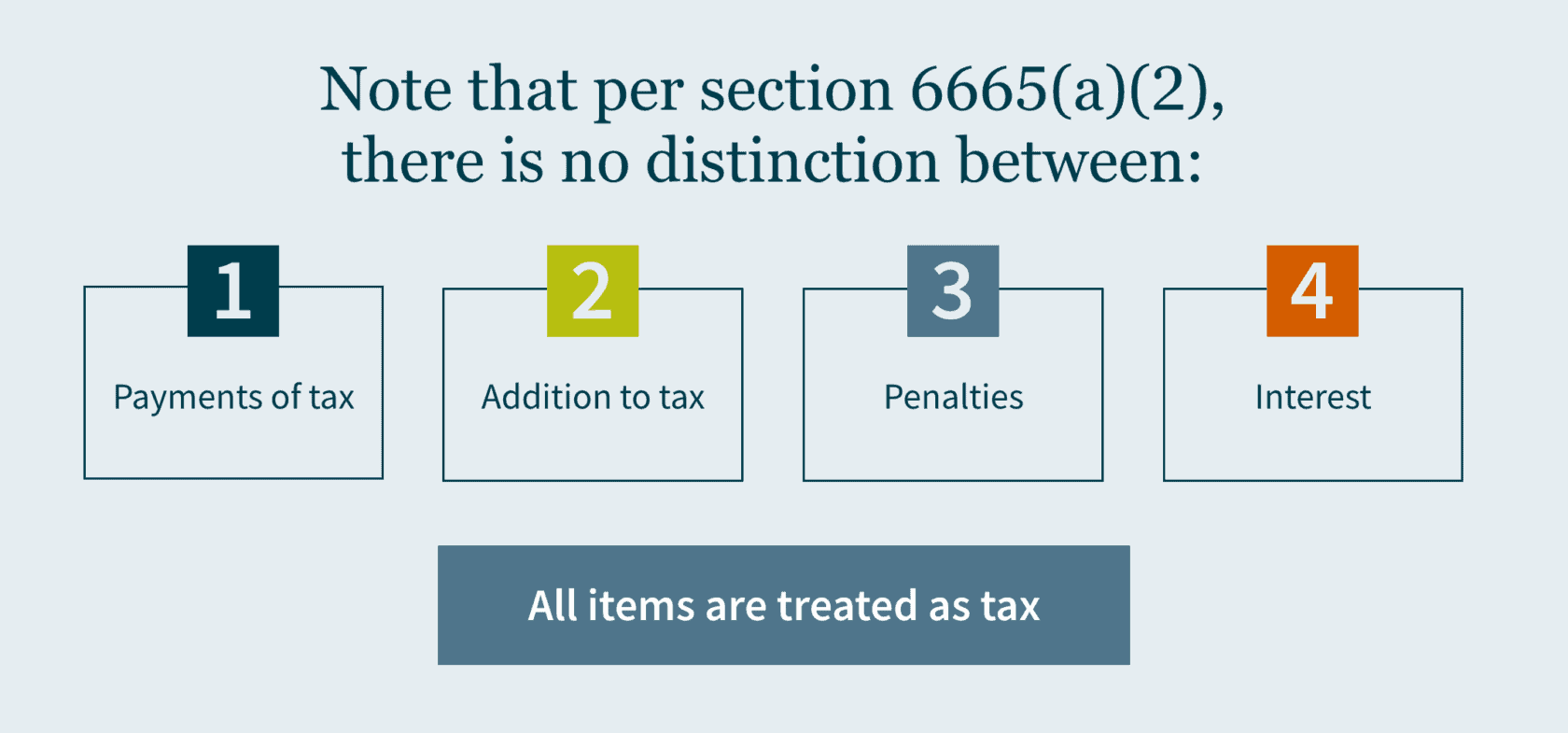
You should move quickly to take advantage of the court’s decision, as there is a two-year statute of limitations from the time a tax is paid to make a protective claim for a refund. It’s likely this legislation wouldn’t affect refund claims since that would be governed by the law that existed when the penalties were assessed. Note that per IRC section 6665(a)(2), there is no distinction between payments of tax, addition to tax, penalties, or interest — so all items are treated as tax.
If you’ve previously paid the $10,000 penalty, it’s important to file your protective claim now, unless you’ve entered into an agreement with the IRS to extend the statute of limitations, which can occur during an examination. Requesting a refund won’t ever hurt, but some practitioners believe the IRS may try to keep any penalty money it collected, even if the assessment is invalid— because, in its eyes, the claim may not be. Just know, you can file your protective claim for a refund but may not get it, at least not any time soon.
The Farhy decision could likewise be applied to other US IRS forms, such as 5472, 8865, 8938, 926, 8858, 8854, and some argue the Farhy decision may also be applied to IRS Form 3520.
How MGO can help
Only time will tell if the court’s decision will open the government up to additional criticisms for other penalty assessments. If you have paid your penalties and are wondering what your current options are, MGO’s experienced International Tax team can help you determine if you’re eligible to file a refund claim.
Contact us to learn more.
]]>
- Many international companies are struggling with their supply chain management amid external factors playing out on the global stage.
- To mitigate the challenges, you should be aware of the current trends in supply management as well as strategies to improve your resilience and flexibility.
- Current trends include AI and automation, supply chain as a service, circular supply chains, risk management and stability, and sustainability.
- Diversifying your supply chain and creating a backup plan can help you remain agile.
- Know the tax implications of your supply chain.
The last two years have seen major disruption in supply chain management — and throughout 2023, that turbulence is expected to continue. The freight supply and demand equation was a common issue during the pandemic and recovery period. We’re now seeing how the Russian-Ukraine conflict is reshaping the global supply chain for many companies. And amid all the economic uncertainty, supply shortages, and rising costs, the U.S. and EU (European Union) have been heavily investing in infrastructure, putting even more pressure on China with the U.S.-imposed tariffs’ strenuous implications.
While managing your supply chain is currently a challenge, you’re not completely at the mercy of these external factors which are generally outside of your control. There are strategies to mitigate the impact to your supply chain: your goals should be to both improve your supply chain resilience and flexibility to allow you to better manage the disruptions — those foreseen and unforeseen.
Our International Tax team breaks down some of the current trends and strategies to be aware of.
Trends in supply chain management
Some of the main trends in supply chain management include artificial intelligence and automation, supply chain as a service, circular supply chains, risk management and stability, and an increased focus on sustainability. Now, more than ever, mid-market multinational companies must be strategic. These additional constraints cause strain on these companies that are being forced to pivot to address these issues among additional disruption.
Odds are, you’ve been rethinking the way you currently manage your supply chain — because the global situations aren’t changing. The China tariffs are unlikely to disband soon, and there seems to be no end in sight to the Russia-Ukraine conflict.
Diversifying your supply chain
Many agree that the global supply chain was too dependent on China, and now companies are considering breaking away from the Asia Pacific region to look at the Mexican maquiladora or IMMEX programs. Both these programs are, for all intents and purposes, synonymous, save for one detail: the IMMEX added shelter companies as a modality. Under this shelter program, companies may set up operations in Mexico without establishing a legal Mexican entity.
These programs have been in existence since the 1960s, so they’ve proven their worth — however, they don’t work for everyone, so it’s worth perusing other options. It’s important to remember that sourcing from vendors in only one location, regardless of where that location is geographically, is accompanied by elevated risk.
To mitigate this, you should not only diversify your supply chain but also create redundancies to avoid a single point of failure. In addition, bringing your sources of supply closer to where you operate also reduces the opportunity for risk. Engage with new suppliers and manufacturers in the Americas, for instance, and analyze your current suppliers to see if there is any one region you rely on more heavily already, then minimize the distance between your production and purchasing — without, of course, sacrificing quality, cost, control, and reputation. By optimizing your global footprint, you can maximize your production opportunities, minimize risk, and scout new vendors and locations for future efficiency.

Devising a backup plan for supply chain disruptions to address multiple contingencies
At the end of the day, we know that no matter how sophisticated or agile your supply chain backup plan is, external factors — which are never static — can affect things in unexpected ways. With rapidly and ceaselessly changing global conditions, there’s no way to account for everything you could encounter.
But there are ways to prepare. Plan for multiple contingencies, weighing their outcomes. Don’t forget to think broadly and for new opportunities — for example, if you’re looking at expanding into new markets or territories or want to add a new product line, you must assess their plausibleness under a variety of conditions (and not just logistical conditions, like lead times and delivery … but also tax liabilities and compliance, too).
Keep your supply chain planning agile and ready to evolve by reviewing its current model and updating it to ensure it reflects the restraints and vulnerabilities you’re presently dealing with. By making a step-by-step plan — for multiple scenarios — you can chart your path forward, regardless of what unfolds on the global stage in these uncertain times.
How MGO can help
Knowing the tax implications of your supply chain is crucial to your global success, and our experienced International Tax team can help you navigate the supply chain turmoil — no matter how turbulent. By reviewing your current supply chain model to determine where your processes can be strengthened and made more efficient, as well as pinpointing your vulnerabilities, we can help you hone your supply chain’s true potential while safeguarding it against whatever comes next.
About the authors
John Apuzzo is the leader of our International Tax Practice. He supports public and private companies, and high-net-worth individuals, as they conduct business on the global stage. His passion for developing optimal tax strategies helps his clients reinvest in their businesses and enjoy the wealth they have worked so hard to earn.
Mandy Li is a transfer pricing partner and provides strategic and tactical transfer pricing solutions to public and private multinational organizations. She supports highly complex global engagements, with an emphasis on transactions moving to and from the China region.
]]>This Tax Alert provides an overview of some of the most significant modifications to the U.S. international tax provisions affecting businesses and individuals. We urge clients to evaluate the impact of tax reform and discuss relevant changes with their tax advisors since many of the new provisions may bring about unintended tax consequences with respect to properly implemented structures under the previous U.S. international tax regime. Overall, the changes expand the base of cross-border income to which current U.S. taxation applies.
Additional tax alerts for Individuals | Business
Details of international provisions
Introduction of Participation Exemption System for foreign income
The Act introduces a dividend exemption system that applies to distributions made after December 31, 2017, which generally provides for a 100% dividend received deduction (“DRD”) for the foreign-sourced portion of dividends received by a domestic C corporation from a specified 10%-owned foreign corporation (other than a Passive Foreign Investment Company – “PFIC”) of which it is a U.S. shareholder, provided certain conditions are satisfied. The DRD is available only to C corporations that are not regulated investment companies (“RICs”) or real estate investment trusts (“REITs”).
Note that dividends received from PFICs do not qualify for the DRD and domestic C corporations may not claim foreign tax credits or a deduction for foreign taxes paid or accrued with respect to any dividend allowed the DRD.
To the extent earnings of foreign corporations are neither subpart F income nor subject to the minimum tax rule discussed below, the new participation exemption system moves the U.S. away from a worldwide taxation system towards a territorial tax system for earnings of foreign corporations.
Sales or transfers involving specified 10%-owned foreign corporations
Certain deemed dividends under Code section 1248 – resulting from the sale or exchange of stock of a specified 10%-owned foreign corporation held for over one year – qualify for the 100% DRD under the new law.
The provision also allows a U.S. shareholder to claim a 100% DRD on deemed dividends under section 964(e) resulting from the gain on the sale of foreign stock by a controlled foreign corporation (“CFC”).
Two new loss limitation rules are included in the provision, which are applicable to transfers and distributions made after December 31, 2017:
- A domestic corporation that is allowed a DRD is required to reduce its basis in the stock of the foreign corporation by an amount equal to the DRD, solely for purposes of determining the domestic corporation’s loss on the sale of stock of the foreign corporation.
- A domestic corporation is required to recapture certain foreign branch losses if it transfers substantially all of the assets of a foreign branch to a 10%-owned foreign corporation of which it is a United States shareholder after the transfer. The active trade or business exception of section 367(a)(3) is repealed for transfers made after December 31, 2017, which disfavors the use of foreign branches.
New mandatory repatriation
As a transition to the new participation exemption regime, a mandatory repatriation provision is included targeting previously untaxed earnings and increasing subpart F income by the shareholder’s pro rata share of each specified foreign corporation’s net untaxed post-’86 historical E&P, determined as of November 2 or December 31, 2017 (a measuring date). However, this mandatory inclusion is reduced (but not below zero) by an allocable portion of the taxpayer’s share of foreign E&P deficit of each specified foreign corporation and the taxpayer’s share of its affiliated group’s aggregate unused E&P deficit. Earnings attributable to the shareholder’s aggregate foreign cash position or liquid assets are subject to tax at a 15.5% rate, while earnings attributable to illiquid assets are subject to tax at an 8% rate.
The tax liability is payable over a period of up to eight years, at the election of the U.S. shareholder.
A special rule applies to S corporations under the mandatory repatriation provisions. S corporation shareholders may elect to continue to defer taxation of such foreign income until the S corporation changes its status, sells a substantial amount of its assets, ceases to conduct business, or the electing shareholder transfers their S corporation stock.
Non-corporate U.S. shareholders are exposed to the new mandatory repatriation rule if the specified foreign corporation is a CFC or any foreign corporation with at least one domestic corporate U.S. shareholder, even though the 100% dividend received deduction from foreign subsidiaries only applies to corporate U.S. shareholders under the Act.
Foreign tax credits and sourcing of income modifications
Foreign tax credits are allowed under the new law only with respect to foreign income taxes associated with the taxable portion of the U.S. shareholder’s net mandatory inclusion. Foreign tax credits are disallowed with respect to foreign income taxes attributable to the participation deduction. Taxpayers may not elect to take a deduction for foreign taxes that are disallowed as foreign tax credits.
The U.S. shareholder’s section 78 gross-up should also reflect the portion of foreign taxes attributable to the U.S. shareholder’s net mandatory inclusion.
The deemed paid foreign tax credit provisions under Code Section 902 are repealed while the deemed paid foreign tax credit provisions for subpart F inclusions under Code Section 960 are retained but modified, providing a credit on a current year basis. Foreign tax credits will be counted on an annual basis and will no longer be pooled.
Foreign taxes attributable to distributions of previously taxed income (“PTI”) are also regulated under the Act
The Act also revises the sourcing rules for income from inventory sales. Income from inventory sales is now sourced entirely based on the place of production and not allocated 50/50 to the place of production and the place of sale (based on title passage).
A separate foreign tax credit limitation basket is created under the new law for foreign branch income.
The Act repeals the fair market value method of interest expense apportionment. Taxpayers are now required to allocate and apportion interest expense of members of an affiliated group using the adjusted basis of assets.
New provisions regarding foreign passive and intangible income
The Act has new provisions that adopt a minimum tax on “global intangible low-taxed income” (“GILTI”) and a new special deduction for certain “foreign-derived intangible income” (“FDII”), subject to certain exceptions.
Regardless of whether distributions are actually made by a CFC during the tax year and similarly to the manner in which subpart F income inclusions operate, a U.S. shareholder of a CFC is now required to include in income its pro rata share of GILTI allocated to the CFC for the CFC’s tax year that ends with or within its own tax year.
GILTI provisions target a portion of the CFCs’ active (non-Subpart F) income and tax it at an effective tax rate of 10.5% prior to 2026 — generally speaking, the targeted portion is equal to the net income over a routine or ordinary return, defined as the excess of an implied 10% rate of return on the adjusted basis of the CFC’s tangible depreciable property used in generating the active income.
In conjunction with the new minimum GILTI tax regime, excess returns earned directly by a U.S. corporation from foreign sales (including licenses and leases) or services defined as FDII are now also subject to a 13.125% effective tax rate (increased to 16.406% starting in 2026). FDII is the amount of a U.S. corporation’s “deemed intangible income” that is attributable to sales of property (including licenses and leases) to foreign persons for use outside the U.S. or the performance of services for foreign persons or with respect to property outside the U.S.
Corporate shareholders are allowed a deduction equal to maximum 50% of GILTI (reduced to 37.5% starting in 2026) plus any corresponding Code section 78 gross-up plus maximum 37.5% of taxpayer’s FDII (reduced to 21.875% starting in 2026) – combined, these three components comprise the GILTI deduction. Not that the total GILTI deduction cannot exceed a corporation’s taxable income. S corporations or domestic corporations that are RICs or REITs are not allowed to claim this deduction. Transfers to foreign related persons generally do not qualify for FDII benefits.
U.S. shareholders can make a Code Section 962 election with respect to GILTI inclusions, which subjects the shareholder to tax on the GILTI inclusion based on corporate rates, and allows the electing shareholder to claim foreign tax credits on the inclusion as if the shareholder were a domestic corporation.
Modification to subpart F rules
The inclusion based on the withdrawal of previously excluded subpart F income from qualified investment is repealed.
The provision that provides for the inclusion of foreign base company oil-related income is repealed; hence, previously excluded foreign shipping income of a foreign subsidiary is no longer subject to current U.S. taxation under the subpart F rules if there is a net decrease in qualified shipping investments.
Stock attribution rules for determining status of a foreign corporation as a CFC are modified, which makes it more likely for a foreign corporation to be treated as a CFC as a result of the stock of certain related foreign persons being attributed downward to a U.S. citizen. As a result, for example, stock owned by a foreign corporation would be treated as constructively owned by its wholly-owned domestic subsidiary for purposes of determining the U.S. shareholder status of the subsidiary and the CFC status of the foreign corporation.
The new law eliminates the requirement that a corporation be a CFC for 30 days before subpart F inclusions apply.
Prevention of base erosion
The Act includes additional anti-base erosion measures, including a Base Erosion Anti- Abuse Tax (“BEAT”) for certain payments paid or accrued in tax years beginning after December 31, 2017. In general, the BEAT imposes a minimum tax on certain deductible payments made to foreign affiliates, including royalties and management fees, but excluding cost of goods sold.
Income shifting through intangible property transfers is further limited. This includes treating goodwill and going concern value and workforce in place as section 936(h)(3)(B) intangibles and, requiring the use of the aggregate basis valuation method in the case of transfers of multiple intangible properties in one or more related transactions. This applies if it is determined that an aggregate basis achieves a more reliable result than an asset-by-asset approach.
Deductions for certain related party interest or royalty payments paid or accrued in certain hybrid transactions or with certain hybrid entities are now disallowed under certain circumstances. The Act provides that the Secretary of State shall issue regulations or other guidance as may be necessary or appropriate to carry out the purposes of the provision for branches (domestic or foreign) and domestic entities, even if such branches or entities do not meet the statutory definition of a hybrid entity.
New rules were incorporated to limit the deductibility of interest within a corporate group.
Surrogate foreign corporations are not eligible for the reduced rate on dividends under the Act.
MGO insights
The Tax Cuts and Jobs Act is the largest overhaul of the tax system in over three decades and will have a significant impact on U.S.-based multinational companies as well as inbound businesses. The bill fundamentally changes the landscape of U.S. international taxation. We recommend that companies, individuals, and flow through entities engaged in cross border business discuss their specific situation with MGO’s experienced international tax professionals and consultants – we are here to help you navigate the changes of this comprehensive tax reform.
]]>On August 3rd, new tax legislation — 26 USC 7345: Revocation or denial of passport in case of certain tax delinquencies — went into effect, taking aim at expats and international travelers. This represents the latest attempt by the Internal Revenue Service (IRS) to limit the amount in taxes lost each year from U.S. citizens living and/or working abroad and not reporting income, filing tax returns, or paying overdue taxes.
The process for enforcement begins with the IRS sending letters to persons with “seriously delinquent tax debt.” If the issue does not reach a timely resolution, the IRS will proceed by sending “certification” of the debt to the Secretary of State, who will then have the power to deny, revoke, or limit a passport.
How to know if you’re affected
This is may be an alarming surprise for expatriates living and working overseas, or U.S. citizens who travel internationally (for work or otherwise) but also have significant tax debt. Before panic sets in, it is important to note that the law lays out several key requirements before enforcement. In this case, “seriously delinquent tax debt” refers to an individual with an assessed tax debt of $50,000 or more, for which a tax lien has been filed and/or a levy has been issued.
While $50,000 (or more) in tax debt certainly seems like a lot, limiting the law’s impact. But as pointed out by Journal of Accountancy, 1.4 million U.S. citizens owe between $25,000 and $100,000 in tax debt, and 453,470 U.S. citizens individuals owed more than $100,000, per 2015 IRS data.
For those the law does affect, the impact could be disastrous. It would certainly be a rude surprise to arrange travel and accommodations, only to have your entry or exit from the U.S. denied. This could limit or undermine business opportunities for persons who rely on international travel. And expatriates living overseas may be barred from returning to the U.S. until the certification is removed.
Expats are at the highest risk
According to a 2014 study by the Treasury Inspector General for Tax Administration (TIGTA), 7.5 million Americans earn a living working abroad and are required to file and pay U.S. taxes. Complex filing and reporting rules, and simply not knowing they are required to pay U.S. taxes, are likely reasons why that same TIGTA study noted that the IRS sent 855,000 notices and letters to U.S. citizens overseas in 2014.
Further complicating the issue many expats may not know about their tax debt. International mail is notoriously unreliable in many regions, plus in some circumstances, the IRS is not required to send international mail.
How to get back on track
Expats and international travelers who are unsure whether they owe unpaid taxes should confirm their status with the IRS by calling 855-519-4965 or 267-941-1004, for international calls.
Persons who have been certified and a passport has been affected, or those who fear certification is imminent, should strongly consider consulting with a CPA who can help identify the best path back to good standing.
The good news is that once an individual has reconciled with the IRS, they will remove the certification within 30 days. The fastest way is to set-up an installment agreement with automatic deductions. Other options, including hardship situations and other agreement types, require submitting detailed financial information to the IRS, which could take months to confirm.
]]>