- The Inflation Reduction Act of 2022 includes $80B in funding for the Internal Revenue Service.
- Over half of the funding will be set aside for IRS enforcement so the agency can hire more staff to conduct more audits, hoping to target those who do not pay their taxes.
- This will most likely subject those taxpayers with complex filings to additional scrutiny.
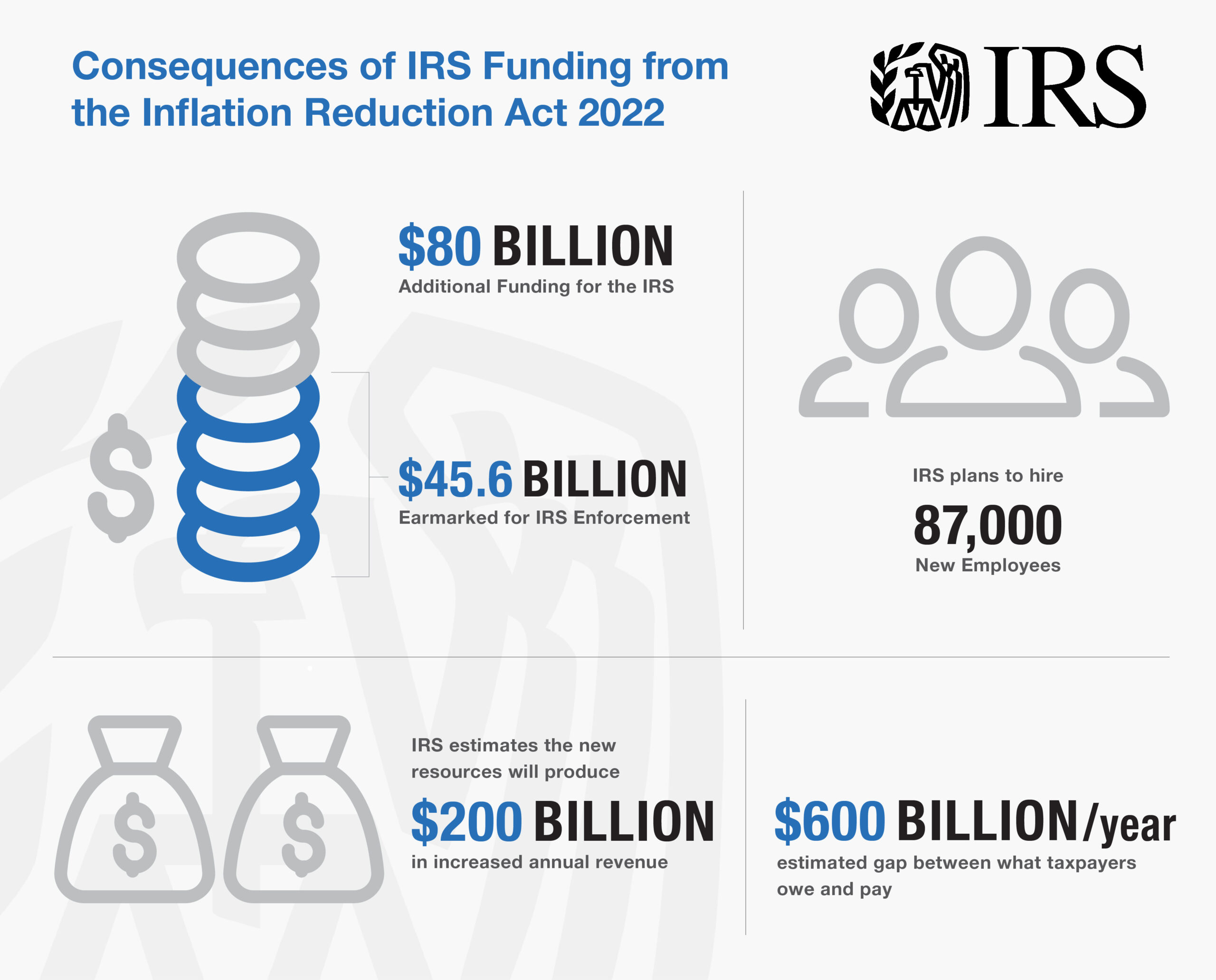
The Inflation Reduction Act of 2022 was recently signed into law with an eye-opening provision: the inclusion of nearly $80 billion in additional funding for the Internal Revenue Service (IRS). $45.6 billion of that is earmarked for IRS enforcement, which will be used to help the underfunded agency hire additional staff and conduct future audits in the hopes of collecting unpaid taxes.
Many publications cite the IRS plans to hire up to 87,000 new employees, though the actual number will be released in the coming months. These new hires will fill positions ranging from auditors to customer service representatives to IT specialists. The IRS has been plagued by more than a decade of budget cuts, which has limited its ability to modernize its old technology and staff appropriately. Since 2010, the agency’s enforcement staff has declined by 30%. The funding appropriate in the Inflation Reduction Act hopes to reverse this trend and bring in an estimated $203 billion in increased revenue.
The MGO Tax Controversy team breaks down what you need to know about this big change that could increase your risk of an audit.
How will the increase in IRS staff affect taxpayers?
Critics of the increase in IRS funding have claimed that the new resources will be used to target low to middle-income Americans and small businesses, burdening them with more audits and examinations. The Treasury Department refutes these claims reiterating they plan to focus primarily on large corporations and the wealthy — those more likely to evade paying their taxes — to close the tax gap, or the difference between what taxpayers pay in taxes and what they actually owe – an estimated to be $600 billion per year.
The IRS hopes the investment in funding will bring in around $203.7 billion in revenue because between 2015 and 2019, IRS audits declined significantly — 75% for Americans making $1 million or more and 33% for filers with low to moderate incomes. Lower-income Americans are mostly wage earners, so their audits are less complex and can be automated. However, more complex filers, notably large corporations and high-net-worth individuals and families – require the hands-on engagement of IRS agents and are most likely to experience increased levels of scrutiny from the new hires.
Ultimately, the average taxpayer should have an improved tax filing experience. New staff will be on hand to answer questions by phone, technology systems will be improved and modernized, and the backlog of unprocessed returns should diminish.
What is the timeline for implementing these changes?
While there is no set timeline, it is likely the way IRS audits work will change with the increase in funding. Currently, software is used to rank each tax return with a numeric score, and higher scores trigger an audit. Other mechanisms the IRS uses to determine candidates for audits include enforcement initiatives referred to as “campaigns” based on various criteria. The new funding will take time to phase in, and so will the hiring and training of new workers. It is expected new auditors will complete a six-month training program, starting small with cases involving a few hundred thousand dollars instead of tens of millions. Forbes performed some creative math to conclude while the funding will increase IRS audits, it is not likely to occur for the next few years.
How can I avoid future audits?
The best way to avoid an audit remains simple: pay your taxes on time and in compliance with tax laws. Simple accounting and documentation best practices are your best friend. If you feel you are at risk for a potential audit, you’ll want to get a head start now by ensuring your records are accurate and have been updated and maintained. Save your receipts and include every detail you can in your bookkeeping logs. If you do get audited in the coming wave, you’ll be glad you have all of this information organized and on-hand.
Our perspective on the increase in IRS staffing
The IRS has long been criticized because of their inability to provide taxpayers with the level and quality of service they deserve. The increase in funding as part of the Inflation Reduction Act should help. On the other hand, the number of tax audits is likely to increase, and you will want to be ready.
MGO’s dedicated Tax Controversy team can help by providing a holistic look at your tax filings as well as provide guidance for conflict resolution. From prevention to resolution, we guide you every step of the way.
If you’re an operator or investor in the cannabis industry, our Tax Practice recently published the Cannabis IRS Audit Survival Guide, which details everything you need to do to prepare for and navigate a tax audit. You can download the Guide for free here.
About the author
T. Renee Parker is a tax partner and the National Tax Controversy Practice Leader at MGO. With more than 15 years of tax controversy experience, she is a member of the IRS Tax Advocacy Panel and is well-versed in all areas of tax controversy. These include but are not limited to U.S. federal, state, and local tax audits; sales and use/payroll tax audits; international tax compliance related audits; negotiation and settlements with tax authorities; and corresponding and negotiation with tax authorities. Contact Renee at RParker@MGOCPA.com.
]]>- President Biden has signed the Inflation Reduction Act of 2022 into law.
- This large package contains many new tax credits to incentivize taxpayers to “go green” with energy from renewable resources while simultaneously receiving financial relief.
- It also extends or adds to currently existing credits for additional tax-saving opportunities.
On August 16, President Joe Biden signed the Inflation Reduction Act (IRA) of 2022 into law. Within the large tax reform package are numerous “green” tax credits focused on providing financial relief to taxpayers while incentivizing them to make sustainable choices and combat climate change.
These new credits are aimed at motivating taxpayers to use energy from renewable sources, prioritizing options like wind and solar. The IRA also introduces new credits and strengthens or extends existing credits that provide tax relief for purchasing new and used clean-energy vehicles and installing energy efficient heating and cooling systems. Additionally, companies that cut their methane emissions can access certain credits, while those that do not could face penalties.
The rules and regulations around claiming these green credits can be complicated. In this article, our Tax Credits and Incentives team breaks down how individuals and organizations can capitalize on these tax saving opportunities.
Swap gas guzzlers for an electric vehicle
Taxpayers that purchase a new or used “clean car” can qualify for this consumer tax credit. Vehicles considered clean are those that use a battery partly or fully manufactured in North America and built with materials extracted or processed in one of the countries currently in a free-trade agreement with the U.S.
Your income is a factor in how much you can reap in tax credits. If a taxpayer makes less than $150,000 annually (or has a combined family income below $300,000), the taxpayer can get up to $7,500 for new electric vehicles that qualify. Note the money would be applied at the point of sale, so the taxpayer’s monthly payments would be lowered (as opposed to reducing the tax bill months down the line).
Previously, the federal tax credit for electric vehicles did not include cars from manufacturers that already sold at least 200,000 models (GM, Toyota, and Tesla were excluded). This bill unravels that; instead, there is now a price threshold per vehicle. To qualify for the credit, bigger vehicles like SUVs, pickup trucks, and vans would have to cost less than $80,000 to qualify for the credits. Smaller vehicles are capped at $55,000. So, if you have your eye on a super sporty electric vehicle, you may be out of luck.
Taxpayers can also get $4,000 off a used electric vehicle if it is sold by a dealer for $25,000 or less — but only if they individually make up to $75,000 annually or $150,000 jointly. The addition of credits for used electric vehicle purchases is a win for the industry, and advocates of the bill are hopeful that this incentive will encourage an increase in electric vehicle adoption.
Modifying your home to be more energy efficient
To incentivize taxpayers to make their homes more energy efficient, the bill’s $4.28 billion High-Efficiency Electric Home Rebate Program provides rebates for low- and moderate-income households when they replace fossil-fuel boilers, furnaces, water heaters, and stoves with more efficient electric devices powered by renewable energy.
Some taxpayers will need to upgrade their electrical panels before they are able to install the new appliances. They can take advantage of up to $4,000 to do so. Furthermore, if they are interested in making their home generally more energy efficient, they can capitalize on a rebate of up to $1,600 given to seal and insulate their house, as well as up to $2,500 to improve their home’s wiring.
In terms of appliances, taxpayers can get up to $8,000 to install heat pumps that both heat and cool their home, plus as much as $1,750 for a heat-pump water heater. To offset the cost of a heat-pump dryer or electric stove, taxpayers can claim up to $840. It is estimated by making these changes, they can save significantly on their future energy bills.
There are several parameters for these rebates. First, the program runs through September 30, 2031 — so you do have time to implement these changes to your home. The maximum amount taxpayers can collect is $14,000, and to qualify, their household income cannot exceed $150% of the median income in the area they live. For those who do not qualify, there is a tax credit of up to $2,000 available to install heat pumps, plus up to $1,200 annually to install new windows, doors, or an induction stove.
Save when installing solar panels
Lastly, taxpayers can collect a 30% tax credit for installing residential solar panels through December 31, 2034. The credit decreases to 26% if you wait until after December 31, 2032. Taxpayers can also install solar battery systems to qualify for the tax credit.
New “green” tax credits
There are other ways taxpayers can take advantage of going green. Here are some of the new tax credits to capitalize on.
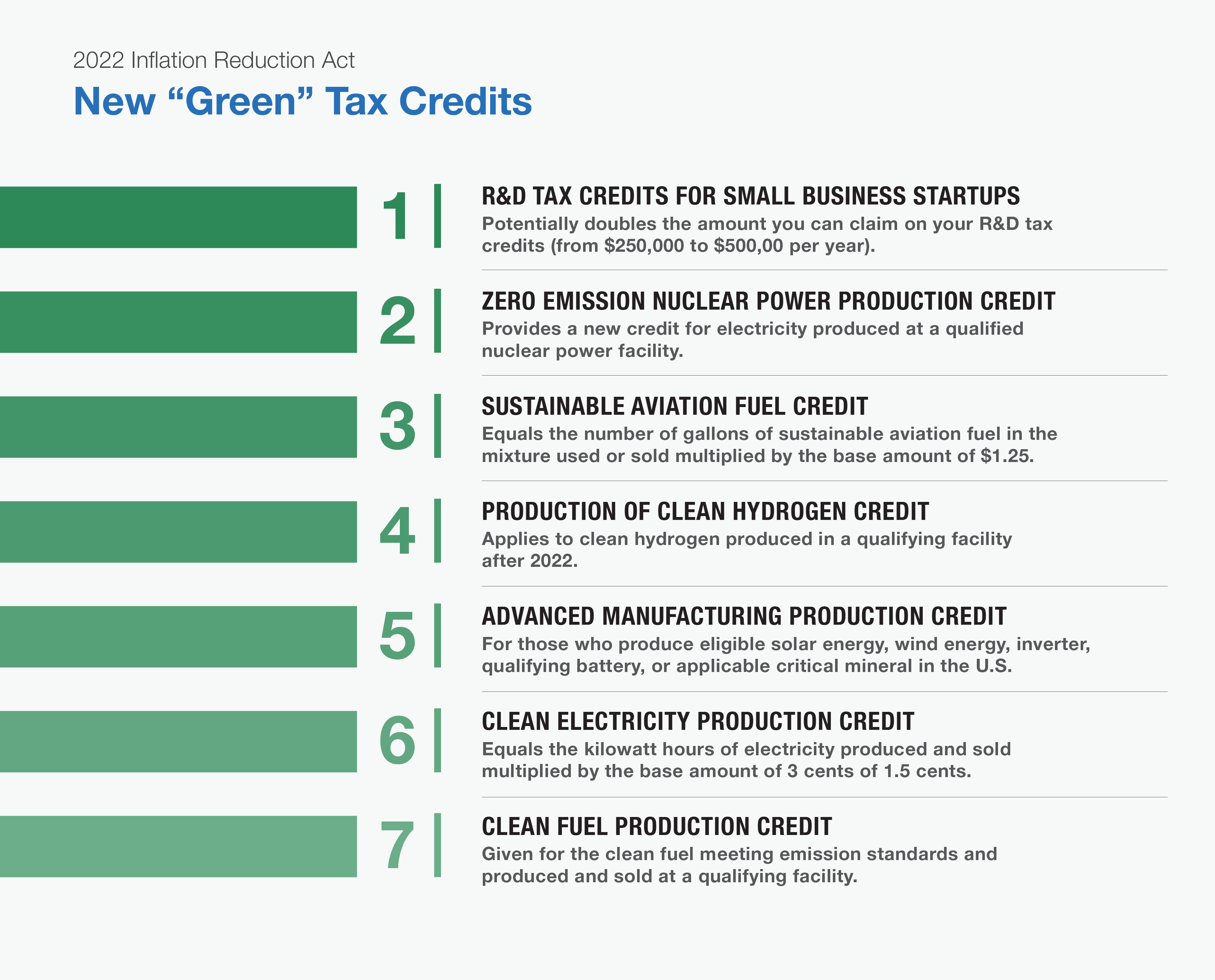
Doubling of R&D Tax Credits for Small Business Startups — Would potentially allow recipients to double the amount they can claim on any R&D tax credits (from $250,000 to $500,000 per year against payroll taxes).
Zero Emission Nuclear Power Production Credit — Provides a new business credit for electricity produced by a taxpayer at a qualified nuclear power facility before the date of enactment.
Sustainable Aviation Fuel Credit – Creates a new business credit for each gallon of sustainable aviation fuel sold or used as part of a qualified fuel mixture. The credit equals the number of gallons of sustainable aviation fuel in the mixture multiplied by the base amount of $1.25. There are increases available if the taxpayer meets certain greenhouse gas emissions reductions, and it applies to fuel sold or used in 2023 and 2024.
Production of Clean Hydrogen Credit — Given to producers of clean hydrogen during the ten-year period beginning on the date a qualifying facility is originally placed in service. It applies to clean hydrogen produced after 2022.
Advanced Manufacturing Production Credit — Provides a new production credit for each eligible solar energy component, wind energy component, eligible inverter, qualifying battery component, and applicable critical mineral produced by a taxpayer in the U.S. (or in U.S. possession and sold to an unrelated person). It applies to components and minerals produced and sold after 2022.
Clean Electricity Production Credit — New business credit for clean electricity facilities placed in service after 2024 (where the greenhouse gas emissions rate is not greater than zero). The credit amount equals the kilowatt hours of electricity produced and sold multiplied by the base amount of 3 cents or 1.5 cents. The credit will phase out one year after the later of 2032 or the year when annual greenhouse gas emissions from U.S. production are equal to less than 25% of the 2022 emissions rate (whichever comes first).
Clean Electricity Investment Credit — New investment credit for clean electricity property investments in energy storage technology and qualified facilities placed in service after 2024 where the greenhouse gas emissions rate is not greater than zero. It phases out after the later of 2032 or when the annual greenhouse gas emissions from U.S. electricity production are equal to or less than 25% of the 2022 emission rate (whichever comes first).
Clean Fuel Production Credit — Creates a business credit for the clean fuel a taxpayer produces at a qualifying facility and sells for qualifying purposes. The fuel must meet certain emissions standards.
Extension and modification of “green” tax credits
Several tax credits already in existence were extended and modified in the Inflation Reduction Act. They include:
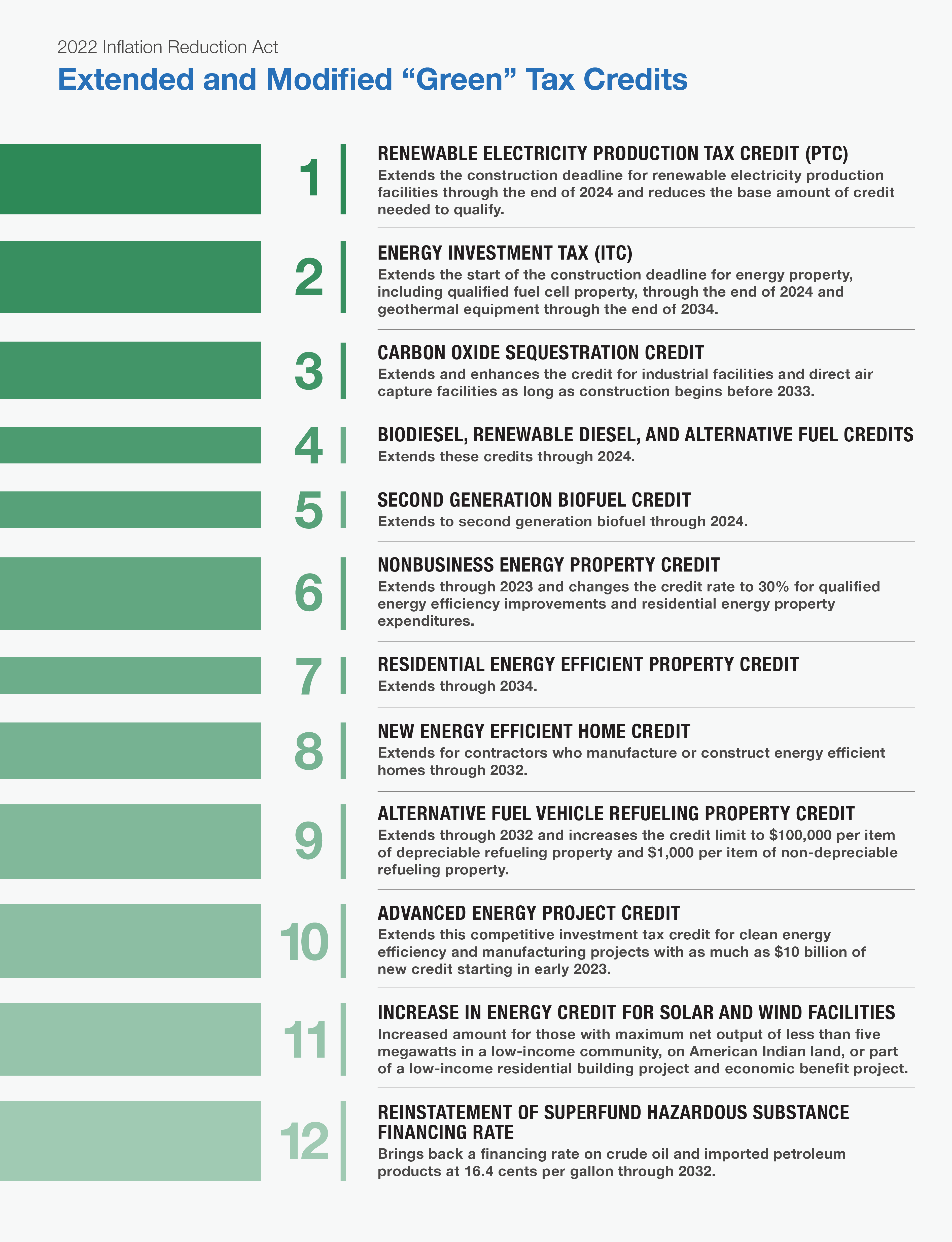
Renewable Electricity Production Tax Credit (PTC) — Extends the beginning of construction deadline for certain renewable electricity production facilities through the end of 2024, as well as reduces the base amount of credit with the potential to qualify for five times that amount. It applies to facilities placed in service after 2021, and increases the credit amounts for domestic content, energy communities, and hydropower.
Energy Investment Tax (ITC) — Extends the beginning of construction deadline for some types of energy property, including qualified fuel cell property, for one year through the end of 2024. It extends the beginning of construction deadline for geothermal equipment through the end of 2034 and permits the credit for new types of energy property like energy storage technology, microgrid controller property, and qualified biogas.
Carbon Oxide Sequestration Credit — Extends and enhances carbon oxide sequestration credits for qualified industrial facilities and direct air capture facilities IF construction begins before 2033. It also lowers the minimum carbon capture requirement, and generally applies to those facilities and equipment placed in service post-2022.
Tax Credits for Biodiesel, Renewable Diesel, and Alternative Fuels — Extends these tax credits through 2024 and apply to fuel sold or used after 2021.
Second Generation Biofuel Credit — Extends tax credits to second generation biofuel through 2024 and applies to second generation biofuel production after 2021.
Nonbusiness Energy Property Credit — Extends this credit through 2023, as well as changes the credit rate to 30% for both qualified energy efficiency improvements and residential energy property expenditures. It replaces the $500 lifetime limit with a $1200 annual limit, modifies the limits for specific types of property, and modifies standards for qualified energy efficiency improvements on property placed in service after 2022.
Residential Energy Efficient Property Credit — Extends the residential energy-efficient property credit through 2034 and replaces the credit for biomass fuel property expenditures with a new credit for battery storage technology expenditures on those made after 2022.
New Energy Efficient Home Credit — Extends the business credit for contractors who manufacture or construct energy efficient homes through 2032. It applies to dwellings acquired by the contractor after 2022.
Alternative Fuel Vehicle Refueling Property Credit — Extends the tax credit through 2032 and increases the credit limit to $100,000 per item of depreciable refueling property and $1,000 per item of non-depreciable refueling property.
Advanced Energy Project Credit — Extends the competitively awarded investment tax credit for clean energy and energy efficiency manufacturing projects. It provides as much as $10 billion of new credit allocations effective in early 2023.
Increase in Energy Credit for Solar and Wind Facilities — In order to qualify, one must have a maximum net output of less than five megawatts and must be in a low-income community, on American Indian land, or part of a low-income residential building project (or low-income economic benefit project), effective in early 2023.
Reinstatement of Superfund Hazardous Substance Financing Rate — Reinstates a financing rate on crude oil and imported petroleum products at a rate of 16.4 cents per gallon through 2032.
Our perspective on the Inflation Reduction Act’s tax credits
Looking ahead, it is imperative that you are ready to capitalize on these tax credits. Getting into the weeds with some of the qualifications, however, could prove challenging, and working with a professional services firm could make all the difference in ensuring you take advantage of the credits you qualify for.
At MGO, our dedicated Tax Credits and Incentives team brings more than 30 years of experience in helping you structure your expenses in a way that will help you acquire appropriate documentation, assist in calculating and claiming credits, and maximize the amount you can receive. Our full-service firm, led by experienced CPAs and attorneys, provides a holistic approach to examining your organization and determining how you can best reach your goals.
About the author
Michael Silvio is a partner at MGO. He has more than 25 years of experience in public accounting and tax and has served a variety of public and private businesses in the manufacturing, distribution, pharmaceutical, and biotechnology sectors.
]]>While the legislation is certainly complex, it will serve as a catalyst for the public and private sectors and allow the United States to align itself with the goals and interests of the largest global economies.
Or, as Bill Gates puts it, “(the Inflation Reduction Act) represents our best chance to build an energy future that is cleaner, cheaper and more secure.”
To date, the Inflation Reduction Act has been met with varying opinions (both positive and negative). However, there is no question that it will provide ample opportunities and incentives for existing businesses to capture new value.
Below, MGO’s Environmental, Social, and Governance (ESG) team breaks down a subset of the most important objectives you need to be aware of.
Objective #1: Supporting emerging climate technology
On its surface, carbon capture (or the process of removing carbon dioxide from the atmosphere and locking it away) offers opportunities to slow, limit, or even reverse climate change — especially if done at scale.
Carbon removal startups continue to research and innovate new technologies which will eventually remove many tons of CO2 from the atmosphere each year. These technologies are still relatively young and require additional financial investment in order to reduce costs and enhance impact.
With the passing of the act comes a new wave of funding, which carbon removal experts and startups are eager to take advantage of. Specifically, the bill will:
- Increase tax credits for permanent carbon removal from $50 to $180 per ton (using direct air capture)
- Significantly lower the amount of carbon companies must remove to qualify (100,000 tons to 1,000 tons)
While there are criticisms of this objective, effective policies and technologies are needed to explore climate change.
Objective #2: Individual tax credits
The Inflation Reduction Act also provides a host of environmental and clean energy tax rebates, credits, and incentives for taxpayers.
In a nutshell, the bill incentivizes taxpayers to seek out and use clean energy – prioritizing wind, solar, and other renewable sources. It also extends credits to taxpayers who purchase new or used clean-energy vehicles, as well as individuals who install energy efficient heating and cooling systems in their homes.
Keep in mind, both come with perimeters, including the amount of annual income you claim. A
Objective #3: Paying for the bill
Here are three ways Congress plans to fund the Inflation Reduction Act:
A minimum corporate tax rate on profits. The legislation will impose a tax rate of 15% on corporations that have at least $1 billion in profits. This will bring in approximately $222 billion in funding.
Increased IRS scrutiny. With strengthened, additional tax enforcement, the gap between what taxpayers owe and what the agency is collecting will shrink, allowing the agency to collect an approximate $124 billion.
Tax on stock buybacks. The Democrats added a 1% excise tax on stock buybacks when revising a draft of the Inflation Reduction Act. (Refresher: a stock buyback occurs when a publicly traded company buys its own stock back to raise the value of its shares). It is estimated that an additional $74 billion in funding will come from this portion of the bill.
Our perspective on how the Inflation Reduction Act will impact the ESG space
Many are calling the Inflation Reduction Act the biggest piece of climate legislation in American history. With $369 billion in subsidies and tax credits in electric vehicles, solar power, renewable energy, carbon capture and storage, the U.S. (which is the world’s second-biggest carbon emitter) is taking a leading position in the global energy transition.
]]>- Increasing Internal Revenue Service (IRS) budget
- Implementing a corporate tax minimum
- Instituting and increasing tax credits focused on investing in green technologies
Notable items that were not addressed in the IRA include removing the $10,000 SALT cap and mandatory capitalization of research and development (R&D) expenses, both provisions of the Tax Cuts and Jobs Act of 2017.
The bill is over 300 pages in length with a number of wide-ranging components. In the following summary we’ll provide the key points that will be affecting taxpayers in the coming years.
Additional funding to the IRS for tax enforcement
One of the most talked-about provisions involves increased funding for the IRS.
Key details:
- Approximately $80 billion in funding over the next 10 years for tax services, operations support, business system modernization, and enforcement
- Enforcement – $46 billion
- Operations support – $25 billion
- Business systems modernization – $5 billion
- Taxpayer services – $3 billion
- An estimated $124 to $200 billion will be generated from enforcement and compliance efforts
- Enforcement is focused on taxpayers – both corporate and non-corporate – with income greater than $400,000
Extension of the business loss limitation of noncorporate taxpayers
The IRA extends the excess business loss limitation for noncorporate taxpayers.
Key details:
- Two year extension on IRC Sec. 461(l) until December 31, 2028
- IRC Sec. 461(l) limits noncorporate taxpayers from deducting business losses above thresholds that are annually indexed for inflation
- These limits are $540,000 for married filing jointly and $270,000 for single and married filing single for the 2022 tax year
- Suspended amounts are converted to net operating losses and may be able to be used in subsequent years
Excise tax on repurchases of corporate stock
The IRA includes a 1% excise tax on stock repurchases by domestic public companies listed on an established securities market. The tax applies to repurchases executed after December 31st, 2022.
Key details:
- 1% excise tax on the full market value (FMV) of stock repurchased by publicly traded US corporations
- Will impact redemptions and certain acquisitions and repurchases of publicly traded foreign corporation stock
- Not an income tax for purposes of ASC 740
- Includes special rules for “applicable foreign corporations” and “surrogate foreign corporations”
- Notable exceptions:
- Stock is contributed to employer sponsored retirement plan
- Stock repurchase is part of a corporate reorganization
- Total value of stock repurchased during the taxable year does not exceed $1 million
- Repurchase by securities dealer in ordinary course of business
- If the repurchase qualifies as a dividend
- If the repurchase is by a regulated investment company (RIC) or a real estate investment trust (REIT)
15% corporate alternative minimum tax
The IRA reinstates the corporate alternative minimum tax (AMT) for large corporations, which had been previously eliminated by the Trump Administration’s Tax Cuts and Jobs Act.
Two key elements to note is that this revised AMT only impacts corporations with annual profits exceeding $1 billion, and includes carve-outs for certain manufacturers and subsidiaries of private equity firms.
Key details:
- 15% tax on adjusted financial statement income (i.e., this would be a book minimum tax)
- Affects tax years beginning after December 31, 2022
- Applies to corporations with profits over $1 billion based off adjusted financial income
- For US corporations with foreign parents, it would apply to income earned in the US of $100 million or more of average annual earnings in three prior years and where the overall international financial reporting group has income of $1 billion or more
- Treatment of split offs remains uncertain. Even though these are tax-free reorganizations for tax purposes, gain is recorded for financial accounting purposes
- Joint Committee on Taxation expects that this new tax would apply to only about 150 corporate taxpayers, approximately equal to 30% of the Fortune 500
Tax credit additions and modifications
A significant number of provisions add or enhance credits and incentives that pertain to domestic research and green energy initiatives. Noteworthy changes include:
Increased small business payroll tax credits for research activities:
- Qualified payroll tax credit for increasing research activities raised from $250,000 to $500,000
- First $250,000 will be applied against the FICA payroll tax liability. Second $250,000 will be applied against the employer portion of Medicare payroll tax.
- Applies for taxable years beginning after December 31, 2022
- Limited to tax imposed for calendar quarter with unused amounts being carried forward
- Qualifying small businesses are required to have less than $5 million in gross receipts in current year and no gross receipts prior to the 5 year period ending with the current year
Green initiative tax credits and incentives:
- Credits for purchasing new and previously-owned clean vehicles
- Extension of IRC Sec. 45L – New Energy Efficient Home Credit – extended to qualified new energy efficient homes acquired before January 1, 2033. Increase value of available credit for single-family homes to $2,500 and modified the credit available for multi-family homes.
- Extension, increase, and modifications to IRC Sec. 25C nonbusiness energy property credit
- Extension and modification of IRC Sec. 25D residential clean energy credit
- IRC Sec. 48 energy credit for businesses and investors
- Expansion of qualifying property, extension of credit including phasedown and phaseout rules, and introduction of incentives
- Credit for producing energy from renewable sources (IRC Sec. 45)
- Retroactive for facilities placed in service after December 31, 2021
- Extends beginning of construction deadline to projects beginning construction before January 1, 2025 including solar energy facilities
- Increased energy credit for solar and wind facilities in certain low-income communities
- New credit for clean hydrogen production
- New credit for zero-emission nuclear power
- Extension of incentives for biodiesel, renewal diesel, and alternative fuels
- Extension of biofuel producer credit
- New income and excise tax credits allowed for sustainable aviation fuel
- Modification of IRC Sec. 179D – Energy Efficient Commercial Buildings Deductions
- Modification of building qualifications
- Deduction increased from $1.88 per square foot to up to $5 per qualified square foot
- Changes in depreciation for certain green energy properties
Final thoughts
The Inflation Reduction Act should have wide-ranging impacts on taxpayers, especially large corporations and high-net-worth individuals. In the coming weeks our tax leaders will dive into the specifics of the legislation, outline immediate and long-term impacts, and provide tax-planning strategies and considerations.
]]>