- Environmental, social, and governance (ESG) information helps investors, regulators, and the public-at-large understand and interpret a government entity’s risk profile and its ability to drive positive impact.
- To present this information publicly, government entities are developing robust “Climate Action Plans,” which are reviewed and refreshed on a periodic basis.
- As disclosing ESG-related information to the public becomes more common, government entities are also expanding ESG-related disclosures within annual financial reports.
Coined in a 2004 United Nations report, the term “environmental, social, and governance” (and its accompanying acronym “ESG”) is less than 20 years old. Yet, you would be hard-pressed to find a boardroom today where ESG is not top of mind. It is not just businesses either — ESG is also an increasingly important topic of discussion within government organizations.
State and local governments use ESG-related information as a mechanism to measure and track priorities, footprints, and targets. As governments have matured, ESG reporting and presented information more consistently with year-to-year comparability, investors*, regulators, and the public-at-large have sought out this reporting to help them understand risk and the government entity’s ability to drive positive impact.
*Note: The term “investors” refers to those who are exploring and/or holding investments in government-issued securities (e.g., hedge funds, institutions, individuals, etc.).
The Increasing Importance of “Climate Action Plans”
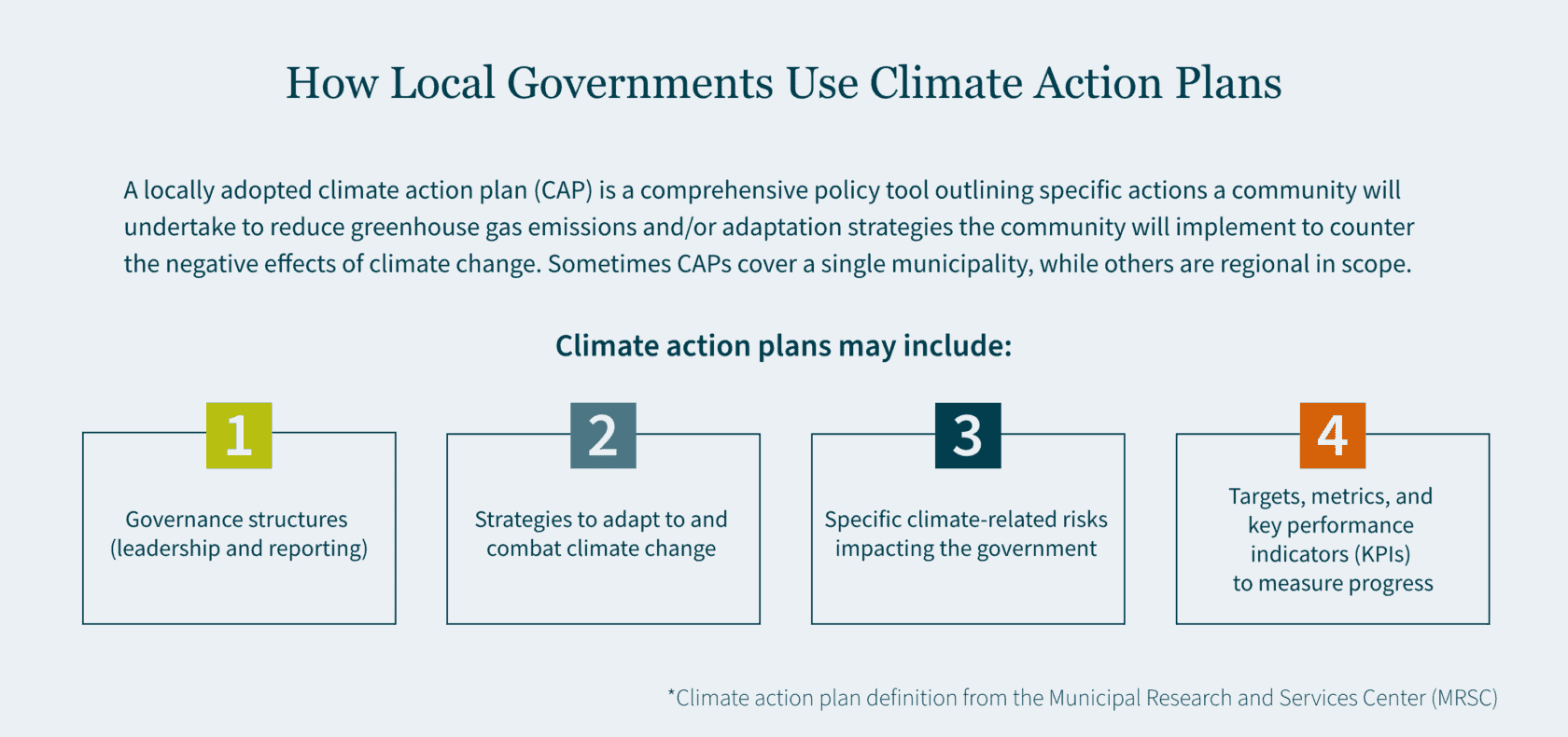
To present ESG-related information to the public, many government entities develop and communicate robust “Climate Action Plans”. These plans highlight a myriad of information, including (but not limited to):
- Governance structures (e.g., communication and reporting lines from environmental leadership into the mayor’s office)
- Strategies to adapt to and combat climate change
- Specific climate-related risks, which impact the government entity
- Targets, metrics, and key performance indicators (KPIs) used to measure progress
As Climate Action Plans continue to evolve, governments are commanding and allocating more financial resources to activate these plans. With the increased focus on climate-related initiatives presented in Climate Action Plans, we are seeing an expansion of ESG-related information disclosed within “Annual Comprehensive Financial Reports” across the country — a sign that financial disclosures are maturing to meet growing interests from investors, regulators, and the public-at-large.
A Growing Push from Investors and Regulators
The focus on non-financial risks (including, but not limited to, ESG-related risks) by investors and regulators continues to intensify. When we take a step back to analyze the trend, a few things become clear:
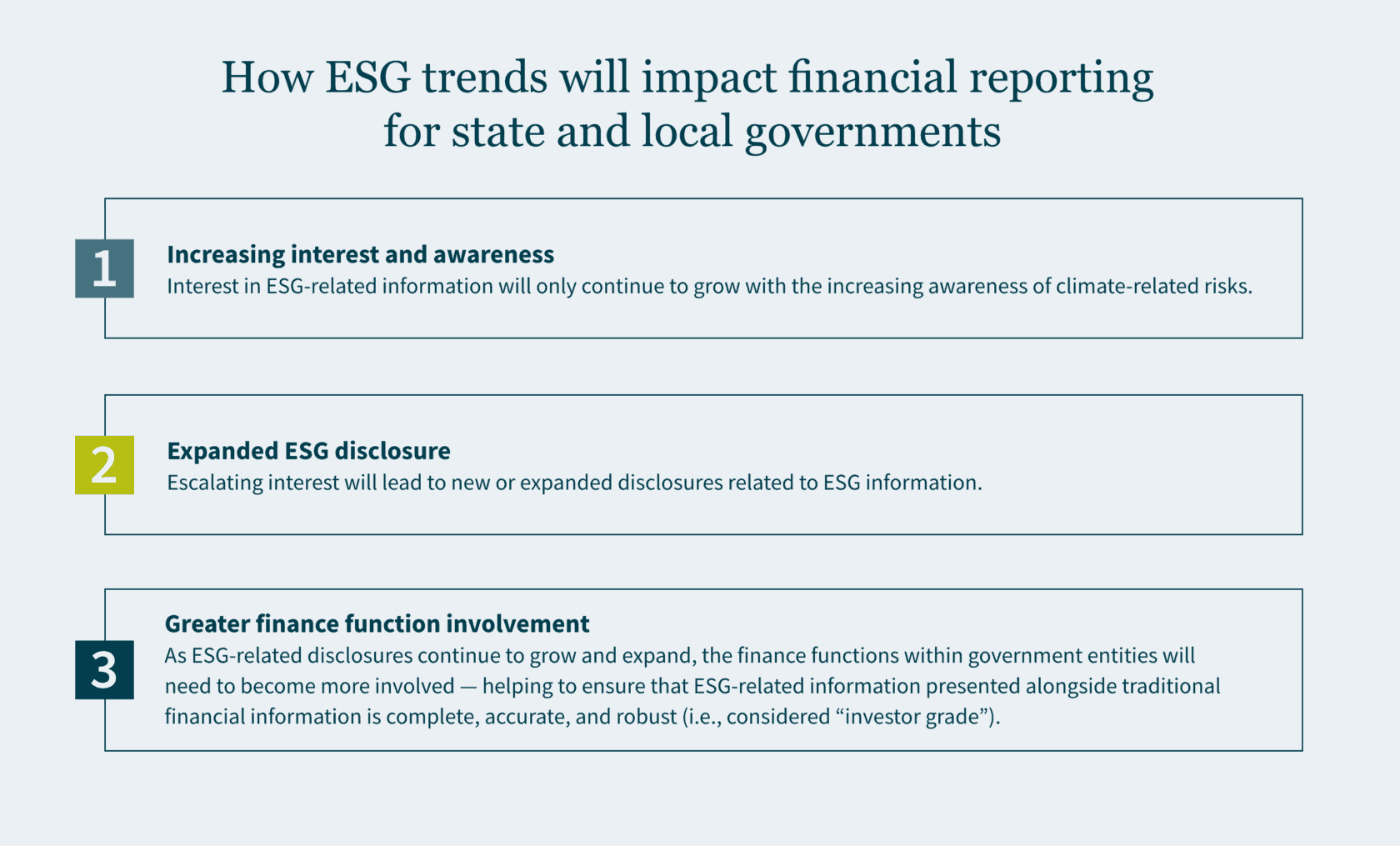
- Interest in ESG-related information will only continue to grow with the increasing awareness of climate-related risks.
- Escalating interest will lead to new or expanded disclosures related to ESG information.
- As ESG-related disclosures continue to grow and expand, the finance functions within government entities will need to become more involved — helping to ensure that ESG-related information presented alongside traditional financial information is complete, accurate, and robust (i.e., considered “investor grade”).
To dive deeper into that last point, where would a finance function start? The short answer is by increasing the integration and collaboration between a government entity’s environmental leaders and the finance functions. The longer answer is that government entities need to develop holistic approaches to collecting and reporting robust ESG-related information to meet the expectations of investors, regulators, and the public-at-large.
The bottom line: As the issuance of and investment in municipal securities continues to grow, the quality of ESG-related information disclosed to the public will need to be enhanced to meet the demands of investors.
Transparency in Budgets and Financial Reporting
With an increase in ESG-related disclosures in annual financial reports by government entities, recent interpretive guidance from the Governmental Accounting Standards Board (GASB) indicates that government entities can expect further scrutiny and regulation as these types of disclosures become more commonplace.
Essentially, it is important for your government to have a robust, well-communicated ESG “story” within a Climate Action Plan — but you also must provide investor-grade transparency within audited financial statements. Government entities are already beginning to meet this challenge. Two examples of local governments with a growing presence of ESG-related information in their Annual Comprehensive Financial Reports are the City and County of San Francisco and the City of Fremont.
The City and County of San Francisco transparently discloses both environmental and social initiatives, capturing details related to its Environmental Protection Fund, as well as specific details related to revenues received from state, federal, and other sources for the preservation of the environment.
The City of Fremont — which is much smaller in terms of population (~230,000) and financial resources (roughly $1.5 billion in total primary government assets from “government activities”) — depicts ESG-related information throughout its annual report, including but not limited to qualitative information in the “management discussion and analysis” section, as well as quantitative information related to “community development and environmental services.”
The Path Forward: Enhancing Your ESG Reporting
With ESG-related information becoming more integrated into investor decision-making, your government needs to focus on enhancing its Climate Action Plans and developing “investor grade” disclosures related to ESG risks and opportunities for inclusion within your traditional financial reporting. These initiatives will require additional financial resources and human capital to create and maintain — and further collaboration between environmental, social, and financial leaders will be needed to drive the change.
How MGO Can Help
Incorporating ESG disclosures into financial reporting can pose challenges to states and local governments unfamiliar with ESG reporting standards. With experience providing ESG solutions, our State and Local Government Practice will work with your team to meet requirements and make information “investor-ready,” while also ensuring accountability and transparency.
]]>To read more about how California’s PTET works from our Insight Library, see here and here.
California’s PTET considerations
To make the election in California for tax year 2022, eligible entities must pay in the greater of $1,000, or 50% of the 2021 PTET liability, by June 15, using FTB 3893. Entities that fail to make this “safe harbor” payment will not be able to make the election on the 2022 tax return. (Note: The election can only be made on an entity’s timely filed original tax return.)
New York extends its 2022 PTET deadline
Previously, the deadline for making the 2022 election was March 15, 2022, but recent legislation not only extended the deadline but also increased the amount of benefit for resident S corporations. Under the prior legislation S corps could only make the election as to the portion of income that is sourced to NY; however, new legislation (A10080/S8948) enables S corporations, for which all owners are New York residents, to include income from all sources, which has the effect of increasing the amount of available credit on the individual owners’ returns. And because these rules went into effect after the PTET election due date for tax year 2022, New York extended its PTET election deadlines for all taxpayers. Now, passthrough entities can make their PTET election any time by or before September 15, 2022.
Accompanying the deadline extension is a new schedule of estimated payments, contingent on when the eligible entity makes the election. Taxpayers must still pay the entire amount of estimated PTET liability by the end of the year (90% of the PTET shown on the entity’s return for the taxable year; or 100% of the PTET shown on the preceding year’s return). However, instead of owing 25% each quarter (March 15, June 15, September 15, and December 15), taxpayers that make the election prior to June 15, 2022, only need to pay an amount equal to 25% of the required annual PTET liability by June 15, followed by 50% due in September, and the remaining 25% by December 15. And taxpayers that make the election after June 15 but before September 15, must submit a payment equal to 50% of the annual liability by September 15, with the other 50% due December 15.
You can find links here to make the election and submit payments online.
MGO’s insights
If you missed making the CA election on the 2021 return, the silver lining is that you can now “lock in” eligibility with a payment of only $1,000 on June 15, regardless of the amount of taxable income the entity ultimately reports. If you did make the election on the 2021 return, be sure to pay at least 50% of prior year liability (and consider adding a cushion for good measure), as there does not appear to be a “reasonable cause” exception to the rule.
And remember, most tax professionals have interpreted IRS Notice 2020-75 to allow the entity only to claim a deduction for the expenses actually incurred during the applicable tax year — regardless of whether the entity is on a cash or accrual basis accounting method. This means that if you intend to experience the full benefit of a state’s SALT Cap Workaround on your 2022 tax return, you will need to submit the full amount of PTET liability before the end of the year. Amounts paid after the end of the year but before the return deadline (March 15, for most taxpayers) will be deducted on the following year’s federal tax return regardless of when they are credited to state tax liability.
Thus, if the entity made the election in 2021 and paid the PTET before December 31, 2021, then it should (or should have already) claimed the entire amount of PTET credit as an ordinary expense deduction on its tax return (and reported on the owners’ K-1s, generally, line 13). But if the payment was submitted between January 1 and March 15, 2022, that payment, plus the upcoming payments, will be deducted on the 2022 return alongside the other payments made during the tax year.
Final perspectives
To take advantage of the 2022 CA and NY SALT Cap workarounds, make sure to submit your payment by June 15, 2022 for the California PTET, and your election and any necessary payments by September 15, 2022 for the New York PTET.
Only state PTET payments made during the entity’s fiscal tax year are deductible on that year’s federal tax return, so in addition to meeting the state’s minimum estimated tax requirements to ensure eligibility, consider making grossed-up estimated payments before year end to maximize the economic effect of the deduction on the 2022 return.
The PTET rules are different in every state, and with a near-constant stream of amendments and clarifications from state legislators and tax agencies, you may be unsure what is due when. MGO’s tax team can provide you with reminders for payment submission deadlines and calculate amounts due to help you navigate this opportunity for tax savings.
Please get in touch and see how New York, California, or another state’s PTET can benefit your business.
]]>Previously, you were not mandated to include independent contractors under the state’s new hire reporting requirement; now you’ll have to add them to the list of other new hires or rehires to report.
If your organization falls into one of the following categories, you’re required to report your new hires for tax purposes:
- Labor organizations, including union-operated placement offices (I.e., hiring halls),
- Employers of individuals performing domestic services,
- Government entities excluding federal agencies.
Your organization will have to report those new hires or rehires, including independent contractors, within 20 calendar days from the date hired. The hiring date is defined as the first day the employee or contractor:
- Is eligible to collect commissions for any job performed based only on commissions,
- Completes the services for which they will be paid (collecting tips, wages, commissions, or another agreed-upon compensation).
If you are an employer looking for clarification regarding additional reporting requirements in New York State (including how to actually file), please contact MGO’s tax team to talk to an advisor who can comprehensively walk you through the steps and ensure you avoid any missteps that could affect your organization.
]]>By Scott P. Johnson, CPA, CGMA
Partner, Macias Gini & O’Connell LLP
State and Local Government Advisory Services
I have spent most of my professional career over the past 35 years serving government agencies and focusing on performance improvement, accountability, and transparency. I recognize the need for continuous monitoring and oversight in the public sector to ensure performance, public accountability, and stewardship of public resources. While participating on a number of professional panels and presentations throughout my career, I have often stated that I embraced the auditor and have welcomed them with open arms into the organizations that I had responsibility over. Why? Because I see auditors as an independent and objective lens, adding value to review and evaluate performance and to make recommendations for improvement. The organizations I have had the pleasure to work for took public accountability very seriously and supported performance improvement as a means to better serve their communities and stakeholders.
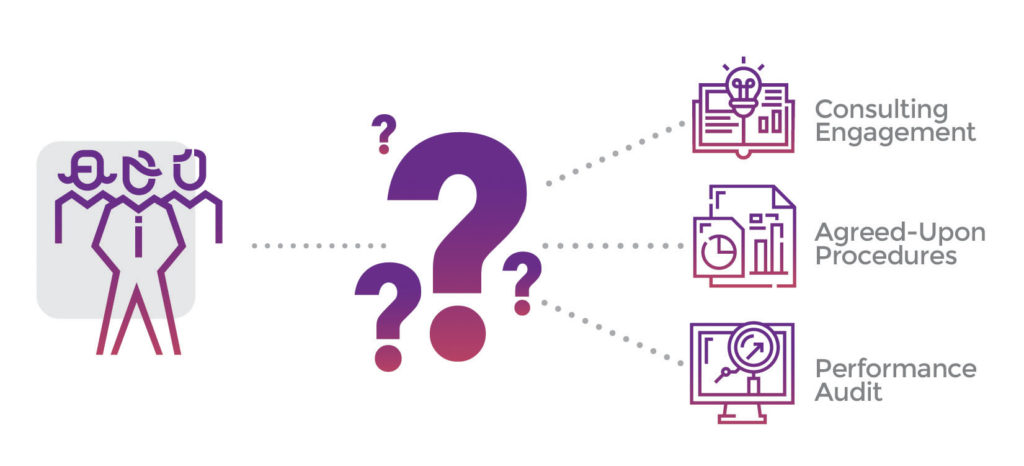
Much like a traditional CPA firm can provide different types of services related to an entity’s financial statements, i.e., audit, review, or compilation, based on need, when government agencies are considering an independent evaluation of performance of their programs or operations, the CPA firm’s advisory or consulting arm can step in and offer a number of engagement types based on the agency’s unique needs: consulting services engagements, attestation engagements (e.g., agreed-upon procedures), and performance audits. It all depends on if, and at what level, assurance is needed. The primary driver of what type of product should be considered is typically based on, for instance, issue complexity, taxpayer concerns or expectations, statute requirements, or increased need for transparency on the efficiency and effectiveness of operations. While the driver of the engagement may differ, time constraints and budget are also determining factors.
This is the first article in a three-part series focusing on performance audits. The primary focus of this article is to discuss the differences of the three aforementioned types of engagements – consulting services, agreed-upon procedures, and performance audits – and to provide guidance when a performance audit might be an option.
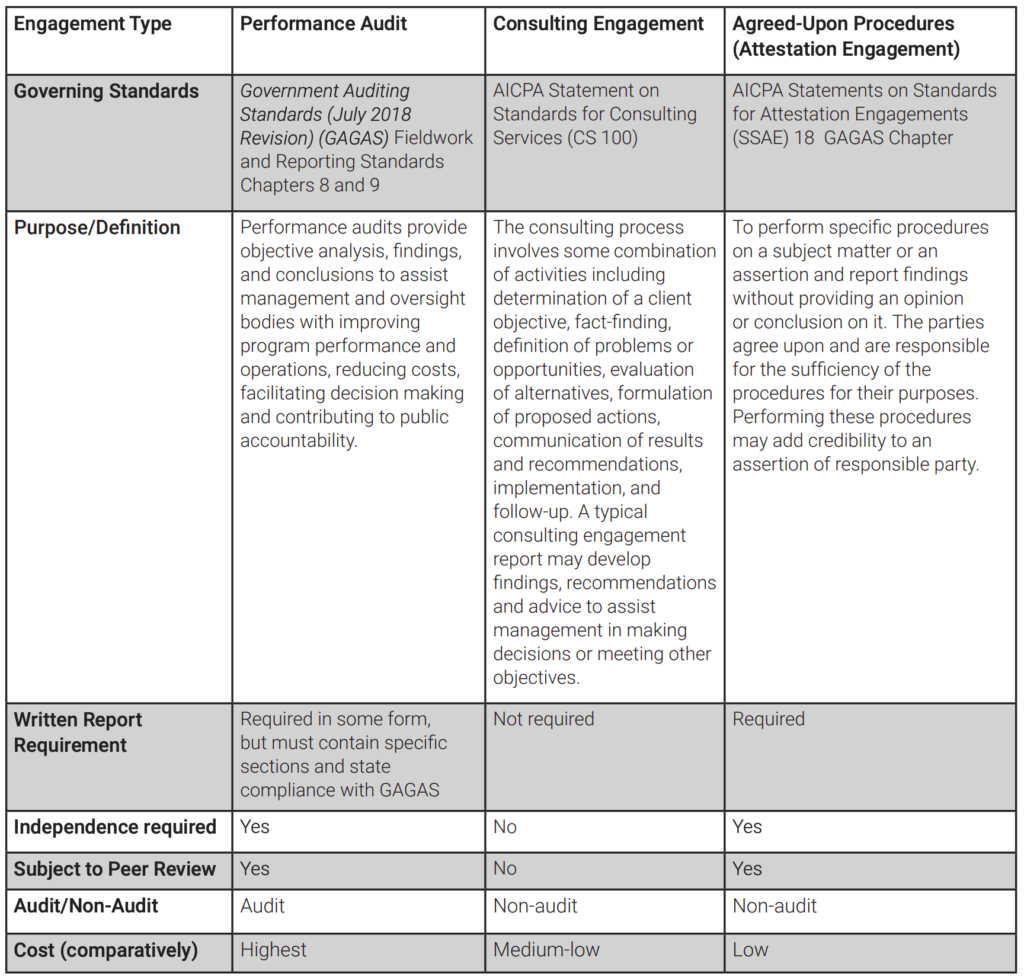
It is important to identify the differences between (1) performance audits, (2) consulting services engagements, and (3) agreed-upon procedures attestation engagements. On numerous occasions throughout my government service career and also while serving clients, questions have come up regarding the objectives sought, the scope of the engagement, and the engagement type when considering an evaluation of performance for a particular program or area of operations. Each of these engagements differ in purpose and reporting requirements, as well as potential cost, as shown below in Figure 1.0. These engagements are governed by different standards, formal reports are not always required for each, and independence is not always required (i.e., consulting services).
Performance Audits Defined

Performance audits are defined as engagements that provide objective analysis, findings, and conclusions to assist management and those charged with governance and oversight to, among other things, improve program performance and operations, reduce costs, facilitate decision making by parties with responsibility to oversee or initiate corrective action, and contribute to public accountability. *1
Furthermore, GAGAS states that management and officials of government programs are responsible for providing reliable, useful, and timely information for transparency and accountability of these programs and their operations. Legislators, oversight bodies, those charged with governance, and the public need to know whether (1) management and officials manage government resources and use their authority properly and in compliance with laws and regulations; (2) government programs are achieving their objectives and desired outcomes; and (3) government services are provided effectively, efficiently, economically, ethically, and equitably. *2
Agreed-Upon Procedures (AUP)

Based on my experience, it usually comes down to identifying a few factors that determine the engagement. First, the agency must determine the purpose and scope of the work, specifically what questions they would like to have answered. These questions can be broad or very narrow. For example, in an AUP, management may make an assertion about whether a subject matter is in accordance with, or based on, established criteria that is the responsibility of a third party and hires a CPA to add credibility to that assertion by performing specific procedures to test compliance with the criteria. If an agency needs to know something very specific and wants an independent party to perform specific procedures and tell them what was found, then an AUP is appropriate. However, an AUP report does not provide recommendations, an opinion, or conclusion about whether the subject matter is in accordance with, or based on, the criteria, or state whether the assertion is fairly stated. While the agency may want to use an AUP, some key steps that are taken in consulting engagements and performance auditing, such as planning, are not required in an AUP engagement. Also, risk is not assessed in developing the scope, nor does the auditor use a risk-based approach, which is required in a performance audit. Finally, in an AUP, auditors do not perform sufficient work to be able to develop elements of a finding or provide recommendations.
1 See Paragraph 1.21 of GAGAS.
2 See Paragraph 1.02 of GAGAS.
Consulting Services Engagement vs. Performance Audit

For a consulting services engagement or performance audit, the initial questions are then turned into the objectives of the engagement. If the agency wants an objective review of operations or a program to assist them in making decisions, for example, to assess the management of specific funds, and wants findings and recommendations to improve operations, then the agency should discuss the options of a consulting services engagement or a performance audit. From here, the decisions are truncated. The agency needs to consider whether the report is for an internal audience, such as governing officials, management, or staff, or an external audience, e.g., a regulatory agency or the public. If the communication is intended for internal use, then a consulting services engagement with observations and recommendations may suffice. For these engagements, findings, recommendations, and a conclusion is provided to assist management in decision making. Or, an independent third party, such as a CPA or an internal auditor, may be asked to answer the engagement’s objectives to an external audience, in which case a performance audit may be more appropriate due to the need for an independent, objective report that can withstand scrutiny and is subject to peer review. Sometimes there isn’t a choice; some agencies are bound by the government code or local ordinance to conduct audits under GAGAS.
Performance audits are typically the more costly engagement type of the three, given the amount of work required to conduct an audit and adhere to stringent standards. As we’ll explore in later articles, performance audits conducted under GAGAS provide the highest level of assurance among the three options, based on the level of work required. These audits involve developing the required elements of a finding and the documentary evidence required for planning, fieldwork, and reporting. The amount of work involved is much greater than in consulting services engagements, where observations and recommendations will suffice. Consulting services engagements are not audits and, therefore, offer no assurance. Similarly, in attestation engagements, where only specific procedures are performed, no assurance is provided. *3
Conclusion
Having been on both sides of deciding what engagement to recommend, either for an agency I worked at or to a client, it’s important to discuss the level of work required for each engagement type, the number of hours required to do the work under the appropriate standard within a reasonable time period, and the available budget. Finally, and most importantly, clients should understand that performance audits and consulting services engagements each have their place and serve unique purposes. A performance audit offers independence and objectivity at a step above a consulting services engagement, and might be the best option if a rigorous audit of a program or agency is needed. This is where the consideration of the agency’s need is paramount. There may not always be the budget or time available to conduct a comprehensive performance audit, nor a need for an in-depth evaluation or a legislative requirement to do so. In these instances, a consulting services engagement is a good option, especially when time and budget are factors. A consulting services engagement can provide a sufficient report with recommendations and advice. However, it’s important to make the agency aware of the limitations of non-audit services. In addition, the audience of the final report product and any regulatory requirements should strongly influence the decision-making process.
Forthcoming articles in this series will drill down and focus in more detail on the professional standards associated with performance audits as compared to other types of engagements, “why” an agency would want a performance audit instead of a consulting engagement or an agreed-upon procedures engagement, when a performance audit would be recommended, what key factors should be considered, and what are the expectations of the audience of the report. The third article in this series will focus on the reporting elements of a performance audit and a sample performance audit report.
*3 Attestation engagement standards are covered in GAGAS Chapter 7, and include agreed-upon-procedures, reviews, and examination engagements. Attestation examinations have the highest level of assurance, as an opinion is given; not so for the others. Auditors may use GAGAS in conjunction with other professional standards such as American Institute of Certified Public Accountants (AICPA), International Auditing and Assurance Standards Board (IAASB), or Public Company Accounting Oversight Board (PCAOB) standards. For financial audits and attestation engagements, GAGAS incorporates by reference for AICPA Statements on Auditing Standards and Statements on Standards for Attestation Engagements. In addition, the AICPA promulgates the consulting standards. AICPA standard committees have taken the position that only the U.S. Government Accountability Office (GAO) sets performance audit standards.
CLICK HERE to download article from AICPA >
SOURCES OF INFORMATION AND DOCUMENTATION CONSIDERED
- Government Auditing Standards, issued by the Comptroller General of the United States
– July 2018 Revision (effective for performance audits beginning on or after July 1, 2019; effective for attestation engagements for periods ending on or after June 30, 2020; early implementation is not permitted) - United States General Accounting Office. Best Practices Methodology – A New Approach for Improving Government Operations. May 1995
About the Author
Scott Johnson has 35 years of experience in government administration, with a focus on successfully overseeing internal service operations including; debt management, information technology, human resources, municipal finance, and budget. He has led large and mid-sized operations for California government agencies including the cities of Santa Clara, Milpitas, San Jose, Oakland, and Concord and the County of Santa Clara. Scott is a past president of the California Society of Municipal Finance Officers (CSMFO) and a member of the AICPA Government Performance and Accountability Committee (GPAC). He is currently a partner with Macias Gini & O’Connell LLP (MGO), leading the Advisory Services sector specializing in State and Local Governments, based out of California. He welcomes any questions or comments via email: sjohnson@mgocpa.com.
Greta MacDonald, MPA – Special recognition is given to Ms. MacDonald for her contributions and research for this article. Ms. MacDonald is a Director with MGO in the State and Local Government Advisory Services division. She has over 17 years of experience conducting over 35 performance audits in accordance with GAGAS, which is her specialization area.
Disclaimer: The views expressed in this article are those of the author and do not reflect the official policy or position of the GAO, AICPA, or Macias Gini & O’Connell LLP.
]]>