- The Internal Revenue Service (IRS) instituted a moratorium on the processing of new Employee Retention Tax Credit (ERTC) claims due to an influx of fraudulent and exaggerated claims — primarily stemming from unscrupulous ERTC mills.
- As of July 31, 2023, the IRS Criminal Investigation division had initiated 252 investigations involving more than $2.8 billion in potentially fraudulent ERTC claims. Fifteen investigations have resulted in federal charges, with six of those resulting in convictions with an average sentence of 21 months.
- Taxpayers who are not certain of their eligibility should consult with a trusted tax professional for a second review and may want to avail themselves of the IRS’s new settlement and/or withdrawal programs.
The IRS recently took a drastic step to impede a wave of ineligible ERTC claims by halting the processing of new refund requests through at least December 31, 2023.
Ineligible ERTC claims have plagued the IRS since Congress enacted the credit in 2020. In fact, the IRS opened its 2023 “Dirty Dozen” list with warnings about common ERTC scams that taxpayers should be wary of. This prominently placed notice — as well as subsequent announcements from the IRS — alerted taxpayers to unscrupulous actors who have been advising employers to claim credits in excess of what they could legitimately qualify for while charging those employers hefty upfront fees or fees contingent on ERTC refunds.
In the wake of a flurry of IRS investigations that identified more than $2.8 billion potentially fraudulent claims, the halt on processing ERTC claims will allow the IRS to further focus their efforts on investigating and ultimately prosecuting fraudulent claims. In the following we’ll detail the impact of the IRS moratorium and provide guidance if you suspect you’ve been exposed to inaccurate or fraudulent ERTC claims.
Background on the ERTC
First established in 2020 by the Coronavirus Aid, Relief, and Economic Security (CARES) Act, the employee retention tax credit was critical — along with Paycheck Protection Program (PPP) — in giving businesses that struggled to navigate the pandemic’s challenges much needed resources to pay employees while the businesses were shut down or facing declining sales.
For most taxpayers, the ERTC was claimed on quarterly payroll tax returns encompassing the period March 13, 2020, through September 30, 2021 (i.e., first quarter of 2020 through the third quarter of 2021). For a small subset of businesses classified as “recovery startup businesses” (as defined below), the ERTC could also be claimed for the fourth quarter of 2021.
Despite the halt in processing by the IRS, eligible taxpayers are still able to claim the credit by filing amended quarterly payroll tax returns. Amended payroll tax returns for 2020 quarters are able to be processed by the IRS as long as they are filed on or before April 15, 2024, while amended payroll tax returns for 2021 quarters are able to be processed as long as they are filed on or before April 15, 2025.
The credit is calculated based on the “qualified wages” of employees. The maximum amount of payroll tax credit that an employer can claim per employee is $26,000.
Qualification Tests
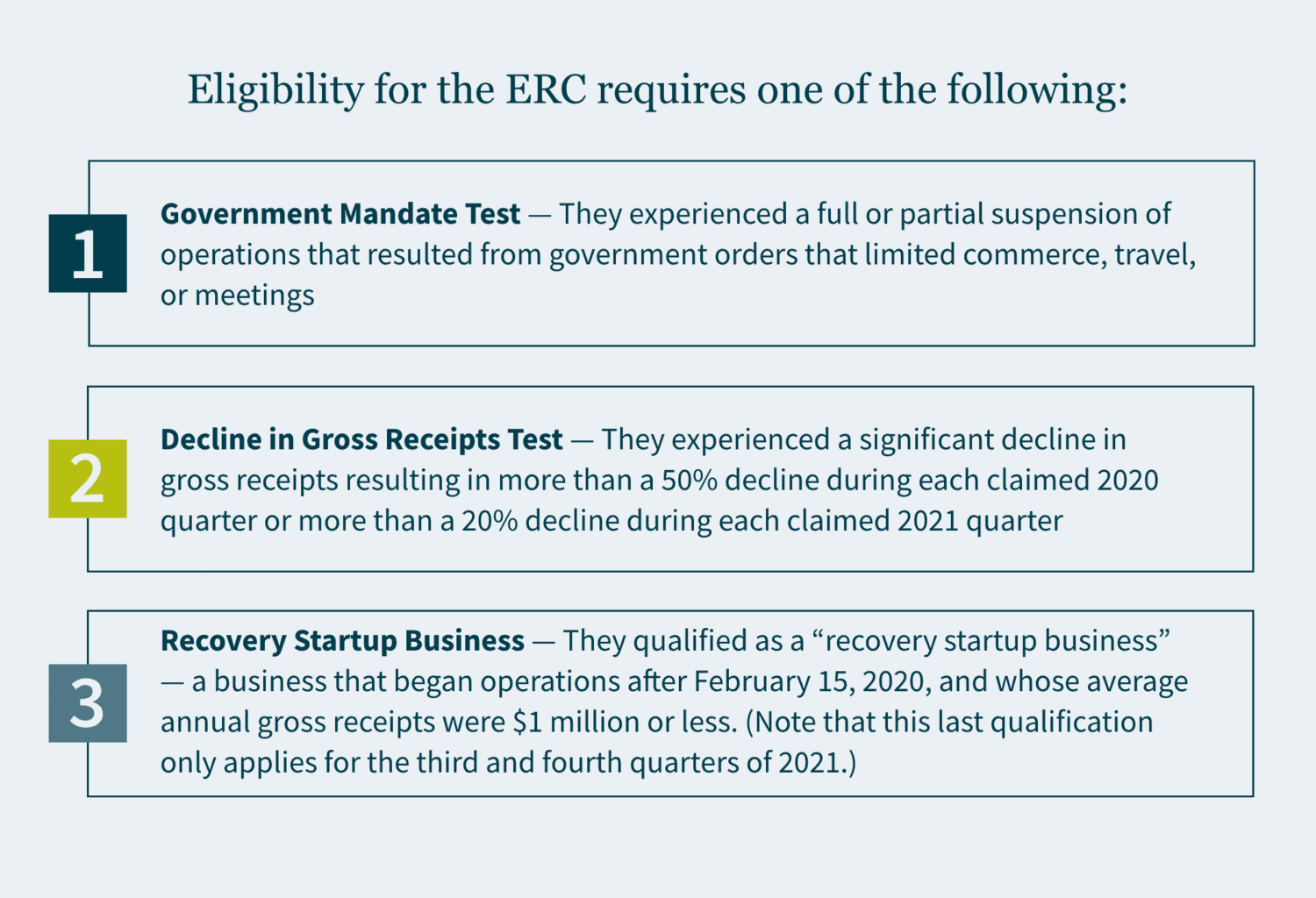
To be eligible for the ERTC, businesses must generally satisfy one of the following criteria for each of the quarters for which they are claiming the credit:
- Government Mandate Test — They experienced a full or partial suspension of operations that resulted from government orders that limited commerce, travel, or meetings.
- Decline in Gross Receipts Test — They experienced a significant decline in gross receipts resulting in more than a 50% decline during each claimed 2020 quarter or more than a 20% decline during each claimed 2021 quarter.
- Recovery Startup Business — They qualified as a “recovery startup business” — a business that began operations after February 15, 2020, and whose average annual gross receipts were $1 million or less. (Note that this last qualification only applies for the third and fourth quarters of 2021.)
The IRS Processing Moratorium
On September 14, 2023, the IRS announced that it would halt the processing of new ERTC claims through at least December 31, 2023. The IRS also stated that it plans to subject its queue of more than 600,000 existing ERTC claims to stricter compliance reviews, increasing the standard processing goal for those claims from 90 days to 180 days — with a potential for a much longer processing time for claims that require further review or audit.
This processing moratorium comes on the heels of a significant influx of claims – many of which the IRS believes are ineligible. The IRS stated that it has received more than 3.6 million ERTC claims over the life of the ERTC program, with about 15% of those claims being received in the 90-day period preceding the processing freeze. This amounts to roughly 50,000 claims still being received a week. To put this in perspective: the IRS has paid out about triple the amount that Congress had originally estimated for the program.
Additionally, as of July 31, 2023, the IRS Criminal Investigation division had initiated 252 investigations involving more than $2.8 billion in potentially fraudulent ERTC claims. Fifteen of the 252 investigations had resulted in federal charges, with six of those resulting in convictions. Four of the six convictions had reached the sentencing phase with an average sentence being 21 months.
The IRS intends on utilizing the moratorium to add more safeguards to the processing of ERTC claims, to protect businesses by decreasing the momentum of the pop-up ERTC mill industry, and to provide several solutions for taxpayers who submitted invalid claims. Those solutions include:
- A claim withdrawal program will be rolled out in Fall 2023 allowing businesses to withdraw ERTC claims that have not been processed or paid, even if those claims are under audit or awaiting audit.
- A claim settlement program rolling out in Fall 2023 that will allow businesses to repay ERTC claims, while also avoiding penalties and future compliance actions. (Note that fraudulent claims may still be subject to criminal referral.)
How to respond to IRS scrutiny of ERTC claims
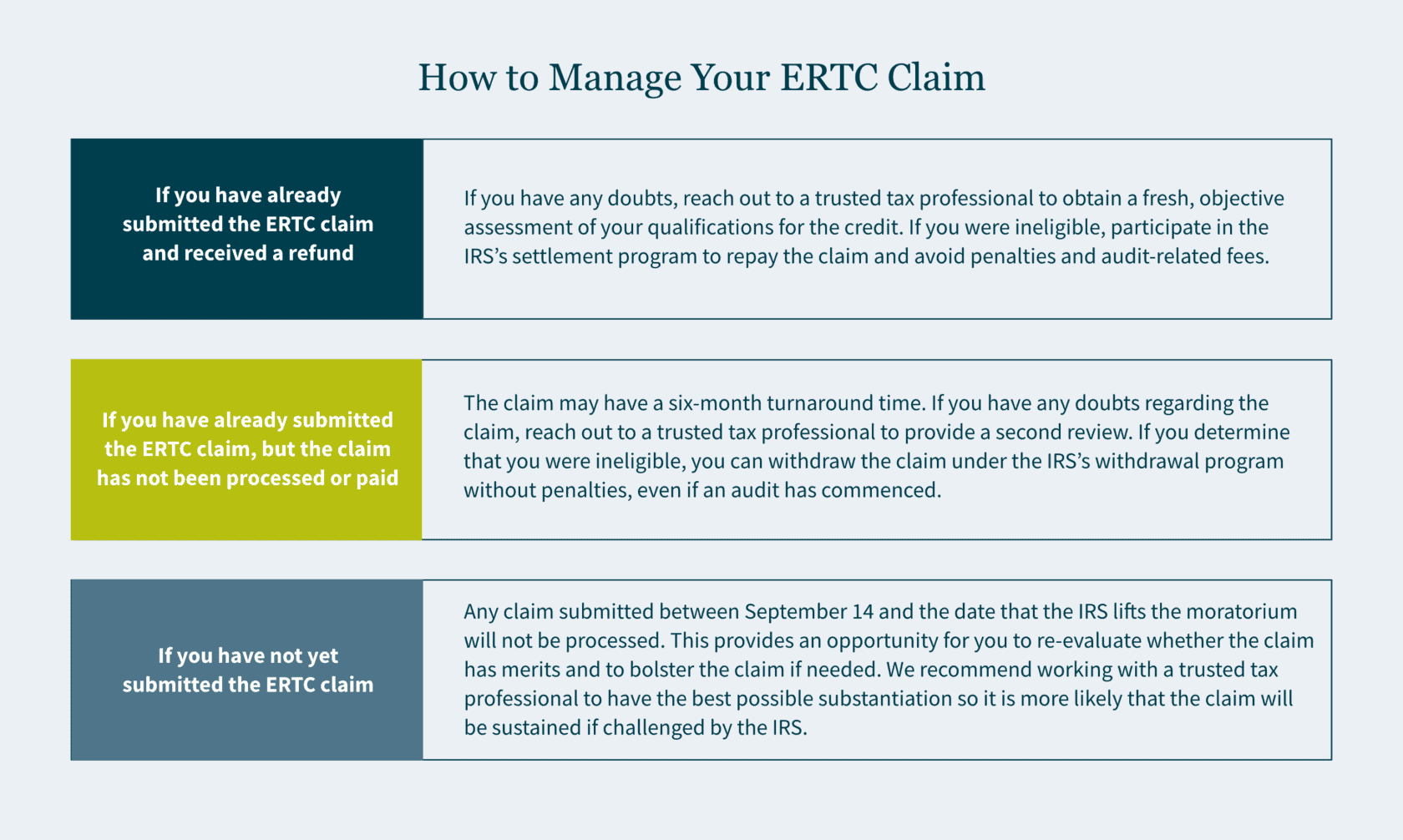
Given the expected extra scrutiny that businesses can expect to face on their claims, businesses should review ERTC claims that they have made and/or intend to make where there are any doubts regarding the eligibility of those claims:
- If you have already submitted the ERTC claim and received a refund: If you have any doubts regarding your eligibility, we recommend reaching out to a trusted tax professional to obtain a fresh, objective assessment of your qualifications for the credit. If you determine that you were ineligible, you can participate in the IRS’s settlement program so that you can repay the claim, avoiding both penalties and audit-related fees.
- If you have already submitted the ERTC claim, but the claim has not been processed or paid: The claim will take longer to process than during the summer — increasing from a three-month turnaround time to a likely six-month turnaround time. If you have any doubts regarding the claim during this period, we recommend reaching out to a trusted tax professional to have a second review of the claim. If you determine that you were ineligible, you can withdraw the claim under the IRS’s withdrawal program without penalties, even if an audit has commenced.
- If you have not yet submitted the ERTC claim: Any claim submitted between September 14 and the date that the IRS lifts the moratorium – currently after December 31, 2023 – will not be processed. This should provide an opportunity for you to re-evaluate whether the claim has merits and to bolster the claim if needed. We recommend working with a trusted tax professional to have the best possible substantiation for your claim so that it is more likely that the claim will be sustained if challenged by the IRS.
How MGO can help
MGO’s ERTC Second Look program is geared towards the types of objective, trustworthy reviews that would benefit you during this time of heightened ERTC claim scrutiny. Our experienced Credits & Incentives team can identify audit red flags, areas that need more substantiation, miscalculations, and incomplete filings. In addition, our Tax Controversy team — in tandem with our Credits & Incentives team — can defend you if any of your ERTC claims are challenged by the IRS, with the ability to represent you during audit, appeals, and tax court. Contact us to learn more.
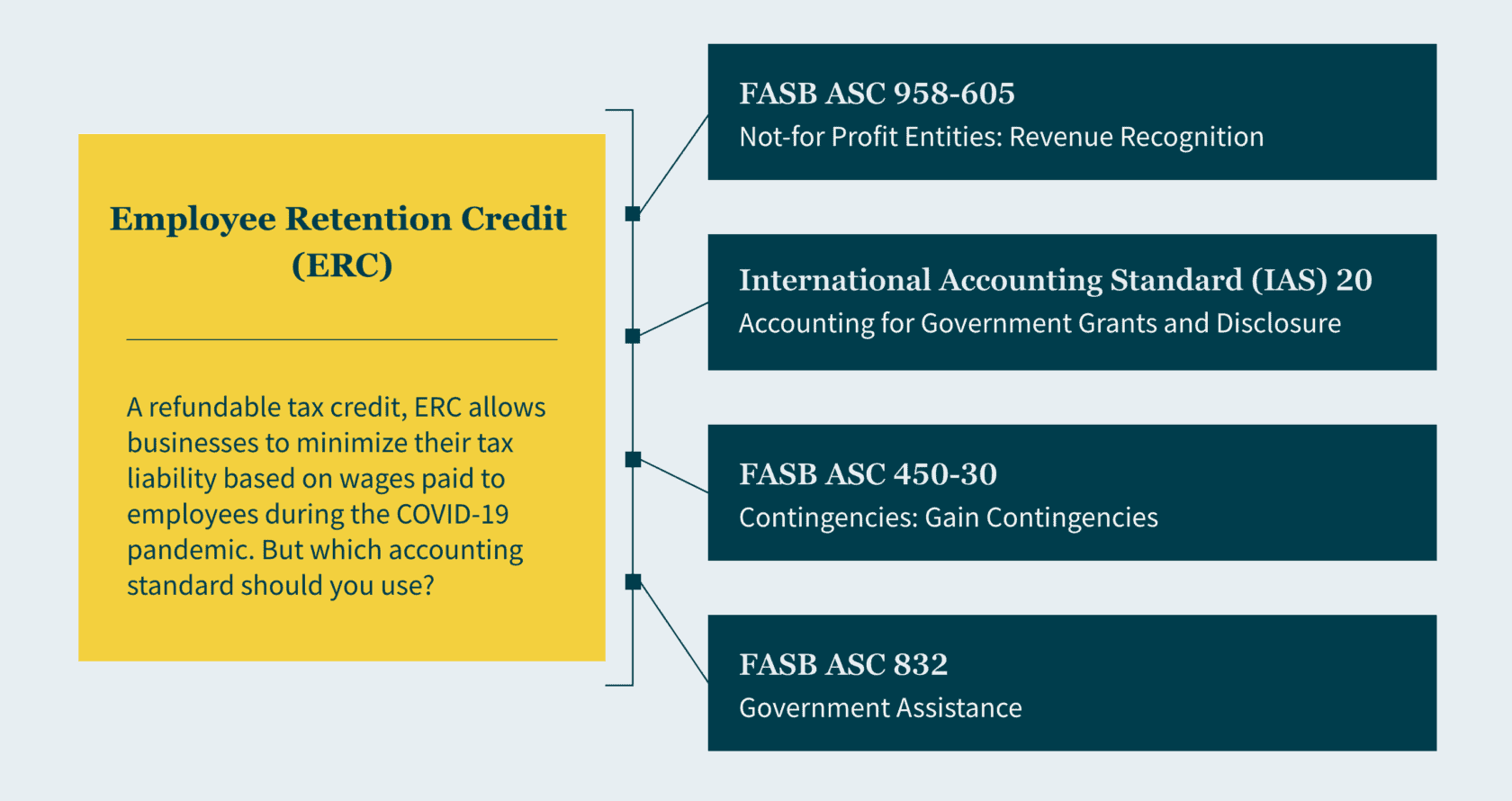
]]>- There is still uncertainty about how to account for the refundable Employee Retention Credit in your books, because you can’t account for it the same way you can account for the Paycheck Protection Program loan.
- The standards you can choose from are FASB ASC 958-605, International Accounting Standard (IAS) 20, FASB ASC 450-30, and FASB ASC 832.
- Depending on the standard you choose, you might have to consider the timing of recognition, the presentation of a grant income line, and financial ratios.
The Paycheck Protection Program (PPP) and the Employee Retention Credit (ERC) were powerful economic stimulus programs instituted during the COVID-19 pandemic to provide financial relief to struggling businesses. Both programs were the first initiatives of their kind, and as a result, there remains some uncertainty about what standards apply when accounting for them in your financial statements and records.
If you’re wondering how to distinguish the two, as well as determine the standard you should be utilizing, Angel Naval, a leader in our Client Accounting Solutions practice, breaks it down.
The PPP versus the ERC
Created to aid businesses facing financial challenges through the pandemic, there are several key differences between the PPP and the ERC.
The PPP is a loan and was created for small businesses with less than 500 employees in mind, giving them the funds needed to cover payroll and other eligible expenses. This includes hiring back employees who were laid off and covering applicable overhead. The loans are forgiven if the proper criteria are met (I.e., maintaining payroll and keeping consistent employee numbers).
A subset of the PPP loan, the ERC is a refundable tax credit that allows businesses to reduce their tax liability based on the qualified wages they’ve paid to their employees during the pandemic. It was created for businesses of all sizes to capitalize on in order to avoid layoffs. They can claim up to $5,000 per employee in 2020 and $7,000 per employee per quarter in 2021.
Determining the appropriate accounting standard for ERCs
If you took advantage of the ERC, currently, there is no straightforward way of accounting for it. Put simply, the ERC is a gray area because it’s so new, and there isn’t a straightforward way of accounting for it. Plus, ERCs are payroll credits, not income tax credits — and while FASB has extensive guidance for accounting for income taxes in ASC 740, it doesn’t for payroll taxes. Even the American Institute of Certified Public Accountants (AICPA) has suggested different standards, so it’s up to you to apply your best judgement based on the facts and circumstances of your business. Some things to consider:
- The timing of recognition,
- The financial ratios important to you, and
- Whether you want to present a grant income line.
For income statement presentation, according to AICPA’s December 2022 report, more public entities are crediting the associated expense rather than recognizing the amounts on a separate line item.
For example, you may think you can account for the ERC the same way you can for the PPP, but you can’t. As we differentiated above, the PPP is a loan and the ERC is a payroll credit, therefore the PPP is subject to debt and liability standards and the ERC is not. While the PPP did come first, those companies that have paid payroll taxes but still qualified for the ERC are still able to retroactively claim the credit.
For prospective applications, for-profit entities can adhere to guidance in one of the following.
FASB ASC 958-605
If you’re applying the revenue recognition model under ASC 958-605, ERCs are treated as conditional contributions. In this case, companies must have met the program’s eligibility conditions to record revenue (and no amounts can be recorded until all criteria are evaluated and “substantially” met according to regulations). Given the conditions are met, a refund receivable and income should be recognized in the period the entity determines the conditions have been substantially met. This standard requires that gross revenue be recorded, and it doesn’t permit any netting of revenue against related expenses.
Some barriers to meeting ASC 958-605’s requirements include the eligibility requirements, like meeting the rules for a decline in gross receipts as well as incurring qualifying expenses (i.e., payroll costs). To file for the ERC, you’ll need to decide whether preparing the related ERC form and filing it with the government presents a barrier you’ll need to overcome. Note administrative and other small stipulations do not represent a barrier.
IAS 20
If you’re applying IAS 20, you can’t recognize the ERC until the “reasonable assurance” threshold is met in correlation with ERC’s conditions and receiving the credit. In this case, “reasonable assurance” translates to “probable” under GAAP standards and is easier to satisfy than “substantially met” in Subtopic 958-605. Once you’ve provided reasonable assurance that conditions will be met, the earnings impact of the government grants is recorded over the periods in which you recognize as expenses the related costs that the grants are intended to cover. So, you’ll need to estimate the amount of the credit you expect to keep.
IAS 20 allows you to record and present either the gross amount as other income or net the credit against other related payroll expenses. For every quarter that a company meets the recognition criteria, it records a receivable and either other income or net expense.
FASB ASC 450-30
If you’re interested in applying FASB ASC 450-30, please note amounts related to the ERC wouldn’t be recognized under this model until all uncertainties regarding the disposition of the credit are resolved — and there’s less detail on the disclosure, measurement, and recognition requirements as compared to the other standard models. For this reason, the AICPA doesn’t believe this model to be a preferred accounting policy for the ERC.
FASB ASC 832
If you’re applying this model, you must disclose several specifics about transactions with a government within its scope. These entail the nature of the transactions, which includes a description of the transactions as well as the form in which it has been received, whether it’s cash or other assets. You must also detail the accounting policies you used to account for the transactions. Any line items on the balance sheet and income statement that are affected by the transactions must be accounted for too — plus, the amounts applicable to each financial statement line item in the current reporting period.
How MGO can help
While there are clear accounting standards for the PPP, there is still some uncertainty surrounding the ERC. Depending on the standard you choose, you may have to consider the timing of recognition, financial ratios, and whether to present a grant income line. Therefore, businesses need to apply their best judgment based on the facts and circumstances of their business when accounting for ERCs. Our Client Accounting Solutions team has extensive experience helping clients navigate complex tax regulations post-pandemic. Contact us to learn more about which standard you should be using for federal relief programs.
About the author
Angel Naval oversees our West Coast Financial Advisory Services practice and provides value-added guidance for your corporate finance, financial planning, and business process needs.
]]>We recently released an article detailing the red flags to look out when dealing with tax credits and incentives providers. If you think you could be at risk for future IRS issues, there is much you can do now to take a proactive approach and mitigate future negative impact. In the following, we break down steps you can take now to better understand and manage your exposure.
An overview of tax credits and incentives
Designed to encourage investment and development, job creation, growth, and certain business activities, tax credits and incentives provide an opportunity to reduce the amount of tax owed for performing certain activities. Credits and incentives are categorically different than tax deductions, which reduce the amount of taxable income.
These incentives often target desirable industries or activities like research and development, job creation for at-risk populations, and expanded growth in underdeveloped areas. When leveraged correctly, credits and incentives can be a powerful tool to funnel back resources into your organization to fuel activities you are already doing. Even more enticing, these credits can often apply retroactively if you determine you qualify for certain credits or incentives after the fact.
There are three basic types of tax credits: nonrefundable, refundable, and partially refundable. A few of the different types of tax credits pertaining to businesses in different classifications, industries, or activities performed include R&D tax credits, the employee retention tax credits, IRC Section 179D, and the work opportunity tax credit. To learn more about their eligibility rules, visit our previous article.
Understanding the risk of IRS tax audits
There is a three-year statute of limitations from the due date of the tax return or the filing date (whatever is later) for the IRS to assess your filings. That means if you think you may be exposed but escaped the IRS’ notice, you could still receive an audit notice for previous years’ returns. And if you do get audited, and the IRS determines you owe back taxes, you will get charged penalties and interest dating back to the infraction itself.
This is even more risky when considering the IRS’s extreme backlog. These IRS tax audits can sometimes take years to complete and if your credit and incentive calculations are the topic of interest, you’ll need to halt any future credit analysis until the situation is resolved. Meanwhile, you’ll be devoting crucial resources, time, and effort working with the IRS for something that yields no financial value and distracts from more conducive business activities.
Reasons to get a head-start and address issues now
Even though there is no guarantee you will get audited, you are still taking a risk if you do not address potential tax credit and incentive exposures in your organization. It may seem easy to “roll the dice” and hope the issue will remain uncovered, but it could come at a cost — especially if you are planning to make some big moves, like engaging in transaction of your business (M&A), going public, or embarking on another major transaction.
During the due diligence period of these transactions, it is almost certain any uncovered tax issues will emerge. You will likely not recover the value of these credits or remain on the hook for potential liability. Even worse, the exposure of these issues reflects negatively on your accounting and control system, potentially lowering the purchase value of your organization or undermining whatever deal you had in place prior to the due diligence. Often your transaction partners will start to question your organization’s trustworthiness, and reputation … due to something that may be no fault of your own.
So, you’ve been exposed … but haven’t received an IRS audit notice
Here is the deal: you know for certain you have been exposed, but you have not been notified by the IRS yet. You probably have a lot of questions — will you get an audit notice? Have you escaped unscathed? Do you need to address the issues preemptively, just in case? It may be overwhelming to decide how to proceed once you realize the exposure.
We suggest working with a qualified CPA firm to review your tax filings. A full-service accounting firm will review your organization holistically at a minimum rate, uncover any exposures, and deliver valuable peace of mind. If the firm does find issues, you have two options:
- Update your credit and incentive filings moving forward.
- While this will likely decrease the amount you can deduct, it exemplifies transparency.
- Issue a Voluntary Disclosure (VA) if the exposure is significant and you do not have a lot of time to fix the issue.
- Essentially, you are volunteering to correct your mistakes by recalculating the credits claimed and paying back the difference.
- While this may sting a little, the IRS looks favorably upon organizations who are proactive to fix the issue by filing a VA and they are likely to waive any penalties or interest you would have had to pay.
You’ve received an IRS audit notice. Now what?
Well, it happened. You received an audit note from the IRS. Before you panic, here is what you need to do:
- Start preparing your documentation right away. The sooner you have your ducks in a row, the sooner you are prepared to handle the audit.
- Check the contract you signed with your original provider and verify if they provide controversy support services for situations like these.
- If they do, reexamine the quality of their work. Do they have any of the red flags mentioned in this article? Could something they have done have caused the audit?
- Consider engaging a qualified CPA firm as your new provider to handle the subsequent controversy support. Someone you trust can get you ready for any available credits and incentives moving forward, too.
- If you used a provider that displays any red flags, you could have some leverage for a reasonable cause defense. Because the “professional” firm handled it for you and made a mistake, you could utilize a first-time penalty abatement, which means you can get relief from a penalty if you:
- Did not previously have to file a return or if you do not have any penalties for the three years before the tax year you received a penalty;
- Filed all currently required returns or an extension of time to file;
and - Paid or have arranged to pay any tax due.
- Verify your contract with the original provider to determine if you have any recourse to seek compensation from them. If the IRS does issue any penalties, you will want to ensure you do not have to pay.
Standalone firms vs. full-service accounting firms
Let’s say you haven’t received an IRS notice, and you do not think you are in danger of receiving one. How can you ensure you will not in the future? It comes down to choosing a firm to help you maximize the potential of these tax credits and incentives.
The bottom line: it is imperative you work with a certified public accounting (CPA) firm instead of a standalone firm. Because standalone firms often use lower-cost, less-experienced recent graduates who are not certified public accountants, there is a distinct lack of knowledge and background in the accounting fundamentals, causing you to be misled by those unequipped to help with complex tax matters. You also run the risk of being oversold benefits by aggressive firms that not only exaggerate the amount you are receiving from the tax credits and incentives, but also behave in a way that attracts IRS attention and jeopardizes your firm.
A full-service accounting firm, on the other hand, knows how to look at an organization holistically — and it has many more capabilities and professionals with experience. It looks at things through various lenses and can advise how certain positions will impact current and future tax positions. Full-service firms also likely have an in-house controversy team that has handled hundreds of audits successfully—so you will be in good hands.
Our perspective
Tax credits and incentives provide plenty of benefits you do not want to miss out on, and their often-complex application and qualification processes are reason enough to hire a professional accountant to help you maximize your returns. Unfortunately, we often see organizations placing their trust in the wrong providers and they end up suffering the consequences of an IRS audit. For many, it is simply easier and safer to cut off the relationship with the initial provider and start fresh with a professional firm you know you can trust.
At MGO, our dedicated Tax Credits and Incentives team brings more than 30 years of experience fixing these types of issues and working with the IRS to limit the damage. We provide cleanup in the event you are being audited by the IRS (or could be audited in the future), and help you identify areas where you can claim tax credits and incentives for next time. If you are concerned, our best advice is to get ahead of it with an opinion you can trust — before the IRS decides to investigate themselves.
About the author
Michael Silvio is a partner at MGO. He has more than 25 years of experience in public accounting and tax and has served a variety of public and private businesses in the manufacturing, distribution, pharmaceutical, and biotechnology sectors.
]]>Since Section 280E does not apply to employment payroll taxes because the provision is found in the income tax section of the code, qualifying cannabis companies may be able to capitalize on the credit that rewards employers for keeping their employees on payroll through the pandemic.
What is the ERTC?
Issued as a refund of an employer’s Form 941, the ERTC provides an incentive for those employers who suffered from pandemic-related disruptions and decreased revenues. If a cannabis company continued to pay employees through these challenges, they may be eligible to qualify for ERTC refunds retroactively. The refundable credit can be claimed on qualified wages, including certain health costs paid to employees.
Why was cannabis excluded?
Cannabis companies were unable to qualify for a Paycheck Protection Program (PPP) loan under IRS Section 280E, which prohibits them from deducting ordinary business expenses from gross income for the purpose of income tax. This is because while many states are now proposing and passing legislation to legalize cannabis, the substance is still federally classified as illegal under the Controlled Substances Act (and thus subject to IRS Section 280E).
How do cannabis businesses claim relief?
MGO’s approach to 280E mitigation is based on the idea that the rule only applies to income tax — not payroll tax. And because the ERTC is a payroll tax credit and issued as a refund, cannabis companies previously thought to be ineligible for relief can now claim it if they meet the qualifications:
(1) prove they had a decrease in percentage of gross receipts in calendar quarters during the COVID-19 pandemic when compared to prior quarters, or
(2) that they underwent a full or partial government suspension due to COVID-19 restrictions, like forced closure or quarantine.
The IRS has not yet weighed in on the cannabis issue, so for now, we consider it safe for cannabis companies to act on the opportunity. To determine qualification, a cannabis company will need to provide information like quarterly revenues, payroll tax returns, employee wages, and lines of business on Form 941, the Employer’s Quarterly Federal Tax Return.
Rely on cannabis tax and accounting specialists
All things cannabis tax and finance are complicated and make a major impact on an operator’s bottom line. On top of that, the IRS’ penchant for focusing additional attention on the cannabis industry is well-documented. As a result, cannabis operators should always utilize a cannabis-focused accounting provider that is well-versed in the ins-and-outs of cannabis tax compliance and planning.
MGO is uniquely positioned as a national leader in both tax credit advisory and cannabis accounting and financial best practices. We can help you identify tax credits, file claims, prepare documentation, and ultimately successfully defend your claim.
About the author
Michael Silvio is a partner at MGO. He has more than 25 years of experience in public accounting and tax and has served a variety of public and private businesses in the manufacturing, distribution, pharmaceutical, and biotechnology sectors.
]]>The guidance comes as Congress weighs ending the ERTC early to help offset the costs of the pending infrastructure bill. As of now, the credit is worth as much as $28,000 per employee for 2021, or $7,000 per quarter.
ERTC essentials
The CARES Act generally made the ERTC available to employers whose:
- Operations were fully or partially suspended due to a COVID-19-related government shutdown order, or
- Gross receipts dropped more than 50% compared to the same quarter in 2019
The credit originally equaled 50% of “qualified wages” — including health care benefits — up to $10,000 per eligible employee from March 13, 2020, through December 31, 2020. As a result, the maximum benefit for 2020 was $5,000 per employee.
And initially, businesses couldn’t benefit from both the ERTC and the popular Paycheck Protection Program (PPP). Most opted for the PPP, which, among other advantages, put money into their pockets more quickly than the credit.
In December 2020, the Consolidated Appropriations Act (CAA) provided that employers that receive PPP loans still qualify for the ERTC for qualified wages not paid with forgiven PPP loans. It also extended the credit through June 30, 2021.
In addition, the CAA raised the amount of the credit to 70% of qualified wages, beginning January 1, 2021, and boosted the limit on per-employee qualified wages from $10,000 per year to $10,000 per quarter — so employers could obtain a credit as high as $7,000 per quarter per employee.
The CAA also expanded eligibility by reducing the requisite gross receipt reduction from 50% to only 20%. And it increased the threshold for determining whether a business is a “large employer,” and therefore subject to a more stringent standard when computing the qualified wage base, from 100 to 500 employees.
The ARPA extended the ERTC through the end of 2021. It also made some changes that apply solely to the third and fourth quarters of 2021.
Guidance on ARPA changes
The majority of the IRS guidance deals with issues raised by the ARPA’s ERTC-related provisions, including:
Applicable employment taxes. Under the CARES Act, employers could claim the ERTC only against Social Security taxes. The guidance states that, for the third and fourth quarters of 2021, employers are entitled to claim the credit against their share of Medicare taxes, with the excess refundable.
Maximum amount. The maximum credit of $7,000 per employee per quarter for the first and second quarters of 2021 continues to apply to the third and fourth quarters. A separate limit applies to so-called “recovery startup businesses,” though.
Recovery startup businesses. The ARPA expanded the pool of ERTC-eligible employers to include those that:
- Began operating after February 15, 2020, and
- Have average annual gross receipts for the three previous tax years of less than or equal to $1 million.
These employers can claim the credit without suspended operations or reduced receipts, up to $50,000 total per quarter for the third and fourth quarters of 2021.
The guidance clarifies that a taxpayer hasn’t begun operating until it has begun functioning as a going concern and performing those activities for which it was organized. It also provides that the determination of whether a taxpayer is a recovery startup business is made separately for each quarter.
Qualified wages. The ARPA directs extra relief to “severely financially distressed employers” with less than 10% of gross receipts for 2021 when compared to the same calendar quarter in 2019. These businesses may count as qualified wages any wages paid to an employee during any calendar quarter — regardless of employer size.
Note that the ARPA prohibits “double dipping.” Wages taken into account for several business tax credits (for example, the research, empowerment zone and work opportunity tax credits, as well as credits for COVID-related paid sick and family leave) can’t also be taken into account for purposes of the ERTC.
Interplay with shuttered venue and restaurant revitalization grants. According to the guidance, recipients of a Shuttered Venue Operator Grant or a Restaurant Revitalization Fund grant may not treat any amounts reported or otherwise taken into account as payroll costs for those programs as qualified wages for ERTC purposes. Such employers must retain documentation that supports the ERTCs they claim.
Miscellaneous issues
The guidance addresses several other lingering issues related to the ERTC for 2020 and 2021. For example, it clarifies the definition of a “full-time employee.”
The notice explains that employers needn’t include full-time equivalents when calculating the average number of full-time employees for purposes of determining whether an employer is a large or small eligible employer. But, for purposes of identifying qualifying wages, an employee’s status is irrelevant, so wages paid to non-full-time workers may be treated as qualified wages (assuming all other applicable requirements are met).
The guidance also sheds further light on the:
- Treatment of tips and the Section 45B credit,
- Timing of qualified wage deduction disallowance,
- Alternative quarter election for 2021,
- Requirements to file amended federal income tax returns.
- Gross receipts safe harbor, and
- Exclusion of wages paid to the majority owners of corporations.
The rules regarding the last item above, which attribute ownership to owners’ family members, could significantly reduce the amount of the ERTC for family-owned corporations. A footnote in the guidance indicates that even the wages paid to minority owners might end up excluded from the ERTC computation.
ERTC’s future is uncertain
The U.S. Senate has passed infrastructure legislation that would eliminate the ERTC for the fourth quarter of 2021. However, the House of Representatives is on recess until the fall, so the fate of the credit remains uncertain. Contact us for additional information regarding the latest ERTC guidance.
]]>Employee Retention Tax Credit
The Employee Retention Tax Credit (ERTC) is a refundable tax credit created by the Coronavirus Aid, Relief and Economic Security (CARES) Act, to encourage businesses to keep employees on their payroll. For 2020, the credit is 70% of up to $10,000 in wages paid by an employer whose business was fully or partially suspended because of COVID-19 or whose gross receipts declined by more than 50%
For 2021, an employer can receive 70 percent of the first $10,000 of qualified wages paid per employee in each qualifying quarter. The credit applies to wages paid from March 13, 2020, through December 31, 2021. And the cost of employer-paid health benefits can be considered part of employees’ qualified wages.
It’s an attractive credit if you qualify.
Eligible businesses
The credit applies to all employers regardless of size, including tax exempt organizations that had a full or partial shutdown because of a government order limiting commerce due to COVID-19 during 2020 or 2021. With the exceptions of state and local governments or small businesses that take Small Business Administration loans, this credit is available to almost everyone.
Of course, there is some fine print:
• To qualify, gross receipts must have declined more than 50 percent during a 2020 or 2021 calendar quarter, when compared to the same quarter in the prior year.
• For employers with 100 or fewer full-time employees, all employee wages qualify for the credit, whether the employer is open for business or shutdown.
• For employers with more than 100 full-time employees, qualified wages are wages paid to employees when they are not providing services due to COVID-19-related circumstances.
One bright point about the ERTC is that employers can be immediately reimbursed for the credit by reducing the amount of payroll taxes they would usually have withheld from employees’ wages. That was a nice touch by the IRS.
Retroactive claims for the ERTC
Although it appears the IRS tried to make this as easy as possible, you may still need a tax professional to sort it out. For instance, if your business had a substantial decline in gross receipts but has now recovered, you can still claim the credit for the difficult period
Retroactive claims for refunds will probably be delayed because currently everything is delayed at the IRS. The credit can be claimed on amended payroll tax returns as long as the statute of limitations remains open, which is three years from the date of filing. So you have some time to claim the credit, but why wait?
Keep December 2021 in mind
The economy is in a state of change, and it is fair to say that we are once again in uncharted territory. On the positive side, there seems to be significant resources and support for businesses from both government and consumers. You and your tax professional should keep your eyes open for credits and benefits to make sure you don’t miss any opportunitie
The ERTC expires in December 2021. Though it may be difficult to think about year-end in the middle of the summer, you’ll want to figure out your position on this credit before December. A tax professional can help you understand the ERTC and help you decide on your next step.
About the author
Michael Silvio is a partner at MGO. He has more than 25 years of experience in public accounting and tax and has served a variety of public and private businesses in the manufacturing, distribution, pharmaceutical, and biotechnology sectors.
]]>The Coronavirus Aid, Relief, and Economic Security (CARES) Act
On March 27th, President Trump signed into law the CARES Act, an emergency relief bill aimed at providing much-needed relief to individuals and businesses in response to the novel coronavirus. Nonprofit organizations also received vital support through the Act. Below are overviews of key provisions that are applicable to nonprofit organizations.
SBA 7(a) CARES Act Loan aka the “Paycheck Protection Program” (PPP)
The definition of eligible businesses for the SBA 7(a) CARES Act loan program includes nonprofit organizations. Generally, only IRC Section 501(c)(3) organizations are included, however veteran organizations (IRC Section 501(c)(19)) and tribal businesses are also eligible. Generally, this program is available to nonprofit organizations with 500 or fewer employees. Organizations can borrow up to 2.5 times their monthly payroll expenses, with a cap at $10 million. Such funds can be used to cover: payroll costs, operating expenses, and rent/lease/mortgage obligations.
- Organizations that do not enroll in this program may also qualify for an Employee Retention Tax Credit, whereby the CARES Act provides a payroll tax credit of up to $5,000 per employee, for Not-for-Profits adversely affected by COVID-19. This credit is available for wages paid or incurred from March 13, 2020 through December 31, 2020.
- Organizations with greater than 500 employees that are not eligible for the Paycheck Protection Program loan, are eligible for funds through the Economic Stabilization Fund, where monies may be used to provide payroll and related benefits for employees. Monies provided through this fund are not eligible for the loan forgiveness provisions as outlined under the Paycheck Protection Program.
Emergency Economic Injury Disaster (EIDL) Grants
The CARES Act includes $10 billion for the federal Small Business Administration (SBA) to provide emergency grants until Dec. 31, 2020. Any nonprofit organization under IRC Section 501(c) is eligible for this loan program and can seek immediate relief through a $10,000 emergency advance within three days after applying for the EIDL grant. If the entity can substantiate the funds through payroll and operating expenses, the applicant is not required to repay the $10,000 advance and as such, the advance is turned into a grant.
Tax-Related provisions affecting nonprofits
The CARES Act also includes tax provisions that may impact nonprofits. including:
- Employee retention credits
- Payroll tax deferral
The CARES Act also lifts the limitations on charitable contributions deductible on future tax returns:
- Individuals: Charitable contributions 100% deductible (from 60%)
- Corporations: Limitation increased to 25% (from 10%)
- Donor-advised funds are not impacted through these provisions.
Unemployment Benefits
The CARES Act includes a specific section allowing nonprofit organizations to be reimbursed for half of the costs incurred through the end of 2020 to pay unemployment benefits, including self-funded unemployment benefits.
Signed into law on March 18th, this relief bill mandates paid leave benefits for small business employees, generally employees of organizations with fewer than 500 employees, affected by COVID-19. It also establishes related payroll tax credits for employers.
~
We understand that in this time of uncertainty you may have growing concerns for the financial health of yourselves and your organizations, employees and families. Please contact us if you have any additional questions, including assistance with applying for the benefits outlined above.
]]>