- A growing organization is a positive, but along with it usually comes increasingly complex financial accounting.
- Outsourcing provides businesses of all sizes with an opportunity to manage an array of issues — from staffing shortages or a lack of specific expertise to disorganized or unsecure financial records.
- Benefits of outsourcing include significant cost savings, direct access to specific accounting knowledge, the minimization of turnover, the ability to scale, access to tools and processes, and flexibility.
Many CEOs and business leaders are experiencing challenges in the aftermath of the COVID-19 pandemic, including changing customer trends, aggressive competition, emerging digital technologies, and the new normal of employee expectations for workplace flexibility.
These uncertain economic forces and cultural shifts are putting increased pressure on staffing for organizations of all sizes – especially fast-growing ones. While these difficulties are difficult to overcome, they are also an opportunity to change the “status quo” and level-up back-office performance.
For leaders navigating the uncertain tailwinds of the pandemic and planning to enter a new era of growth, outsourcing represents a powerful opportunity to address any staffing issues or business challenges. It empowers you to access specialized insight on a temporary basis, create value ahead of a major transaction, manage overhead costs, and modernize and revitalize business processes.
A recent study showed that 59% of all businesses utilize outsourced resources and that accounting is the most commonly outsourced function. So, how do you know if outsourcing your accounting function is right for your organization?
In this article we’ll look at five indicators that this strategy might be right for you and detail the key benefits to outsourcing or augmenting your accounting function.
Five signs your business may benefit from outsourced accounting
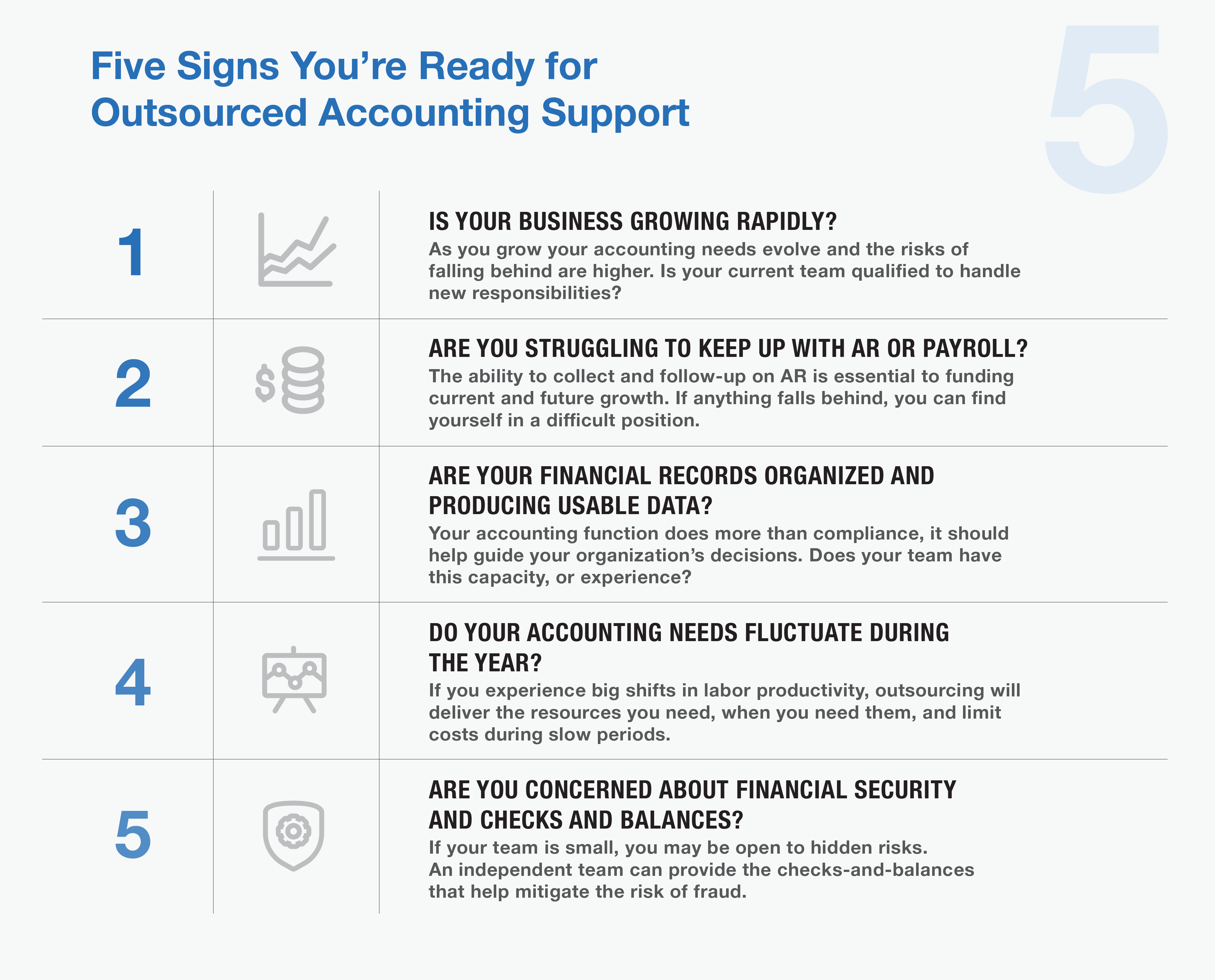
Here are some questions you should ask yourself to determine if your organization would benefit from outsourced accounting services:
- Is your business growing rapidly?
If you’re experiencing a significant influx of revenue, first off, great work! Your business model is proving out and you’re on the fast-track to success. But what is happening to your expenses, profitability and working capital? Depending on your answer it could mean that your accounting needs are evolving, the risks of a breakdown are higher, and overall, there is simply more at stake. It may be time to confirm that your current in-house team is qualified and staffed appropriately to handle these new responsibilities.
- Are you struggling to keep up with your accounts receivable or payroll?
One way to get a firm answer to whether your team is understaffed is if you’re missing key deadlines or struggling to get timely collection of cash from your accounts receivable. The inability to collect and follow-up on AR is essential to funding current and future growth and is directly connected to meeting your payroll commitments – one of the largest expenses of any business. If anything falls behind, you can find yourself in a difficult position if you do not have the ability to access cash or financing.
- Are your financial records organized and producing usable data?
Your accounting function does more than compliance, it should help guide your organization’s financial hygiene. Organized financials tell a clear story of earnings, spending, and investment, so you can make informed decisions. An over-worked or inexperienced accounting team will be working furiously to keep up with compliance and may not have the capacity, or necessary experience, to provide guidance on your financial scorecard to accrete value to the organization.
- Do your accounting needs fluctuate significantly throughout the year?
If your business experiences big shifts in labor productivity based on the calendar year and your taxes filings are late with significant overages from the tax preparers, or your audits have a significant number of adjustments, that may mean your accounting team lacks capability. Striking the right balance between hiring quality talent and the speed of bringing new hires up to date with company procedures can be a challenge. Outsourcing your team can deliver the resources you need, when you need them, and limit costs during the slower periods.
- Are you concerned about financial security and checks and balances?
If your internal accounting team is one or two individuals, you may be open to hidden risks. An independent team can provide the checks-and-balances that help mitigate the risk of fraud and asset misappropriation.
If you answered yes to any of these questions, you should consider outsourcing part or all of your accounting function. With an outsourced accounting team, you gain immediate access to trained, knowledgeable staff with the knowledge you need in technical accounting. The right outsourced resources can help your business grow faster and run more smoothly — often at a lower price than building an internal accounting department.
Benefits of outsourced accounting services
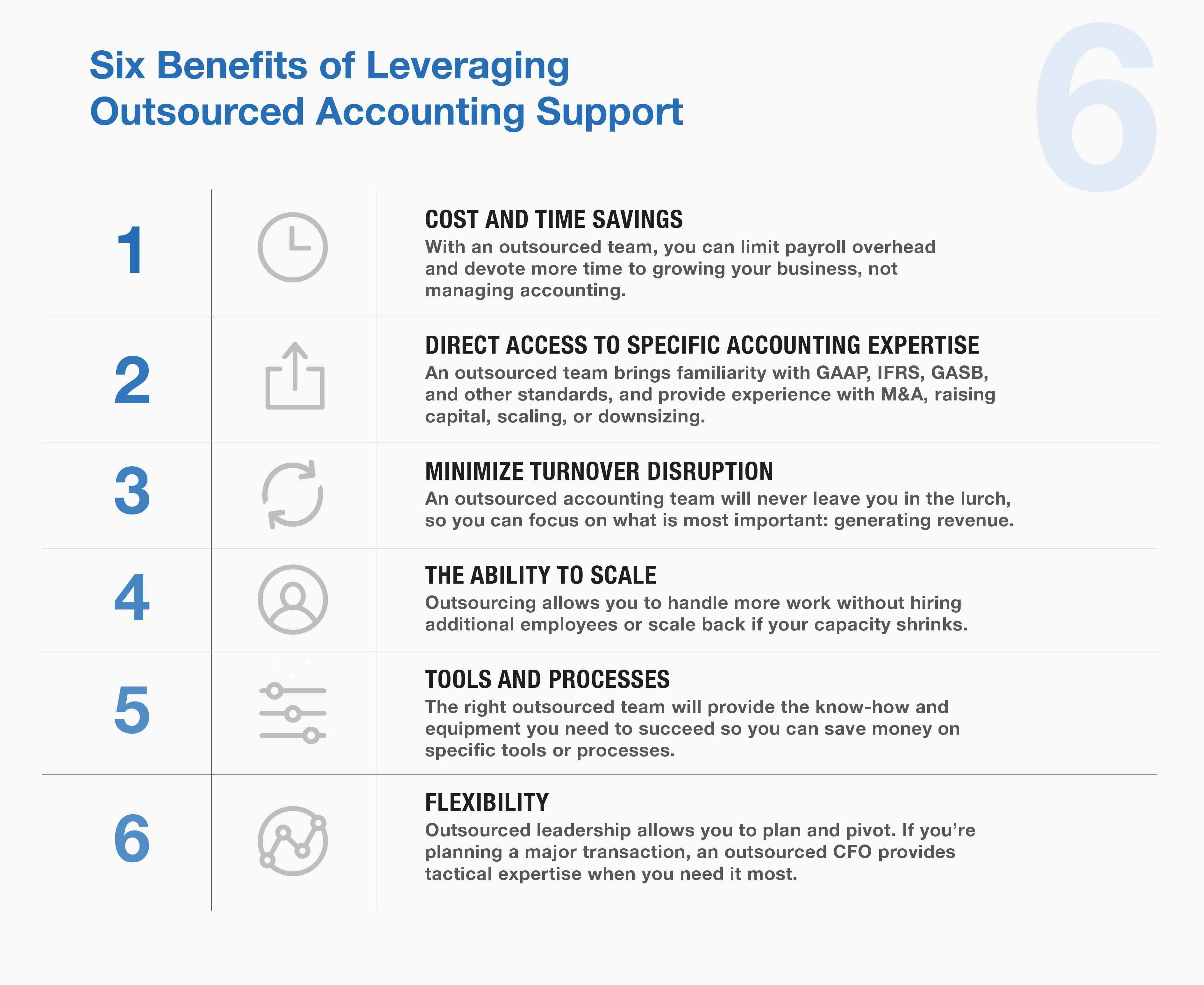
1.Cost and time savings
Maintaining full-time employees can be costly — and for most organizations, labor costs are some of the highest expenses. By relying on an outsourced team, you can devote your time to growing your business and spend less time managing accounting.
- Direct access to specific accounting expertise
Every company is different, which means every company’s needs are different. By outsourcing, you have access to the service you need when you need it. An outsourced team will bring familiarity with an array of accounting and reporting standards, including GAAP, IFRS, GASB, etc. Plus, they can provide specific experience with M&A transactions, raising capital, scaling, or downsizing operations.
- Minimize turnover disruption
In a smaller organization, each employee is vital to the business’s success. When you lose one, the disruption left in their wake can provide additional challenges. An outsourced accounting team will never leave you in the lurch, so you can focus on what is most important: generating revenue.
- The ability to scale
If your organization has grown quickly, you may experience growing pains when your fortunes suddenly shift. In boom times, you may need to hire more staff to meet demand. But that also means you may find yourself laying off employees in a downturn. Outsourcing allows you to handle more work without hiring additional employees or scale back if your capacity shrinks.
- Tools and processes
No matter what your organization’s size, you should always try to keep your overhead costs minimal. By outsourcing, you can save money on specific tools or processes you might otherwise need to function. The right outsourced team will provide the know-how and equipment you need to succeed.
- Flexibility
By outsourcing certain jobs, you can plan — and pivot, as needed — depending on your organization’s needs. This is especially relevant in the case of needing specialized guidance. If you’re planning a major transaction or other market move, an outsourced CFO can provide tactical expertise when and where you need it.
MGO can help
As your organization grows, your financial accounting needs become increasingly complex. Because your in-house accountants may be limited to handle the basics, outsourcing to professional teams with specialized knowledge and experience can provide precisely the kind of service you require — and give you the time you need to focus on the organization’s other needs.
MGO has a robust outsourced accounting team staffed by CPAs with diverse industry background and technical specialties. We’ll provide the right-size solution to your organization’s needs. Areas we support include day-to-day accounting tasks, complex financial systems projects, regulatory compliance demands, and support for M&A deals, raising capital, and other major transactions.
Whether you’re interested in simply augmenting your team with additional financial knowledge, or undertaking a complete accounting transformation, we can help you with the people, processes, and technology you need to move your business forward.
To explore your options and start along the path to organizational change, contact us.
]]>Private organizations, while not always smaller, often have limited resources in specialty areas, including accounting for income tax. This resource constraint —the work being done outside the core accounting team — combined with the complexity of the issues, means private companies are ideal candidates for, and can achieve significant benefit from, internal controls enhancements. Thinking beyond the present, the following are five reasons private companies may want to adopt public-company-level controls:
1. Future Initial Public Offering (IPO) – Walk before you run! If the company believes an IPO may be in its future, it’s better to “practice” before the company is required to be SOX compliant. A phased approach to implementation can drive important changes in company culture as it prepares to become a public organization. Recently published reports analyzing IPO activity reveal that material weaknesses reported by public companies were disproportionately attributable to recent IPO companies. Making a rapid change to SOX compliance can place a heavy burden on a newly public company.
2. Merger and Acquisition Deals – If the possibility of the company being sold to an M&A deal exists, enhanced financial reporting controls can provide the potential buyer with an added layer of security or comfort regarding the financial position of the company. Further, if the acquiring firm has an exit strategy that involves an IPO, the requirement for strong internal controls may be on the horizon.
3. Rapid Growth – Private companies that are growing rapidly, either organically or through acquisition, are susceptible to errors and fraud. The sophistication of these organizations often outpaces the skills and capacity of their support functions, including accounting, finance, and tax. Standard processes with preventive and detective controls can mitigate the risk that comes with rapid growth.
4. Assurance for Private Investors and Banks – Many users other than public shareholders may rely on financial information. The added security and accountability of having controls in place is a benefit to these users, as the enhanced credibility may impact the cost of borrowing for the organization.
5. Peer-Focused Industries – While not all industries are peer-focused, some place significant weight on the leading practices of their peers. Further, some industries require enhanced levels of security and control. For example, cannabis companies with a heavy regulatory burden, industries with sensitive customer data like lifesciences, and tech companies that handle customer data, often look to their peer group for leading practices, including their control environment. When the peer group is a mix of public and private companies, the private company can benefit from keeping pace with the leading practices of their public peers.
Private companies are not immune from the intense scrutiny of numerous stakeholders over accountability and risk. Companies with a clear understanding of the inherent risks that come from negligible accounting practices demonstrate their ability to think beyond the present, and to be better prepared for future growth or change in ownership.
]]>Similar to the flurry of dotcom companies building out their platforms in the late 1990s, cannabis companies are investing vertically in order to provide seed-to-sale capability all under one roof. It’s this development, along with anticipated nationwide legalization, that is driving a number of mergers and acquisitions. Although there has been consolidation in prior years, 2019 is shaping up to be a bellwether, illustrating that the cannabis industry is preparing for a growth explosion.
The record-breaking start to 2019
So far in 2019, there have been several mergers and acquisitions worth billions of dollars. The action got an early start with two announcements in December of 2018; the MedMen acquisition of PharmaCann, and the purchase of a 45% stake in Cronos by Altria, the parent company of Phillip Morris USA. The MedMen-PharmaCann agreement included an all-stock transaction worth US$682 million and gave the combined company licenses to operate in 12 states with 79 cannabis facilities. The Altria-Cronos deal equates to US$1.8 billion for a 45% stake, with an option to purchase a majority stake in Cronos down the road.
In March of this year, Arizona-based Harvest Health & Recreation, announced it would purchase Chicago-based Verano Holdings, a vertically-integrated operator of licensed cannabis cultivation, manufacturing and retail facilities, for US$850 million.
More recently, in early April Cresco Labs agreed to purchase Origin House in an all-stock transaction valued at US$824 million. In late April, Canopy Growth Corp paid US$300 million for the right to merge with Acreage Holdings. Ontario-based Canopy Growth Corp, the first publicly traded cannabis company in North America, will purchase Acreage shares for US$3.4 billion, with full legalization acting as a triggering event for the complex merger deal.
In addition to mergers and acquisitions between cannabis companies, there is growing interest in cannabis from non-industry companies, such as alcohol, pharmaceutical, and tobacco – as illustrated by the Altria-Cronos announcement. Companies such as Constellation Brands, an international producer and marketer of beer, wine and spirits, paid $190 million for a stake in Canopy Growth Corp, hoping to counteract slowing beer sales and enter new cannabis-related markets.
What is driving cannabis M&A activity?
There are several factors motivating the increase in mergers and acquisitions in the cannabis space. Companies are seeking a variety of goals, such as a desire for vertical integration, an interest in operations in multiple states, and the aspiration by non-cannabis companies to enter the market. While these developments are worth noting, the trend is being driven by a much larger issue: the likelihood that cannabis use will be legalized nationwide by the US federal government. Investors and analysts believe this is more a case of when rather than if.
When legalization occurs and interstate restrictions are lifted, those companies maneuvering now will be well-positioned to effectively seize market share while others play catch up.
The US Congress, while not including language that would help resolve conflicting federal and state cannabis laws in pending criminal justice reform legislation, has left the door open to having a debate on nationwide legalization. “If there is an attempt to legalize across the country, we should have that debate and let the Congress decide the issue instead of creating a backdoor to legalization,” said Senator Chuck Grassley, the outgoing chairman of the Senate Judiciary Committee.
Forecasting beyond 2019
The wave of consolidation in 2019 is likely only the beginning. If a federal law is passed that legalizes cannabis, there will likely be a second wave of mergers and acquisitions with much higher stakes as the industry sorts itself out in in an effort to anticipate and fulfill coming demand.
In addition to consolidation, there will likely be a change to the banking industry in relation to doing business with cannabis companies. As of now, financial institutions are at risk of penalties, such as asset forfeiture and criminal fines, if they do business with companies in this space. In response to that risk, the House Financial Services Committee voted in favor of a bill protecting banks from federal punishment if they do business with such companies.
These moves signal a shift in how lawmakers are now viewing cannabis. If the federal government legalizes cannabis and financial institutions are allowed to engage those companies growing and selling it, then consolidation and investment in the near future could make 2019’s dazzling transactions look like chump change.
]]>Similar to the flurry of dotcom companies building out their platforms in the late 1990s, cannabis companies are investing vertically in order to provide seed-to-sale capability all under one roof. It’s this development, along with anticipated nationwide legalization, that is driving a number of mergers and acquisitions. Although there has been consolidation in prior years, 2019 is shaping up to be a bellwether, illustrating that the cannabis industry is preparing for a growth explosion.
The Record Breaking Start to 2019
So far in 2019, there have been several mergers and acquisitions worth billions of dollars. The action got an early start with two announcements in December of 2018; the MedMen acquisition of PharmaCann, and the purchase of a 45% stake in Cronos by Altria, the parent company of Phillip Morris USA. The MedMen-PharmaCann agreement included an all-stock transaction worth US$682 million and gave the combined company licenses to operate in 12 states with 79 cannabis facilities. The Altria-Cronos deal equates to US$1.8 billion for a 45% stake, with an option to purchase a majority stake in Cronos down the road.
In March of this year, Arizona-based Harvest Health & Recreation, announced it would purchase Chicago-based Verano Holdings, a vertically-integrated operator of licensed cannabis cultivation, manufacturing and retail facilities, for US$850 million.
More recently, in early April Cresco Labs agreed to purchase Origin House in an all-stock transaction valued at US$824 million. In late April, Canopy Growth Corp paid US$300 million for the right to merge with Acreage Holdings. Ontario-based Canopy Growth Corp, the first publicly traded cannabis company in North America, will purchase Acreage shares for US$3.4 billion, with full legalization acting as a triggering event for the complex merger deal.
In addition to mergers and acquisitions between cannabis companies, there is growing interest in cannabis from non-industry companies, such as alcohol, pharmaceutical, and tobacco – as illustrated by the Altria-Cronos announcement. Companies such as Constellation Brands, an international producer and marketer of beer, wine and spirits, paid $190 million for a stake in Canopy Growth Corp, hoping to counteract slowing beer sales and enter new cannabis-related markets.
]]>